

Contents
- 1 The idea behind LB: Universal Scanner
- 2 Learning by building
- 3 Why scanning a barcode isn’t enough
- 4 When there’s no barcode to scan
- 5 Machine learning reads, but doesn’t decide
- 6 A local-first approach to privacy
- 7 Verifying what the scanner tells you
- 8 When building the tech is the easy part
- 9 When traditional education doesn’t fit
- 10 Building differently, not fitting a template
- 11 Keeping the consumer app free
- 12 What comes next
LB: Universal Scanner combines barcode data, physical labels, and deterministic analysis to help users understand what is actually inside everyday products.
Some people might think there’s only one way to do an interview. While in-person conversations or Zoom calls are the norm, that format doesn’t suit everyone.
I believe that if someone has a compelling story to tell, they should have the opportunity to tell it in a way that works for them.
I’m also increasingly interviewing very young founders — some under 18 — who tell me that I’m their first-ever media interview, often conducted in a language that isn’t their first. I want to give people the opportunity to tell their story and shine, rather than make the format itself a barrier.
Bálint László is 19 and the founder of LB: Universal Scanner, a privacy-focused product and ingredient scanner.
Point your phone at a barcode — or photograph the ingredients if the barcode isn’t recognised — and the app helps explain what’s actually in the product. It covers everything from food and pet food to cosmetics, cleaning products, and household and art supplies.
Bálint is also neurodiverse and prefers written rather than verbal communication. So, instead of a conventional interview, I spoke with Bálint and his mother, Mónika, in writing to learn more about him, what he’s building, and why.
Bálint was born in Hungary and has lived in Germany since he was five. He shared:
“I’m autistic, and I’ve always processed information somewhat differently from the way traditional education expected me to. I tend to focus on how something actually works, whether there’s a logical solution, and whether there’s a more efficient way of doing it.”
LB is a consumer app, available on Android and iOS. It may have been built with limited resources, but it has a serious focus on usefulness, accessibility, privacy, and responsible information.
The idea behind LB: Universal Scanner
The idea for LB: Universal Scanner originated from his mother, Mónika, who has fructose and lactose intolerances/sensitivities, which caused her a lot of digestive problems.
She explained:
“The original idea came from a friend of ours, Tünde. I asked what kind of app she would want if someone could build exactly what she needed but couldn’t find anywhere.
She said she wanted an app that could tell her which ingredients in food might harm her. That immediately made sense to me because of my own allergies, so we started with food.”
One day, Mónika was standing in the shower looking at the ingredients on a shower gel. She realised she didn’t understand many of those either:
“I thought, why should this only work for food? We also have two cats, Bella and Teddy, and I wanted to understand what was actually in their food.”
One thing led to another. Food expanded into pet food, cosmetics, cleaning products, and eventually art and craft supplies. The same problem kept appearing: we’re surrounded by product information, but it isn’t always easy to understand or verify.
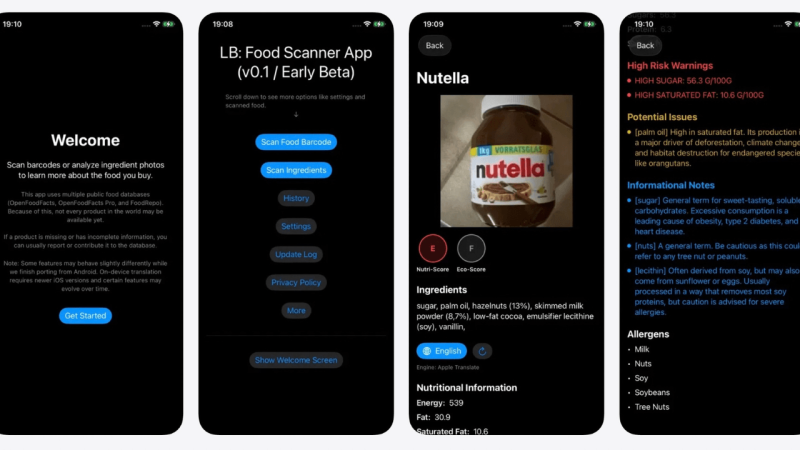
With LB, users can scan a product barcode or photograph an ingredient or safety label. Barcode scans search supported public product databases, while photo scans use text recognition. Users can review and correct the recognised text before the app analyses it.
Today, LB covers four broad categories: human food, pet food, cosmetics, and cleaning and art/craft products. The latter includes paints, glues, pigments, clay, dyes, solvents, and resins, where ingredient or safety information can be important. For food and personal health-related use, people can create profiles around allergies and sensitivities, including cross-allergies and medication allergies, as well as settings such as IBS/SIBO, FODMAP, Keto, Blue Zone, and healthy-longevity preferences.
The app can show ingredients, warning triggers, allergens or cautions, nutrition information where available, translations, and which parts of a label it could or couldn’t match. It also includes product comparisons, notes, scan history, and recall-related information.
To be clear, it stands as an informational aid, not a medical diagnosis, and it can’t guarantee that a product is safe from trace ingredients.
Bálint explained:
“I’m primarily building it for people with allergies or sensitivities, visually impaired users, families, caregivers, and anyone who wants clearer product information.”
Learning by building
Bálint started learning English quite young through YouTube. Around the age of 12:
“I taught myself to touch-type because I thought it would be useful in the future.”
Later, he found online Python and C++ courses, which eventually led him to platforms such as edX and courses from HarvardX, IBM, and others.
However, he asserts that while a course can teach you an algorithm or concept, building and shipping a real application forces you to deal with unreliable network responses, camera behaviour, corrupted data, accessibility, localisation, performance, device differences, and app-store requirements at the same time.
“The strongest learning happens when something you built has to work in the real world, something fails, and you have to understand why, fix it, and prevent it from happening again.”
Why scanning a barcode isn’t enough
While there are already numerous barcode and product-scanning apps, many treat finding a database record as the end of the process. Bálint saw it as only the beginning.
The company conducted its own small-sample test, scanning protein powders by barcode and comparing the database results with the ingredient lists printed on the packaging.
“One test really changed the way I thought about this. In roughly 90 per cent of the cases we tested, the barcode information didn’t fully match what was on the package.
That was a serious warning for us. A barcode can identify a product, but the database record behind it may be incomplete, outdated, or different from the formulation currently on the shelf. For someone with a serious allergy, relying solely on that information could be dangerous.”
That’s why LB uses a layered process. It validates the barcode, identifies what kind of information it contains, retrieves available data, and, when necessary, falls back to the physical label. Users can review OCR results before analysis, and the app shows what it matched and what it couldn’t.
“I don’t want the app to pretend it knows more than it actually does. Scanning is only the entry point.”
When there’s no barcode to scan
But reading a physical label creates a different set of problems. The print might be tiny, the packaging curved, or there might be glare, damaged text, multiple languages, or unusual fonts. OCR can also make mistakes. Then you have to separate the recognised text into meaningful ingredients, normalise those ingredients, and match them against aliases without creating dangerous false positives.
“That’s why LB includes a review-before-analysis step. It can interpret a label without a barcode, but it remains clear that text alone can’t authenticate the exact product,” explained Bálint.
This is further compounded by different barcode standards, packaging formats, and identification systems across countries and industries — LB recognises several common one-dimensional and two-dimensional barcode formats, but according to Bálint, recognition alone isn’t enough.
The app classifies the payload before attempting a product lookup, validating common product identifiers such as EAN, UPC, and GTIN, as well as decoding GS1 data where available.
“Where that information is encoded, it can also expose details such as batch or lot numbers and package dates.”
An important part of the process is deciding what not to treat as a product identifier. A QR code might contain a website, Wi-Fi credentials, or contact information rather than product data. LB rejects those as non-product content and doesn’t automatically open them.
Database coverage and packaging conventions also vary by country and industry. When those sources disagree or are incomplete, the physical label provides an independent fallback.
Machine learning reads, but doesn’t decide
In terms of tech, Bálint uses machine learning in a narrow, practical role, mainly for perception and language. On-device models can help recognise barcodes and printed text, identify languages, and translate content. Google’s barcode recognition, for example, can run on the device without requiring a network connection.
“But I deliberately don’t give a generative AI model responsibility for deciding whether a product is safe,” he explained.
After recognition, LB uses deterministic rules, bundled ingredient knowledge, validated identifiers, and the user’s selected profile settings.
“The same input should produce the same warning, and the app can explain what triggered it. My approach is simple: machine learning helps the app read. It doesn’t get permission to invent the answer.”
A local-first approach to privacy
Personal profiles, allergen settings, notes, favourites, and scan history remain on the device. LB doesn’t require an account, and there’s no third-party advertising or analytics backend collecting user activity. Barcode and label recognition and bundled ingredient analysis can operate locally.
Some features naturally require connectivity, such as searches of public product databases, live external evidence, or recall lookups. Translation may also require downloading a language model or using a selected online translation method.
Local-first doesn’t mean pretending the internet is never used. It means local processing and user control are the default, while network-dependent actions have a clear purpose and boundary.
Verifying what the scanner tells you
Bálint explained that there are really two questions: whether LB’s own logic is behaving correctly, and whether an external product record is current.
“I can rigorously test the first, but no independent scanner can guarantee the second. The build process validates our bundled JSON datasets for structure, accepted fields, duplicate aliases, and warning levels.
Deterministic regression tests cover known ingredient relationships, barcode validation, GS1 decoding, and false-positive cases. The app also includes an offline self-test in App Health.”
For users, warnings identify their source, analysis coverage shows matched and unmatched text, and external records retain their source attribution. Most importantly, LB reminds users to compare important results with the current physical packaging and official information.
When building the tech is the easy part
Bálint is building and shipping a consumer product at an age when many developers are only beginning their studies.
“I’m comfortable spending huge amounts of time solving technical problems. Communication, outreach, and many of the practical aspects of running a public product are much harder for me.
I’m the developer and product owner, but I’m not doing everything alone. My parents have supported me with testing, communication, research, outreach, and the practical work involved in releasing a real product. I wouldn’t have been able to do it in the same way without them.”
LB is free, account-free, and ad-free, and it’s built without a conventional marketing budget, sponsors, or advertising revenue.
“My parents have contacted allergy organisations, foundations, doctors, and newspapers in many countries, sending several hundred emails. Often there was no response. In some cases, organisations asked for payment to include the free app in a newsletter,” said Bálint.
Even app-store distribution has produced unexpected challenges. At one point, a Google Play testing requirement meant finding 12 testers who would use the app for two weeks and keep it installed.
“Our first attempt failed because we had only 11. There have been many moments when the technical problem wasn’t actually the hardest one. The technology was often easier for me than getting people to see what I had built,” he shared.
When traditional education doesn’t fit
Mónika raised another significant aspect of Bálint’s learning story. At school, he was often judged against a traditional structure that didn’t fit the way he thinks and processes information.
She explained:
“Bálint is autistic, and he doesn’t always approach a task by asking, ‘What is the expected way to do this?’ His instinct is often closer to, ‘What actually works, and is there a better way?’
At one point, someone in the German school system told him he would probably never achieve more than a Hauptschulabschluss, or HSA. That prediction clearly didn’t describe his potential.
For me, that’s one of the most important parts of his story: don’t mistake someone’s difficulties for the limits of their potential.
His way of thinking can make some traditional situations difficult, but that same way of thinking can be extremely valuable when he’s solving technical problems.”
Building differently, not fitting a template
Bálint admits that being a developer doesn’t mean everything else is easy.
“I can become very stressed by things that other people might consider simple, and sometimes I can’t easily control that stress. I’m autistic, and I can hyperfocus very deeply on one thing at a time. When that happens, almost all my attention goes towards the problem I’m trying to solve.
I was also born with right-sided clubfoot, and I have some articulation difficulties. These are parts of who I am, but I don’t want them to define what people think I’m capable of. I don’t think people should have to fit a standard template to be taken seriously.”
Keeping the consumer app free
While Bálint wants to keep the basic consumer version of the app free, he’s open to the underlying technology becoming an SDK, API, or licensed component for retailers, accessibility services, consumer-goods companies, or other product-discovery systems. That could include collaborations around scanning, product identification, label understanding, accessibility, or parts of the analysis engine.
“Any collaboration would need to preserve the principles behind LB: user agency, privacy, transparent sources, and honest uncertainty. I wouldn’t want the technology turned into another advertising or behavioural-tracking layer.”
Responsible business partnerships could help support the free consumer product rather than replace it.
What comes next
Bálint wants to keep building useful things, learning, and improving. He’s open to honest technical criticism, collaboration, and opportunities to work with people interested in what he builds, whether that means developing LB further or contributing his programming skills to other projects.
From her perspective as his mother, Mónika wants Tech.eu readers to understand that Bálint may not always express himself perfectly in words.
“But he expresses himself extraordinarily well through what he builds.”