

Contents
A surprise resignation followed by an extremely long show of unity: Britain’s centrist force — a potential key player in a future coalition — doesn’t seem ready to topple its leader just yet.
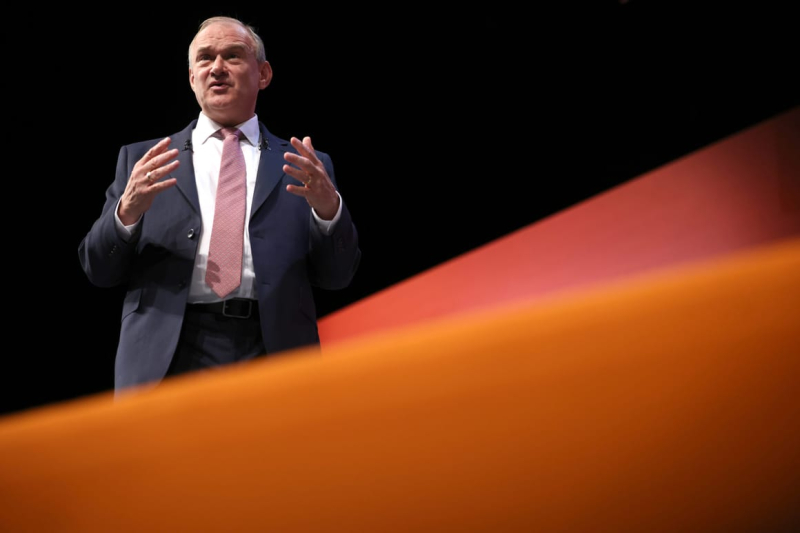
LONDON — The Liberal Democrats used to watch their rivals indulge in messy factional squabbles with glee. Now they are scrambling to project an image of unity.
Britain’s third-largest Westminster group could hold significant power after the next election if no party wins a majority of MPs and Prime Minister Andy Burnham is casting around for a deal.
But for now, the focus is on weathering an internal storm in the centrist outfit. MPs rallied around their leader Ed Davey this week at a marathon four-hour meeting — held days after one of his frontbenchers resigned in an ill-fated attempt to oust the party chief.
The botched coup comes as the Liberal Democrats try to answer a more existential question: what are they actually for and how do they make an impact in Britain’s fragmented political landscape?
POLITICO’s Poll of Polls shows the Lib Dems coasting along. After getting 12.2% in the 2024 general election — and bagging a record 72 members of parliament as a result — the party has slipped down, polling between 9% and 11% since Andy Burnham became prime minister.
POLITICO explains why Lib Dems are now openly discussing Davey’s future; how much danger he is in; and exactly how the man known for a cheery demeanor and eye-catching paddle-board stunts could be capsized.
1) Why is Davey’s future in the headlines?
The surprise resignation of the Lib Dems’ Treasury spokesperson Charlie Maynard a week ago triggered the latest round of soul-searching about the leader’s future — but the grumbling goes back a bit further.
Maynard’s resignation followed costly tax-cutting pledges from Davey at the party’s conference in September and came hot on the heels of sharp responses — including from 2024-intake Lib Dem MPs Tom Gordon and Vikki Slade — to the way Davey defended an existing guarantee on state pensions. Some MPs believe the party isn’t adequately representing younger voters by opposing changes to the so-called triple lock, now targeted for reform by Burnham.
The immediate threat looks to have receded. Maynard’s resignation has gone down badly among a host of colleagues.
One Lib Dem frontbencher — granted anonymity to speak about internal matters like others in this piece — said the “vast majority of us think it’s beyond ridiculous and are really angry.” A second frontbencher said it was “bang out of order” for colleagues to brief internal policy discussions to the press.
2) So he’s safe?
Not quite — fizzled plots like this have a habit of still bringing grumbling to the surface (just ask Theresa May)
There remains frustration among some MPs over Davey’s perceived failure to exploit a gap in British politics opened up by voters’ deep dislike of Keir Starmer’s Labour government after the 2024 general election.
All 3 Years 2 Years 1 Year 6 Months Smooth Kalman
-

Labour Party Labour Party
-

Reform UK Brexit Party (relaunched as Reform UK in 2021)
-

Conservative and Unionist Party Conservative and Unionist Party
-
The Green Party of England and Wales The Green Party of England and Wales
-

Liberal Democrats Liberal Democrats
-

Restore Britain Restore Britain
-

Scottish National Party Scottish National Party
-

Plaid Cymru – The Party of Wales Plaid Cymru
YouGov’s Anthony Wells explains that the party was stagnant “during a period where the Starmer government came in, became extremely unpopular [and] lost a huge amount of support” that “didn’t go to them.”
He contrasted this with how the Lib Dems gained traction in the 2000s when the Labour government was in big trouble. The Lib Dems are normally good at grabbing “the low-hanging fruit of unpopular left-of-center governments.”
“They haven’t nailed their colors really firmly to any mast,” says Wells. “They have been something to all men — and it means they may have suffered in comparison to people like the Greens under [leader] Zack Polanski, who’ve been much clearer about what they stand for.”
Removing a Lib Dem leader remains reasonably easy — though a crunch meeting of the parliamentary party on Tuesday suggests there currently aren’t enough MPs to actually trigger a ballot of no confidence, let alone win one.
Eighteen MPs (25% of the parliamentary party) would need to push for a vote of no confidence to be held. An absolute majority — 36 MPs — would then have to vote no confidence in Davey for a leadership election to be triggered.
Davey could stand in that leadership election if he could secure nominations from 10% of Lib Dem MPs and 200 members from at least 20 different local parties.
Unlike in the Conservatives, where a leader cannot be challenged again for a year after they win a no-confidence vote, Davey would be given no such grace period if he survived — meaning another ballot could take place just months after he saw off a coup attempt.
3) What’s the view from Davey world?
The arguments in the leader’s favor appear to have won out — for now.
For one, he has a record of winning. Davey can point to having taken the party to its largest number of constituencies in its modern form by focusing on a fight-by-fight, seats-first strategy. The 2024 campaign prioritized targeted campaigning in specific areas, rather than seeking a higher national vote share that doesn’t translate to a high number of MPs.
Loyal allies have come out to bat for their embattled boss this week. Deputy Leader Daisy Cooper, seen as a possible future leadership contender, said there’s a “real sense that we need to come together as a group” to stop the Tories and Reform UK “from forming the most right-wing government in our history.”
Subtext: let’s not mess around and let our real enemies in.
A third frontbencher told POLITICO Davey doesn’t “just have the support of the parliamentary party — there clearly aren’t anything like enough MPs to trigger a vote of no confidence.” They said Davey changing his top team earlier this year by appointing James Holt as director of political strategy and Ruth Younger as chief of staff “just needs time to percolate.”
4) So can Davey just keep calm and carry on?
Maybe.
Wells believes the party doesn’t “necessarily need to do much” to hold its current crop of seats at the next election — and that a middle-of-the-road approach against flashier, potentially more divisive opponents — might actually work in its favor.
While “their brand may be less distinctive, it also means they’re more coalition-able,” Wells says. He points out that there’s already much less objection from Labour about working with the Lib Dems compared to the Greens, who Burnham this week threatened to can local power-sharing agreements with amid a row over anti-semitism.
“There is a strategic advantage to them in terms of not offending people, but there’s also a strategic weakness in not defining yourself very clearly,” he says.
Sam Francis contributed reporting.