

Contents
The Ukrainian-founded deeptech company is combining materials science with existing industrial infrastructure to bring alternative fibres into mainstream packaging production.
Ukrainian-founded, Paris-based Releaf is developing an alternative to conventional wood-based paper by transforming urban fallen leaves into fibres for packaging, paper and other materials. The company is not only a boost for the circular economy but has enabled established paper producers to integrate its materials into existing industrial processes rather than building an entirely new manufacturing ecosystem.
I spoke to Valentyn Frechka, founder and CEO of Releaf, to learn more.
From scientific breakthrough to commercial reality
While many startups have demonstrated that alternative materials work scientifically, commercialisation remains a major obstacle. According to Frechka, success depends on two factors: positioning and proximity to both raw materials and customers.
“If you position yourself as a breakthrough company that’s going to compete directly with major corporations, you’re already putting yourself in a difficult position.
These are enormous businesses with established infrastructure and supply chains. Trying to disrupt that model by introducing something completely new often doesn’t work.”
He argues that geography, logistics and supply chain resilience are equally important.
“If you’re targeting European customers, for example, they may be reluctant to buy products manufactured elsewhere, particularly when geopolitical instability could disrupt their supply chains.”
Releaf initially believed its greatest opportunity lay in selling fibres directly. However, the team discovered that customers further down the supply chain were primarily interested in the finished product rather than the origins of its raw materials.
The company subsequently shifted its business model towards producing paper for converters, which manufacture finished packaging products.
Turning fallen leaves into an industrial raw material
The shift from plastic to paper reduces dependence on petroleum-based materials but creates another challenge: growing demand for virgin wood fibres.
Frechka points out that trees can take five or ten years, sometimes longer, to grow, while the resulting paper might become a shopping bag used for just two hours.
“If we can produce a material with the same properties, at a comparable price, using an alternative raw material that’s less vulnerable to supply chain disruption, why wouldn’t the industry consider it?
That’s the problem Releaf is addressing.”
Today, Releaf operates primarily as an engineering and materials company, developing technologies that transform fallen urban leaves into components for paper, packaging and other applications. The company uses two technological processes.
The first is a dry mechanical process that produces a material that can be incorporated into existing paper manufacturing machinery as a filler.
The second involves chemical and thermal treatment and refining to extract short fibres that behave similarly to cellulose fibres derived from trees.
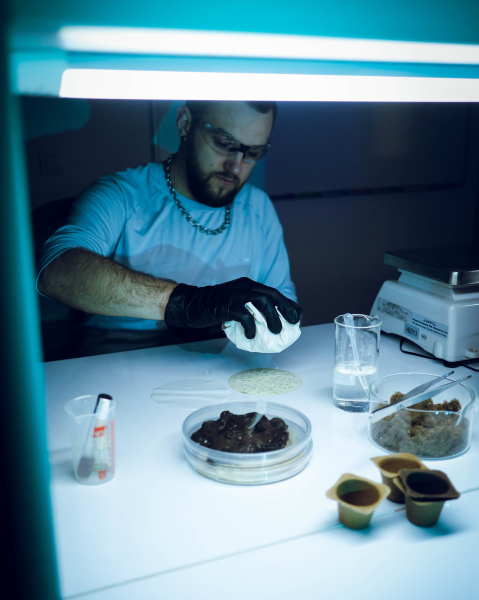
Together, these processes give Releaf flexibility in the materials it can manufacture, with products designed to match the performance of conventional paper.
Releaf works with cities and industrial partners across France, Germany, the Netherlands and Italy, including several French municipalities, commitments with German cities and collaborations with three of France’s largest paper groups.
Global brands have also tested its materials, including Uber Eats, Chanel, L’Oréal, Samsung and Rituals. The economics of turning municipal waste into paper
Cities already collect fallen leaves as part of their routine maintenance operations.
“They did it before Releaf existed, and they’ll continue doing it,” explains Frechka.
Municipalities need to manage this seasonal waste for practical and sanitary reasons. Leaves left on streets can rot and create slippery surfaces, while collected leaves are typically composted or incinerated.
Both options have limitations. Compost derived from leaves has relatively low economic value, while composting operations can depend on public subsidies. Incineration presents challenges because leaves contain sand and minerals that can damage boilers over time.
Releaf sees an opportunity to turn this existing waste stream into an industrial resource.
In Germany, the company is working with a partner in Dortmund to explore how to implement the model. In Paris alone, Frechka estimates that tens of thousands of tonnes of leaves could potentially be available, depending on the collection area.
Working with Releaf could reduce municipal leaf disposal costs by at least half, freeing up funding for other public services.
However, the seasonal nature of leaf collection creates logistical challenges, and thus managing and preserving large volumes of biomass is central to Releaf’s intellectual property.
“We receive large volumes of material within a relatively short period, so we need to process and preserve them efficiently.”
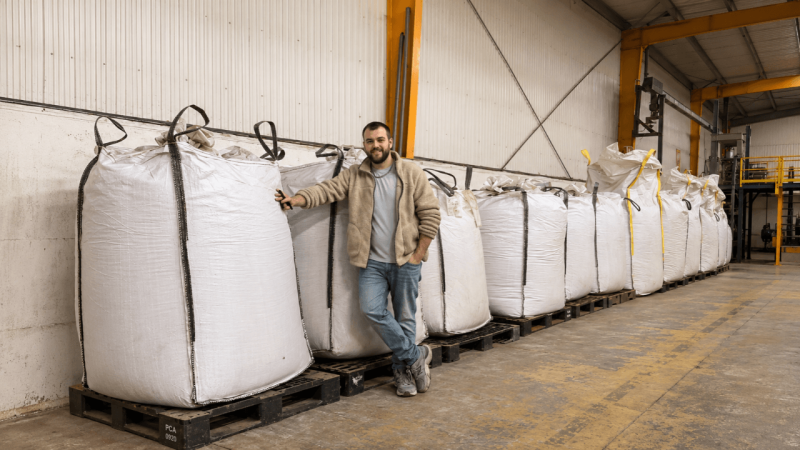
The company’s preparation line removes waste and contaminants before compacting the leaves into bales and preserving them to prevent degradation.
“This allows us to store approximately 400 kilograms of leaves in one cubic metre,” he explains.
The prepared material can then be directed into dry or wet processing systems, depending on its intended application.
Last year, Releaf processed about 1,000 tonnes of material on its pilot line and is preparing to handle roughly twice that volume next season.
Why Releaf isn’t building its own paper mills
Releaf keeps its core technology in-house, particularly the processes used to transform leaves into fibres, while working with established industrial partners to manufacture finished materials. The primary advantage is avoiding the substantial capital expenditure required to build and operate paper mills.
“The paper industry is extraordinarily complex. Building and operating a paper mill requires enormous investment and technical expertise.
Working with existing manufacturers allows us to avoid those costs.”
Frechka believes these partnerships also provide important technical and commercial validation.
“If an established paper mill is willing to introduce our material into its production processes, that demonstrates the technology can work within existing infrastructure.
These companies wouldn’t take the risk of introducing an unfamiliar material unless they saw a genuine commercial opportunity.”
However, established industries can be slow to adopt new technologies, particularly when manufacturing changes carry significant financial risks. Frechka argues that breaking into the paper industry requires technical expertise and a compelling economic case.
“You need to understand the industry from the inside. Technical knowledge is essential because this is an extremely competitive and complex sector where mistakes can be very expensive.”
With a background in biotechnology and genetic engineering, Frechka has spent years researching the properties of fallen leaves, including the molecular structure of their fibres. This has given him a detailed understanding of how Releaf’s materials behave under different manufacturing conditions, production speeds and volumes.
“When you approach an industrial manufacturer, you need to speak their language. You can’t simply arrive with an interesting sustainability story.
You need to demonstrate that your material works technically and makes economic sense.”
For a manufacturer producing 500,000 tonnes of paper annually, Frechka suggests that a reliable supply of 100,000 tonnes of alternative raw material could be attractive if it reduces costs without compromising product quality.
From cardboard boxes to luxury packaging
Although Releaf’s technology can support a range of material applications, the company is deliberately prioritising paper as its first commercial market.
Frechka sees it as the most familiar and commercially established application, providing an opportunity to build a financial foundation before expanding into other materials.
Releaf has developed several paper grades for cardboard boxes, paper bags, printing, graphic applications and luxury packaging.
Its current commercial focus, however, remains paper for corrugated packaging and bags.
Luxury packaging represents a further opportunity, although the market is relatively concentrated, with a small number of specialist paper producers, particularly in Italy.
One challenge is the geography of existing supply chains. Paper manufactured in Europe is often shipped to countries such as China, India or Indonesia for conversion into packaging before returning to Europe as finished products.
Frechka sees an opportunity to shorten these supply chains by bringing more production closer to European luxury brands.
“Our hypothesis is that we could produce the raw material, paper and finished packaging locally for European luxury brands.
We’re currently validating that approach with several customers, including discussions with Kering and LVMH, as well as independent luxury brands.
Of course, we’re not suggesting that every luxury brand will replace all its existing packaging. But there are clear opportunities in e-commerce packaging and secondary packaging.”
In September 2026, Releaf announced a partnership with Italian paper and cartonboard producer RDM Group and its Dutch subsidiary Eska to develop leaf-based materials for premium and luxury packaging.
The collaboration’s first product combines Eska’s 100 per cent recycled solid board with a Releaf leaf-based paper laminate, retaining the natural texture of fallen leaves while meeting the technical requirements of applications such as luxury boxes and book covers.
Unveiled at LUXE PACK Monaco, the material provides a concrete example of Releaf’s strategy to enter higher-value packaging markets through existing industrial production systems.
Building a materials company beyond paper
Releaf’s longer-term ambition is to become an international materials company, operating much like traditional wood-processing businesses. While cellulose fibres for paper remain its immediate priority, the company is exploring other applications for components extracted from fallen leaves, including water-resistant packaging coatings, moulded products and bioplastics.
“Growth will also allow us to reinvest in research and development and expand into other applications, including moulded packaging, biocomposites and polymers,” explains Frechka.
“The opportunity is much broader than paper alone.”
For Frechka, the biggest development is that Releaf has moved beyond its original scientific hypothesis.
The company has demonstrated its technology, developed products and established relationships with major industrial players. He also hints at forthcoming announcements involving companies he has long wanted to work with, some of which have become both partners and customers.
“For me, that’s particularly exciting because it demonstrates that what began as a scientific idea is becoming a real industrial business.”