
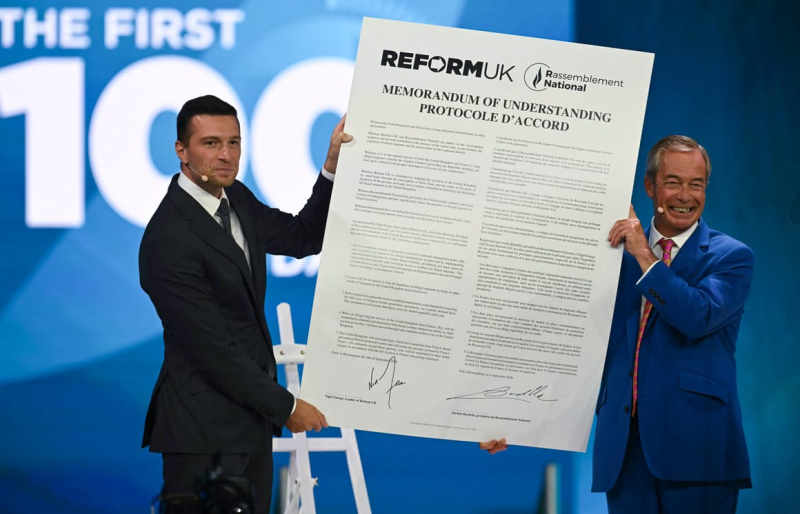

The Reform UK leader said with a smile: “Are you suggesting that I’d interfere in overseas politics? Quite possibly, yes.”
LONDON — Nigel Farage indicated Tuesday that he might appeal to a future far-right French president in an attempt to block Britain’s reentry to the European Union.
The Reform UK leader said he has been studying a rule under which France would offer the French people a referendum on allowing individual countries to join the EU after U.K. Prime Minister Andy Burnham opened a broad conversation on closer ties, not ruling out pushing to rejoin the bloc.
France passed constitutional reforms in 2005 and 2008 that state its president should hold a referendum on letting any country join the EU — unless both houses of the French parliament approve the accession by a three-fifths majority.
Farage suggested that Marine Le Pen, the leader of the far-right National Rally who is leading the polls ahead of next April’s presidential election, would be “pretty much as skeptical as me” about EU enlargement.
Farage told a press conference in Westminster: “Whilst it’s slightly tortuous, there is still quite a strong probability that for us to join the European Union … the French would have a referendum and a right to veto over us joining.
“I’ve been checking this out again. It would need to go through the assembly, etc. But there is a relatively strong possibility that there will be a referendum on it and so a lot would depend on who the French president and French prime minister were at that moment in time.
“If it was to be the current bookies’ favorites of Jordan Bardella and Marine Le Pen, I don’t see them overwhelmingly endorsing the enlargement of a European project over which they’re pretty much as skeptical as me.”
Asked by POLITICO if he could try to persuade a Le Pen-led France to block the U.K.’s reentry to the EU, he replied jokingly: “Are you suggesting that I’d interfere in overseas politics? Quite possibly, yes.”
‘Europe could change’
Senior figures in Burnham’s government are already aware of the French referendum rule.
Burnham has also indicated publicly that his thoughts on forging closer ties with the EU may shift if the far-right gains more power in Europe. He told MPs on Monday: “Europe could change again in the next year, 18 months, and we’ll have to obviously watch how life changes.”
France is not the only country that has domestic checks and balances on EU enlargement.
Catherine Barnard, an academic and director of the Centre for European Legal Studies, said: “Even if all 27 member states unanimously agree to U.K. accession, further blockages may then occur at domestic level.
“For example, France might need a referendum or at least three-fifths majority in both houses. Belgium would need agreement of all of its national and regional parliaments.”
Burnham said Monday that it would be “unthinkable” for Britain to rejoin the EU without holding a repeat of Britain’s 2016 referendum, in which 52% voted to leave the bloc.
The prime minister has previously said he would like to rejoin the EU in his lifetime, but has not yet decided whether he will put the proposition of full membership in Labour’s next election manifesto, expected by 2029.
Farage said it would be “illegitimate” to rejoin the EU without a new referendum, though he batted off the suggestion that Britain might need a referendum to rejoin the single market or customs union alone.
Farage also appeared to suggest there could be riots if the result of the 2016 referendum was overturned. “If people really think that voting changes nothing, they will resort to other means,” he said. “Democracy is the safety valve. Rather than setting fire to things, or smashing up buildings, or behaving even worse than that, you have a vote and you accept the result and say, ‘I’ll get the so-and-sos next time.’”
Farage has not recently held a meeting with Le Pen, despite a Reform official previously suggesting that a rendezvous in Paris was being lined up by the end of October.
Bardella, who is poised to be prime minister under a Le Pen presidency, unveiled an agreement with Farage in September to deport migrants who make unauthorized small boat crossings across the English Channel back to France. But the plan provoked a backlash in France, where politicians across the spectrum questioned why the country would act as a “gatekeeper” or a “subcontractor” for the U.K.