
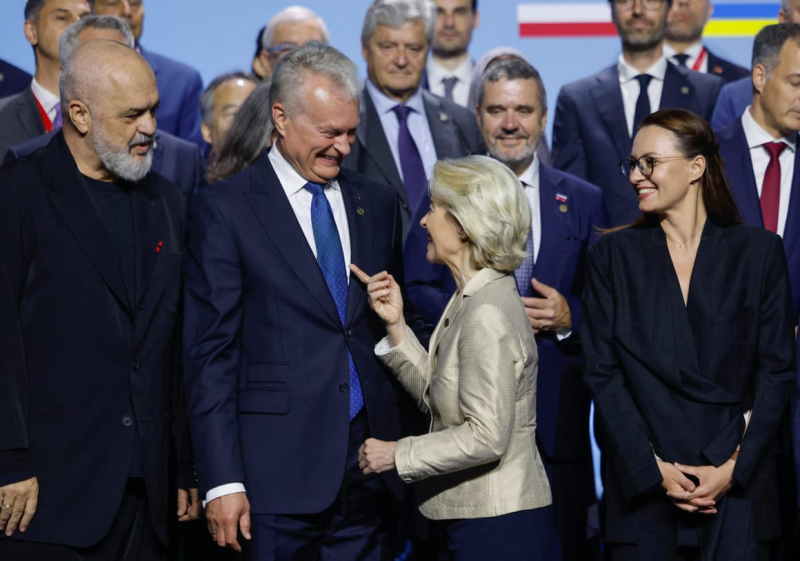

For the first time, Brussels is considering setting target dates for Montenegro, Ukraine, Moldova and Albania to complete key stages of accession talks.
BRUSSELS — The EU is developing proposals that would see the four countries closest to joining the bloc given a clear, step-by-step path toward membership — while the others languish behind.
Targeted “roadmaps” are being considered for Montenegro, Ukraine, Moldova and Albania, two senior European Commission officials working on the draft proposals told POLITICO, as part of efforts to speed up the decades-long process. They were granted anonymity to speak about the sensitive plans.
The four countries are seen as frontrunners to join the EU, but still face slow progress and unclear timelines as to when they might formally be admitted. While Brussels has long backed their membership bids, the roadmaps mark the first time they will be given assurances that if they continue with essential reforms, they will be admitted — and offered indicative timelines for the completion of negotiations.
The roadmaps will make clearer exactly what’s expected of each candidate country, one of the officials said, as well as create obligations for current members, which need to give their blessing for the process to go ahead. The plans also set rough dates for when groups of reforms, known as negotiating “clusters,” will be formally completed — major milestones on the path to membership.
Commission President Ursula von der Leyen pledged targeted support for the candidate countries “that have made most progress” during her State of the Union speech earlier in September.
However, other candidate countries at an earlier stage in the process, like Kosovo, North Macedonia, and Bosnia and Herzegovina would not be offered the roadmaps at this stage, the officials confirmed. Nor would Georgia, Turkey or Serbia, which have seen their applications grind to a halt over concerns about democratic and judicial backsliding.
A spokesperson for the Commission confirmed that the new roadmaps “will provide a pathway toward the conclusion of the accession negotiations. They will set out a clear priority list: timelines and deliverables to help the most advanced candidates complete the necessary reforms.”
‘Geopolitical imperative’
EU leaders are increasingly looking to other pro-trade democracies, particularly in their neighborhood, amid tensions with partners like the U.S., hostile practices from China and threats from Russia. Officials are concerned that joining the EU takes too long, exposing would-be new members to disillusionment or pressure from rivals not to pursue membership.
The move comes as the EU’s “pre-enlargement” policies undergo a separate overhaul. Candidate countries need to be offered a better path toward “gradual integration” into the bloc, officials believe, one that would use economic benefits and access to joint projects to reward them for progress. That policy review, led by von der Leyen’s close adviser Alexandre Adam, is to be presented to top officials Oct. 6; it is designed to keep them on the path toward the EU while their applications unfold.
“Enlargement … remains a geopolitical imperative. Accession, however, takes time,” reads a draft version of the pre-enlargement review text seen by POLITICO. “Candidate countries must complete a rigorous, merit-based process and deliver far-reaching and lasting reforms. That time should be put to full strategic use to both prepare the Union for larger membership and deepen gradual integration in areas of mutual interest.”
As part of that review, von der Leyen and Enlargement Commissioner Marta Kos will propose changes to the bloc’s internal workings to ensure safeguards are in place to prevent new joiners from disrupting key policies or reneging on their commitments. The revisions could include emergency clauses and transition periods before certain membership rights are fully granted.
“The policy reviews show that the Union can accommodate a larger membership through targeted adaptations, largely within the existing Treaty framework,” the draft reads, arguing that the EU’s fundamental laws don’t need to change to assuage concerns about enlargement.
Capitals are cautious about admitting new members, some of which have had only a few decades of democratic governance, following Hungary’s backsliding on rule-of-law principles under former Prime Minister Viktor Orbán and its use of veto powers to block key policies like sanctions on Russia and support for Ukraine. The support of current members must be unanimous for candidate countries to move through the process of joining the EU.
National leaders will weigh in on how, and how fast, new members can be brought in during a two-day summit in Brussels from Oct. 15; in turn, the Commission will ask them for political support to pick up the pace. The European Council will hold “a strategic discussion on enlargement and internal reforms,” a draft agenda shows.
Kos told POLITICO earlier this month that she hopes the changes being proposed, and the talks with leaders, will make for an “autumn of enlargement” after years of slower progress.
Von der Leyen travels to the Western Balkans this week for talks with leaders in Montenegro, Albania, North Macedonia and Kosovo. She will skip Bosnia and Herzegovina, however, as well as Serbia, both of which are in the midst of national elections.