
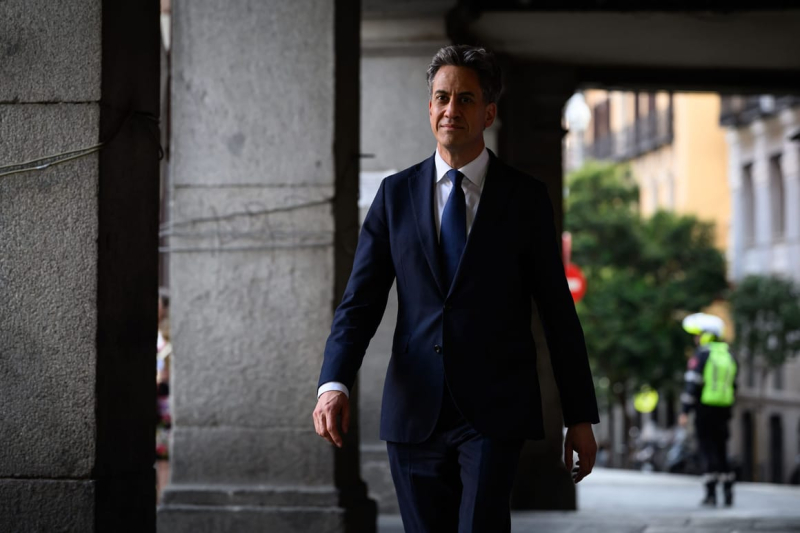

U.K. Foreign Secretary Ed Miliband formally announced the trade ban in the House of Commons.
LONDON — France and Canada will join the U.K. in imposing new trade sanctions on illegal Israeli settlements Tuesday in a major diplomatic coup for Britain as it resets its relationship with Israel.
In the House of Commons, British Foreign Secretary Ed Miliband confirmed Britain, France and Canada will impose a ban on the trade of goods and some services from Israeli settlements, having last month condemned Israel’s plans for 1,200 new homes in the E1 area east of Jerusalem.
The U.K. “will take action against specific companies and individuals who provide services such as construction, infrastructure, financing, or real estate for settlement expansion,” Miliband told MPs, adding: “To those who finance or facilitate illegal settlements, let me say this, you will face the full force of UK sanctions.”
He said Britain will “act in concert with others in a broad international coalition,” confirming France and Canada will also ban the import of goods from illegal settlements.
Confirming the move in a post on X, France’s Foreign Affairs Minister Jean-Noël Barrot said: “France will end trade with Israeli settlements in the occupied Palestinian Territories, along with 11 other countries that have made similar commitments.”
“France cannot, through its trade, support a situation that threatens the security of both Israelis and Palestinians.”
It follows a major diplomatic effort by the British government over the summer, which culminated in a visit to Downing Street by French President Emmanuel Macron last week.
Miliband’s announcement marks a sharp shift in Britain’s stance on Israeli settlements under new British Prime Minister Andy Burnham.
The relationship between Israel and France, historically one of its close allies and home to more Jews than any other country in Europe, has become strained in light of the war in Gaza.
Macron last year said Europe must “harden” its collective position on Israel given the dire humanitarian situation in the coastal enclave, and he found some success in convincing other Western democracies to join France in recognizing a Palestinian state last year.
Barrot said last week that the recent effort to sanction EU-wide trade with illegal West Bank settlements has been met resistance in Brussels.
Although several EU countries have pledged to ban trade with the settlements, the move is legally murky under EU law, because trade is an exclusive EU competence. Member states can do it on the grounds of either national security or violation of human rights and democracy, but any measures at national level is assessed for compatibility with EU law.
US threats
Hours before the policy announcement Tuesday, U.S. Ambassador to Israel Mike Huckabee suggested the U.S. could retaliate against the U.K. over the move.
Huckabee, who over the weekend condemned the government’s “Jew hate” despite Miliband being Jewish, told the BBC that the decision would be a “discrimination against the Jewish people.” He also suggested that individual U.S. states — specifically Florida — might take trade action against the U.K.
Speaking at an awards ceremony in Jerusalem on Tuesday, Israeli President Isaac Herzog raised the prospect of other nations joining the U.K., and warned the imposition of trade sanctions on Israeli settlements would prove to be a “grave miscalculation, a decision that will fall on the wrong side of history,” according to a readout of the comments provided by Herzog’s office.
UNGA looming
It comes just two weeks before world leaders meet in New York for the U.N. General Assembly — and ahead of Burnham’s expected first in-person meeting with U.S. President Donald Trump since becoming British prime minister.
While Trump has yet to respond to the sanctions, political differences have previously influenced his decisions on trade.
In January, the president threatened to impose 10 percent tariffs on eight countries, including the U.K., for opposing his demands to use military force to take control of Greenland.
Israeli Foreign Minister Gideon Sa’ar warned the U.K. last week that Israel will retaliate against the sanctions. “If Britain acts against the state of Israel, the state of Israel will act against Britain. We have tools,” Sa’ar told a podcast by media outlet Ynet. Britain, he said, “will be making a big mistake.”
Daria Zakharova and Aitor Hernández-Morales contributed reporting.
This developing story has been updated.