
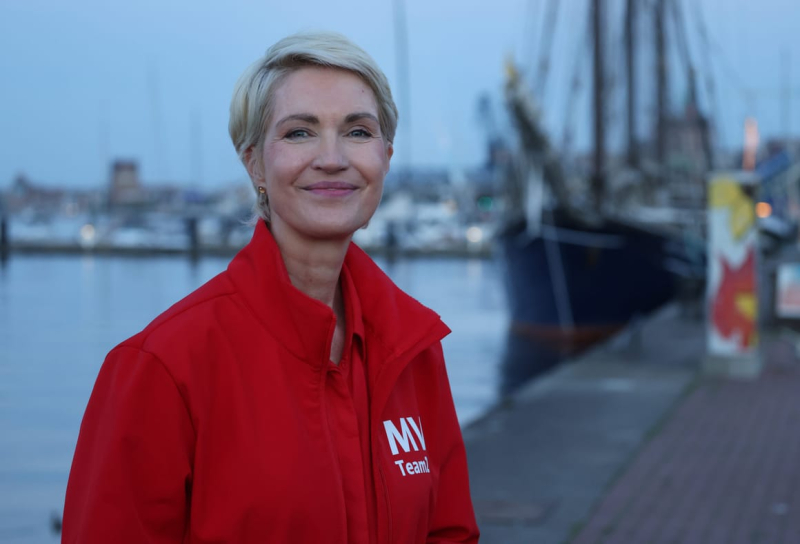

State premier Manuela Schwesig is close to stopping the AfD’s advance ahead of Sunday’s regional elections — but at a great cost to Chancellor Friedrich Merz.
ROSTOCK, Germany — Manuela Schwesig, a popular center-left politician, is within striking distance of stopping the far-right’s advance in the former East Germany.
Her success is coming, however, at a steep price for embattled Chancellor Friedrich Merz and the ailing national coalition her party helps sustain.
Ahead of an election in the northeastern state of Mecklenburg-Western Pomerania on Sunday, Schwesig, the sitting premier of the state and the lead candidate for the left-leaning Social Democratic Party (SPD), has narrowed the far-right Alternative for Germany’s lead to just a few percentage points in some polls.
It’s emblematic of just how far mainstream parties have fallen across large swaths of Germany that Schwesig is considered a rare and remarkable success for simply managing to keep her SPD — a sinking party that has suffered a string of historic defeats — within range of beating the far right on Sunday in what would amount to a major upset. “Manuela Schwesig could be Germany’s savior,” ran the headline of one column in Der Spiegel magazine.
Schwesig, a former tax inspector who has risen to become one of Germany’s most well-liked politicians, has thrived by casting herself as a bulwark against the far right — employing the slogan “Frau gegen Blau” — “Woman against Blue,” a reference to the AfD’s party color.
To help her cause, she has also frequently attacked the deeply unpopular Merz as out of touch with ordinary people and their financial struggles — exhibiting a populist streak that both distances her from a historically unpopular federal coalition while blunting the AfD’s ability to capitalize on the widespread anti-Merz sentiment that propelled its regional election victory in Saxony-Anhalt earlier this month.
Schwesig’s approach has effectively turned the election in her state into a two-party race that has greatly weakened Merz’s conservatives. Her strategy was clear during a “citizen dialogue” with a few hundred supporters held in a tent on the waterside in the port city of Rostock one evening this week.
When someone from the crowd asked what she would do to halt rising gasoline prices, Schwesig, dressed in the bright red of her SPD, called it “fully unacceptable” that Merz had failed to implement a price cap to lower costs for consumers in her rural state, where people often need to drive long distances to get to work.
“I’m pretty angry at Chancellor Merz,” she said.
Schwesig’s success is creating an unprecedented challenge for Merz’s conservatives — and may hasten the demise of the coalition he shares with the SPD. Recent polls show Merz’s conservative Christian Democratic Union has crashed to around 7% support in Mecklenburg-Western Pomerania in recent days, as the race increasingly morphs into a contest between the strongest mainstream candidate and the far right.
That level of support for the CDU would already constitute the worst result for the party in any state or federal election in Germany’s postwar history. A further decline would put the party at risk of failing to meet the 5% vote threshold required to enter the state parliament. A CDU collapse on this scale will almost certainly intensify internal debate that has been roiling since the summer over replacing Merz in a so-called Kanzlertausch.
Conservative leaders are blaming Schwesig’s “Frau gegen Blau” campaign for effectively taking them out of the running in the state as centrist voters rally around the SPD candidate to prevent an AfD victory.
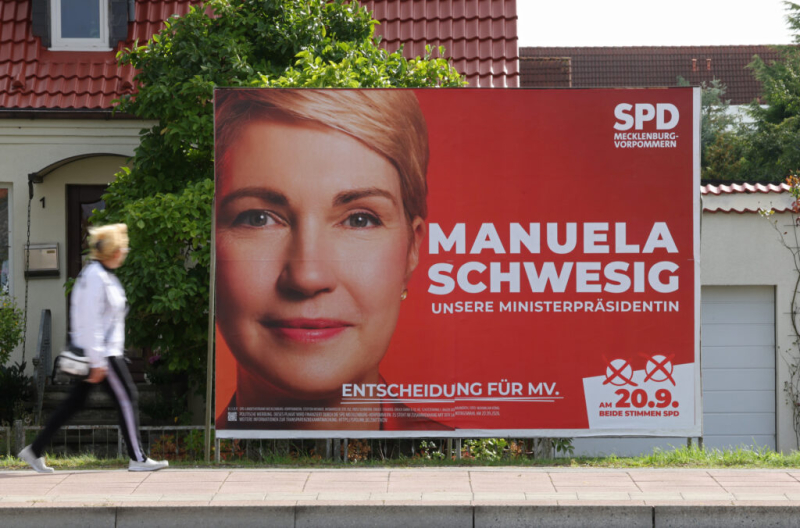
“Her attempt to keep the CDU in check with a personalized campaign weakens the political center and ultimately helps the AfD,” the party’s general secretary, Franziska Hoppermann, told the German Press Agency.
From Schwesig’s perspective, however, the CDU and Merz have no one to blame but themselves. A vote for her and the SPD, she said during her campaign event in Rostock, “is the only real chance to prevent the AfD from becoming the strongest party.”
‘Heart for the vulnerable’
Schwesig is by no means simply a local politician. Having served as Germany’s family minister for a three-and-a-half-year stint under former Chancellor Angela Merkel, she has a national profile and a high degree of influence within the SPD. Before Russia’s full-scale invasion of Ukraine, Schwesig was a strenuous advocate of importing natural gas from Russia via the Nord Stream pipelines, though she has since argued her state’s future lies with renewable energy.
If she’s able to defeat the AfD on Sunday, it will raise her national stature immensely — and likely lead to calls for her to run for chancellor.
But her popularity in her home state and beyond stems mainly from her ability to project herself as an empathetic, relatable politician at a time when many in Germany view their government as out of touch with the concerns of regular citizens.
“She’s close to the people,” 64-year-old Simone Kroh, a former elder caregiver, said outside of Schwesig’s campaign event in Rostock. “She’s one of us.”
Those are qualities Merz has struggled to muster, admitting even by his own account that he’s failed to emotionally connect with voters. The chancellor has often come off as chiding, accusing Germans of not working hard enough or of failing to recognize the urgent need for his sweeping economic reforms — at one point telling trade unionists that the country needed to “pull itself together.”
Schwesig, by contrast, projects herself as a politician who understands the struggles of everyday people. Born and raised in the former East Germany, she often tells the story of how her family struggled after her father lost his job in construction around the time of the fall of the Berlin Wall — an experience many families from the region can identify with.
As premier of her state, she has pushed through measures to make pre-schools free for all families and to give young people in vocational training and seniors a €20 discount on monthly train passes — a measure she says makes a big difference in the lives of retirees who often survive on small state pensions.
She has also criticized Merz’s federal reform drive as punishing hard-working people, even though her own party has enabled it nationally, pushing back against one proposal in particular from the coalition to curtail early retirement for people who have worked 45 years.
“Reforms, yes, but they must be fair, and they must also be reasonable,” Schwesig told the crowd at her campaign event in Rostock. “What we currently have on the table regarding pensions, long-term care, and health care — we are not satisfied with this, and it is our duty to represent the interests of the people here.”
The message clearly resonated with many people in the crowd, particularly in a time of rising prices and slow growth. Following her talk in Rostock, supporters approached Schwesig to ask her about their financial worries. A school social worker asked whether funding for her job would be guaranteed. A university student asked whether state money to cover living costs during his studies would be cut.
For Kroh, the former elder caregiver, Schwesig’s criticisms of Merz and the government were absolutely justified.
Schwesig, she said, recognized people’s struggles.
“Merz,” she added, “just doesn’t have a heart for the vulnerable.”