
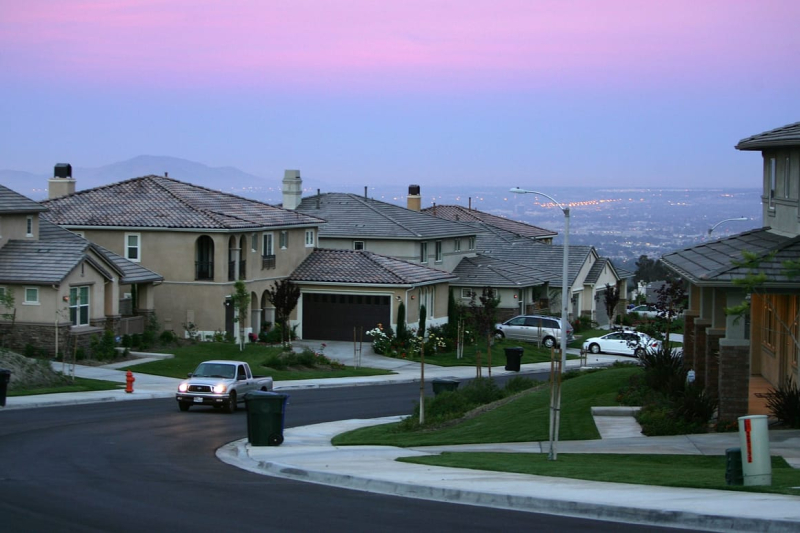

A quarter of all homes approved in California in 2025 were so-called granny flats, according to analysis.
LONDON — The U.K. reveled in California-style sunshine this summer. Now it wants to try the Golden State’s housebuilding policies.
Faced with a housing crisis successive governments have failed to address, Britain’s new administration under Prime Minister Andy Burnham is desperate to push up building rates and is looking west for answers.
A recent update to planning rules encourages adding homes above existing buildings and in gardens in England. The policy bears similarities to the “accessory dwelling units” (ADUs) that now make up a quarter of all new housing in California.
Experts think the tweaks could help the government stretch towards its target of building 1.5 million new homes before the next general election, but note the risk of a political backlash among local residents worried about their neighborhoods losing their character and green spaces and becoming overwhelmed.
“It could be significant and it’s certainly creative,” said Simon Creer from the Royal Town Planning Institute. “But it’s hard to say definitively what the increase in housing delivery could be, and whether it will be popular. There’s always a fundamental tension between the need for more homes and the potential local backlash about where those homes are and what they look like, which is why early, meaningful communication with communities matters.”
Indeed, planning changes around garden use during the previous Labour government in the 2000s led to public outrage about homes being demolished so speculators could cram properties into available land, as well as fears about destruction of green spaces. Labour was forced to intervene on what was dubbed “garden grabbing” as the 2010 election loomed, then the successor Conservative-Lib Dem administration was quick to change the rules.
Now the government has tweaked them again to fuel development on and around existing buildings, instructing planning committees via national guidance to favor upward extensions to homes and commercial buildings and filling gaps around houses.
The aim is densification: increasing the number of homes on a designated land mass.
“These changes are in line with our push for urban and suburban intensification, aiming to unlock private land and speed up small-scale construction alongside major transport-hub and grey-belt redevelopment,” said a government official who was granted anonymity to speak about the plans.
The official said the rules are designed to encourage “ADU-style” building, but help “safeguard residential gardens from inappropriate development” while retaining local government oversight.
The Cali formula
When it comes to finding gaps to slot homes into, California is the blueprint. The state that invented suburban sprawl has seen a surge in ADU home construction over the last 10 years to add more housing into already-developed neighborhoods — although it took aggressive government intervention to make it happen.
For decades, the state had laws on the books to encourage the building of ADUs, also dubbed casitas and granny flats. But cities implemented barriers including high fees, strict rules on size and lengthy reviews that stymied most new building.
Amid a housing shortage driving up home prices, California state lawmakers passed a series of new laws, starting in 2016, to strip away restrictions local governments were using to block construction.
Those behind the effort worked clandestinely at first. They didn’t want to provoke a backlash from residents fearing the plans would upend the suburban development pattern of a single-family home, spacious backyard and two-car garage — putting their property values at risk. Authors of the 2016 legislation changed the terminology for the buildings in state code from “second unit” to “accessory dwelling unit,” helping the new houses appear as part of an existing home’s footprint, rather than a separate development.
Over time, the effect of all the new laws not only made it simpler and less expensive for individual homeowners to build on their properties, but it also spurred the growth of a niche construction industry. Without having to wade through individual permitting rules, contractors could work across cities more easily, increasing their opportunities to drum up business.
“The goal here was to standardize the process across the board,” said Muhammad Alameldin, director of growth for California YIMBY, a pro-development organization that has supported the new state laws. “The theme is that if you own a piece of property, you should be able to build on that piece of property.”
The state’s effort on backyard homes is considered its most successful policy to increase homebuilding in recent memory. In 2018, fewer than 9,000 backyard homes were permitted in California, making up less than 8 percent of the state’s total production, according to an analysis of state data by researchers at the University of California, Berkeley, and shared with POLITICO. Last year, backyard home permits topped 32,000, representing a quarter of all homes approved in California, the analysis found.
Due to rising interest rates and high labor and materials costs slowing down construction, among other headwinds, it’s possible that housing construction in California would be declining without the boom in backyard homes.
Meanwhile, back across the pond
Labour in the U.K. wants a piece of that action as part of wider efforts to fuel building. But opponents are fueling dissent before a single new unit has even been approved.
The Conservatives have already sounded the alarm about “garden grabbing,” arguing the new rules will create a boom in one-bedroom flats to make up building targets, despite high demand for larger houses with sizable gardens for families.
“Britain needs more homes,” said Shadow Housing Minister Gareth Bacon. “But Labour’s top-down housing targets and density requirements will result in more blocks of flats being crammed into people’s gardens, rather than communities getting new family homes with gardens and parking spaces.”
Recent experience suggests a political war on the issue can be successful. A similar densification plan in the London borough of Croydon was implemented in 2019 and led to a boost in new homes. It was revoked in 2022 amid a public backlash over properties being demolished and replaced with low-rise flat blocks.
Government officials insist their policies will not cut across local government power to account for public concern, and will protect gardens via a series of caveats about maintaining the character of areas and ensuring transport routes and services are not overwhelmed.
“We have made changes which recognize that in many places, there is potential for more development to support thriving neighborhoods, improve access to jobs and services and make the best use of land within our towns and cities,” said a housing department spokesperson. “Our changes will help more homes be built where they are needed, while stopping unsuitable development.”
Other examples in the U.K. suggest a balance can be struck. Upward extension allowances in the London district of South Tottenham in 2013, which included strict rules on maintaining building character, led to a significant increase in residential space in that one small area.
“Making it easier for homeowners to build granny flats and loft extensions could make a big dent in England’s housing shortage,” said Sam Dumitru, Head of Policy at pro-building campaign group Britain Remade. “So long as politicians hold their nerve when the inevitable objections from angry neighbors rear their head.”