
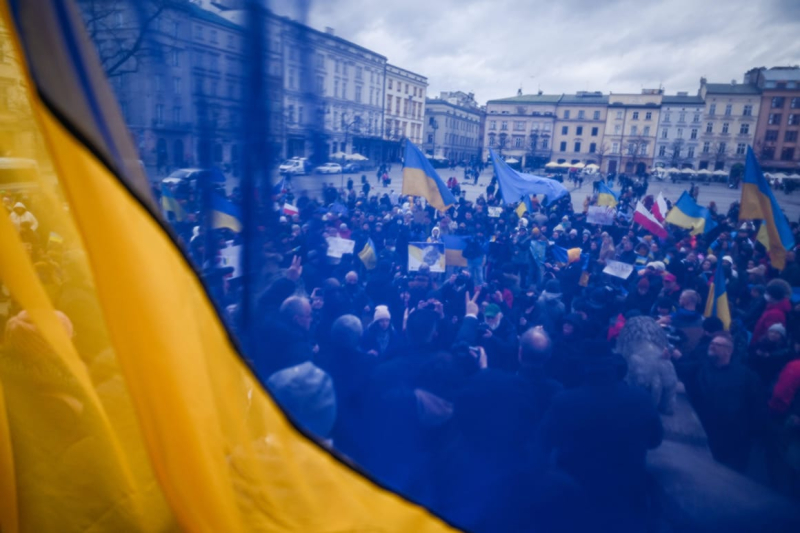

The number of crimes against Ukrainians in Poland is rising as right-wing Polish politicians ramp-up anti-Ukraine rhetoric.
WARSAW — Poland’s nationalist right is turning hostility toward the country’s roughly 1.5 million Ukrainians into a potent political issue, tapping into local resentment over social benefits and wartime history just over a year before a pivotal parliamentary election.
During Poland’s 2025 presidential campaign, politicians began portraying Ukrainians in Poland as freeloaders straining the country’s public finances.
This summer, Polish President Karol Nawrocki stripped his Ukrainian counterpart, Volodymyr Zelenskyy, of Poland’s highest honor, the Order of the White Eagle, in reaction to Zelenskyy’s decision to name a military unit after the World War II-era Ukrainian Insurgent Army, or UPA. The group murdered tens of thousands of Poles during an ethnic-cleansing campaign in 1943-1945, although it also fought against the Soviet Union.
Warsaw has been one of Kyiv’s strongest supporters against Russia since the full-scale invasion of Ukraine began in 2022. But the nationalist camp, which Nawrocki seeks to lead, has sought to capitalize on tensions over the Ukrainian presence in Poland and the wartime massacres.
Anti-Ukrainian rhetoric is already intensifying ahead of the fall 2027 parliamentary election, when Prime Minister Donald Tusk’s broadly pro-Ukraine coalition will face the nationalist Law and Justice party and two other far-right parties. Polls show Tusk is far from certain of victory.
The libertarian Confederation party denounced Ukrainians getting social welfare, while Gregorz Braun, the European Parliament member who leads the far-right Confederation of the Polish Crown party, said: “The Kyiv regime is neither our ally nor our friend, it is our enemy,” during a summer gathering commemorating the wartime killing of Polish civilians by Ukrainians.
Przemysław Czarnek, the candidate for prime minister from the Law and Justice party, said July: “Military aid to Ukraine must be suspended until that country changes its historical policy.”
Rafał Pankowski, a sociology professor at Warsaw’s Civitas University and co-founder of the Polish anti-racism group Never Again, believes that while the Polish population is broadly supportive of Ukraine, fissures are beginning to show.
“Solidarity with Ukrainians remains strong among many Poles, but populist anti-Ukrainian rhetoric has created fertile ground for attacks, turning a large and visible minority into a target and helping verbal hostility spill into violence. Russian propaganda seized on the opportunity, too,” he said.
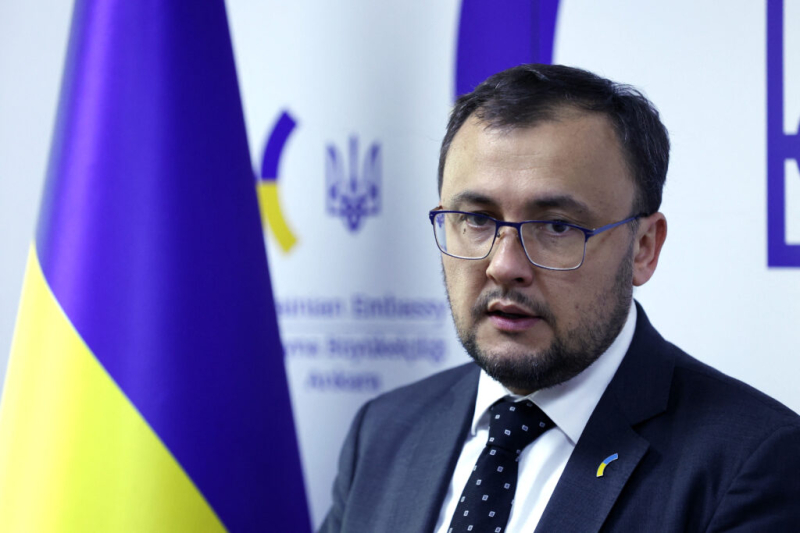
Ukrainian Ambassador to Poland Vasyl Bodnar is worried about politicians using Ukraine as a wedge issue.
“Part of Poland’s political class is trying to exploit the Ukrainian issue for political gain. Some focus on developments in Ukraine, others on the behavior of Ukrainians living here. One way or another, Ukraine features in the narrative of every political group — it is simply packaged differently,” he told POLITICO.
In the line of fire
The latest Polish-Ukrainian row might have faded from the headlines, but the fear it helped instill has not.
“I’ve lived in Poland for about 10 years. I came here to study and stayed,” said Olena, a guide at a Warsaw cultural institution whose name POLITICO changed at her request because she feared for her safety.
“It took me quite a while to integrate, but I have never felt as alienated as I have over the past year. I have become afraid to speak Ukrainian in public, and I have started worrying about my friends and loved ones who live here or come to Poland to visit,” she said.
Opinion polls show a decided shift against Ukrainians.
In an annual survey by the state-run pollster CBOS, sympathy among Poles toward Ukrainians fell from 51 percent in 2023 to 29 percent in January 2026, while antipathy rose from 38 percent to 43 percent over the last year.
Another CBOS poll found that 45.4 percent of those polled attributed the deterioration to disputes over the wartime massacres and historical policy, with social benefits for Ukrainians in second place at 36.4 percent.
Ivan, a Ukrainian national who works at the University of Warsaw and asked to only be identified by his first name, said a neighbor confronted him over Zelenskyy’s decision to name a military unit after the UPA.
“We were in the elevator. My neighbor started yelling at me, telling me to go back to Ukraine and explain to Zelenskyy that he shouldn’t have done that. It was absurd,” Ivan said.
Olena recalled a Polish woman following the group she was guiding and complaining that hearing her speak Polish was “an embarrassment” to her as a Pole.
“I said loudly that Polish was not my native language, that I came from Ukraine,” Olena said.
For Ivan and Olena, the hostility remained verbal. For other Ukrainians, it has turned violent.
In July, two men were arrested after two Ukrainians, Anastazja, 20, and her 21-year-old partner Maksym, were beaten outside a Wrocław grocery store. The attack was denounced by Poland’s Interior Minister Marcin Kierwiński. Ukrainian Foreign Minister Andrii Sybiha thanked the police for the arrests.
Earlier that month, an off-duty employee of Bielsko-Biała’s municipal bus company hurled nationality-based abuse at three Ukrainians, including two 11-year-old schoolgirls, on a bus.
In August, a Ukrainian man was attacked on a tram in Poznań.
The Polish police recorded 180 reports of ethnically motivated crimes against Ukrainians in the first half of this year, a 30 percent increase over the same period last year, reported the Rzeczpospolita newspaper.
The Polish government — which has tightened Ukrainians’ access to welfare, even though their collective contribution to Poland’s economy far exceeds public spending on them — set up 50 specialist prosecution teams in early 2026 to investigate hate crimes.
Between February and June, Polish prosecutors sent 283 cases to court. Ukrainians were the victims in more than 80 percent of such cases, up from 4 percent in 2014 and 74 percent in 2023.
Tusk said in July that attackers had become bolder because they believed they enjoyed political protection and called on Nawrocki to speak out on the matter.
“I am appealing directly to the president to stop remaining silent on this matter,” Tusk said. “We must wage a decisive fight against this violence, because the bandits, the hooligans, this violent pathology has gained courage and audacity because it has also received political patronage.”
The Roman Catholic Church has also weighed in, issuing an appeal “not to fuel nationalistic sentiments.”
Ambassador Bodnar hopes politicians will stop inflaming relations between the two countries.
“The best response will be effective communication — from politicians, the media, and, of course, government officials — who would communicate in a positive manner and resolve those issues that are painful or important to both sides,” Bodnar said.
For Ivan, the change in tone is making him more wary of drawing attention to himself in Poland.
“I still speak Ukrainian, and I wear a pin with the Polish and Ukrainian flags. What has changed is the way I feel about potential conflicts. I used to not be afraid to speak up and stand up for myself if someone attacked me because I’m Ukrainian,” he said. “Now I’m afraid no one would help me and that I would be accused of violating some law and simply deported, even though I’ve already built my life in Poland.”
The government’s policy is to deport Ukrainians even for minor offenses — one Ukrainian 18-year-old was kicked out of Poland for jumping a barrier at a concert.