

The president wants to avoid fresh elections that would likely hand power to the far right, but rival parties are struggling to agree on a new coalition.
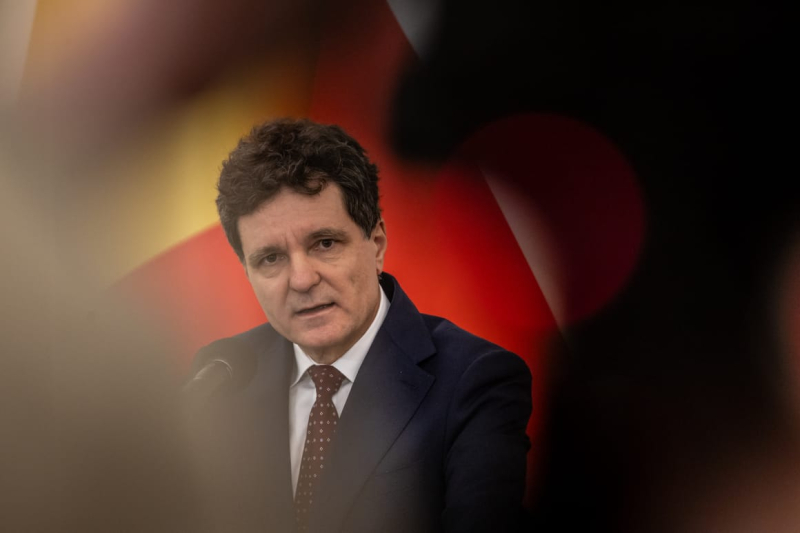
Just over a year after Romania’s moderate President Nicușor Dan won power in a tense showdown with the far right, he is facing his most serious test yet — trying to broker a deal between rival parties to form a stable government.
Romania’s last coalition fell apart in April, and Dan’s first two nominations for prime minister failed to secure enough party support to lead a new administration. He now has one more chance to nominate a new prime minister and get the candidate approved in a parliamentary vote before the option of a snap election comes into play.
Dan will be reluctant to trigger a new general election, as his arch rivals on the far right — the Alliance for the Union of Romanians party — have a strong lead in the polls.
But there’s a risk in refusing to call an election, with the president’s opponents in AUR and other parties already threatening to try to impeach him — an option some believe will gain broader support the longer the crisis drags on.
Meanwhile, for the country of 19 million on the EU’s eastern border, time is running out. Bucharest is under pressure to reduce its high budget deficit and meet key targets for economic reforms by the end of August to secure around €11 billion in EU funding.
Credit rating agencies are also watching, amid fears that the political uncertainty could trigger a deeply damaging downgrade to the country’s status.
Adding to the pressure is parliament’s scheduled summer recess. If there’s no deal by the end of June, analysts say, the current caretaker government of outgoing Prime Minister Ilie Bolojan will likely continue governing until the fall.
“We are now at the beginning of a constitutional crisis,” said Cristian Pîrvulescu of the National University of Political Studies and Public Administration in Bucharest. Under the constitution, some ministers currently in post “do not have the right to be ministers” because the interim government’s term is not supposed to last beyond 45 days, a deadline that has already expired.
Talks among Romania’s political parties to agree on a minority government continued on Thursday but ended after two hours, local media reported, without a deal being announced.
Dan is due to meet party leaders again on Friday, but won’t propose a new prime minister unless they’ve agreed a deal to form a minority government.
Radu Magdin, a political analyst, said he believed a snap election is not a “credible” scenario because Romania has never held one since the fall of Communism in 1989.
“We are speed-dating in terms of presidential consultations with the parties,” Magdin said. The choice, he explained, was between two options — either a minority government formed by the social-democrat PSD, whose members this week proposed their leader, Sorin Grindeanu, for prime minister; or a minority government made up of the outgoing prime minister’s Liberals, along with other center-right and liberal parties.
A third option is also now being discussed, which would involve a “rotation” between a single-party PSD minority government and the proposed center-right-liberal minority coalition until the next election, due in 2028.
The PSD had pulled out of Bolojan’s coalition in April and teamed up with the far-right AUR — which is led by Dan’s former rival for the presidency, George Simion — to back a no-confidence motion. The party didn’t like Bolojan’s severe deficit-reduction policies, which impacted the areas it represents.