

Contents
- 1 The circular economy opportunity in insect protein
- 2 Why insect protein startups have struggled to scale
- 3 Turning an old printing house into a protein factory
- 4 Three factors behind Volare’s production efficiency
- 5 From demonstration to industrial-scale production
- 6 A 10,000-square-metre factory run by four people
- 7 Competing with soy and fishmeal
- 8 Winning over customers new to insect protein
- 9 Scaling across Europe while staying focused
As many insect protein pioneers struggle to scale, Volare is taking a leaner approach, combining automation, cost-efficient engineering, and four years of testing to bring industrial production to market.
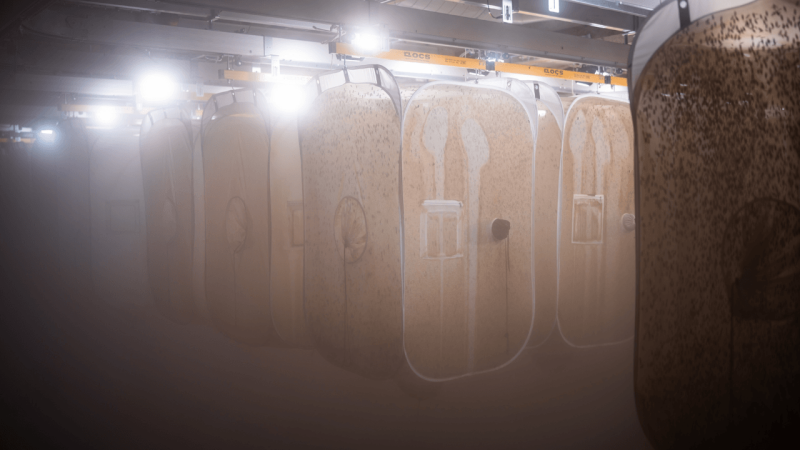
Finnish technology company Volare has completed Volare 01, its first industrial-scale protein factory in Pori, Finland. The 10,000-square-metre facility targets to produce up to 5,000 tonnes of insect protein and 2,000 tonnes of insect oil annually from food-industry side streams.
Volare 01 represents a 1,000x scale-up from the company’s demonstration plant, using the same process proven through four years of commercial production. The facility was delivered on schedule and within its €15 million CAPEX budget. I spoke to Jarna Hyvönen, CEO and co-founder of Volare, to learn more.
“Volare 01 proves that our technology and production model work at industrial scale,” she says.
“We delivered the factory on schedule and on budget, demonstrating our ability to build production capacity cost-effectively and laying a strong foundation for further growth.”
The circular economy opportunity in insect protein
Founded in 2021, Volare has taken technology originating from research at VTT Technical Research Centre of Finland to industrial scale in just five years.
Co-founder and CSO Tuure Parviainen, an agronomist, previously researched biomass at the University of Helsinki and worked in the biogas industry.
Co-founder and CTO Matti Tähtinen, an engineer by training, worked on energy and circular economy research at VTT. Together, they explored ways to extract greater value from industrial side streams and produce alternative proteins, eventually identifying the black soldier fly as a promising solution.
Jarna Hyvönen joined the founding team with a circular-economy background, having previously worked at Finland’s largest waste management company, where she developed new services, including initiatives to reduce food waste in restaurants.
Volare uses black soldier flies (Hermetia illucens) to convert food-industry side streams into sustainable insect protein, oil, and fertiliser. Its proprietary production process, from larvae rearing to finished ingredients, reduces waste, supports regional agriculture, and strengthens Europe’s food system resilience and self-sufficiency.
Hyvönen admits, “There’s a strong rationale for doing what we’re doing, but it’s not easy. In this world, it’s still easier to use linear models than circular ones because you have to solve a lot of problems at once. I think we’ve managed that very well so far.”
Why insect protein startups have struggled to scale
Europe’s insect protein industry has suffered a series of high-profile failures despite attracting hundreds of millions of euros in investment.
French startup Ÿnsect, once considered a flagship of the sector, raised more than €600 million before being placed into judicial liquidation in 2025 — The French government identified technical difficulties, factory construction delays, cost overruns, and commercial setbacks as contributing factors.
Denmark’s ENORM, which raised €50 million in 2022 to develop a large-scale black soldier fly facility, was declared bankrupt on 30 October 2025 after a failed restructuring process.
Germany’s FarmInsect is another example of the challenges facing the sector. Founded in 2020, the Munich-based startup developed a decentralised model that enabled farmers to rear black soldier fly larvae on-site using agricultural waste. The company raised €8 million in 2023 to scale its technology.
However, despite attracting approximately €16.2 million in equity investment and public funding since its founding, FarmInsect entered insolvency proceedings in 2026 and subsequently ceased operations after failing to secure a buyer. Its financial difficulties were compounded by high production costs, low prices for competing proteins such as soy and fishmeal, and delays in financing. The closure highlighted the difficulty of making insect protein commercially competitive, even with a decentralised production model designed to reduce capital expenditure.
As Hyvönen notes, many of these things are company-specific rather than endemic of an entire industry:
“You have to succeed in so many different areas, and it hasn’t been easy for us either. You need customer buy-in and relationships with customers who are ready to purchase your product.
The regulation needs to be there, which it wasn’t before 2017. You also need technology that makes sense, the ability to execute, and the science.
You need many different skills within the organisation from the very beginning, and people who take ownership of what they do. That’s what makes it quite hard.
I think some companies failed in one of these areas, which then turned into much bigger problems.”
Turning an old printing house into a protein factory
Volare 01 was built inside a former newspaper printing facility rather than from the ground up, in just nine months, keeping capital expenditure to a minimum. “It probably saved us at least a year compared with building a new facility,” shared Hyvönen
“Printing houses also have very sturdy floors designed for large machinery, so they work quite nicely for our purposes.”
Three factors behind Volare’s production efficiency
According to Hyvönen, Volare’s production efficiency comes down to three key factors: the natural efficiency of the black soldier fly, VTT’s research expertise, and the company’s decision to retain control over its industrial processes.
“First, we’re using an organism that nature has already made extremely efficient. There’s a reason so many companies work with the black soldier fly. We’ve also developed our own strain, adapted to the specific side streams we use.”
The second advantage comes from Volare’s origins as a VTT spin-off. The research institute has decades of experience developing food and feed ingredients and processing technologies, which Volare has incorporated into its production model, including selecting and developing individual processes. The third factor is the company’s hands-on approach to industrialisation.
“For our first industrial-scale factory, we haven’t brought in external consultants for project management or engineering. We work with suppliers, of course, but we keep project control in-house.
That gives us much greater control over costs, from capital expenditure to how the factory will operate. When you’re building a factory for the first time, nobody else is going to know exactly how it should run.”
Volare’s production model requires four to ten times less capital expenditure, approximately 50 per cent fewer employees, and 30 per cent less energy in end-product processing than competing insect protein producers.
From demonstration to industrial-scale production
Much of Volare’s technology is based on smaller, modular units that can be replicated as production scales. This has allowed the company to validate its processes over several years rather than attempting to scale untested technology.
The demonstration factory ran continuously for more than four years before moving to Volare’s new industrial facility, where it remains operational. Although considerably smaller than the new factory, it uses the same underlying production principles and provided the team with crucial hands-on experience:
“You can test, refine, and optimise every detail of the process,” said Hyvöne.
“A one per cent gain in efficiency becomes much more significant when you’re operating at industrial scale.”
The demonstration factory also allowed Volare to showcase its technology, host potential customers, and supply product samples for testing and commercial launches.
“We’ve been able to show customers exactly what we’re doing, invite them to see the process firsthand, and provide samples they can test and use in commercial products.”
A 10,000-square-metre factory run by four people
The factory is designed to operate with just four people per shift, using automation and existing industrial technologies to simplify operations. Integrating the different unit processes is also key.
“Our factory is approximately 10,000 square metres, and it can be operated by four people per shift. That’s how it was designed.
It’s a big area for a four-person team, and that’s a significant difference between us and many of our earlier competitors. We measure what takes time rather than simply accepting existing ways of doing things,” shared Hyvönen.
Further, Volare has designed its production processes to run entirely on electricity rather than natural gas or other fossil fuels.
“One thing I appreciated when I joined my co-founders was their fundamental thinking about how industry should be built in the future. We firmly believe that industry is moving towards electrification, which is why we’ve designed all our processes around electricity rather than natural gas or other alternatives,” explained Hyvönen.
Beyond its overall production model, Volare has developed patented technologies and proprietary production designs to improve efficiency and product quality. A key differentiator is its dry-processing approach, which Hyvönen says reduces energy consumption and production costs while maintaining high product quality.
“Our technology isn’t just about the overall production model.
We also have patents, our own production designs, and a dry-processing method that gives us high product quality while reducing energy costs.”
Rather than reinventing every stage of production, Volare combines established industrial technologies with its own innovations.
“It’s really about finding the right combination of existing technologies and our own innovations,” Hyvönen explained.
This efficiency comes with strong product performance: Volare’s protein meal delivers over 90 per cent digestibility and is already used commercially in aquafeeds, pet foods and poultry feeds.
Competing with soy and fishmeal
Cost has been one of the biggest barriers to scaling insect protein. Volare’s protein is locally produced from existing food-industry side streams rather than virgin materials.
According to the FAO’s 2026 report, 84.5 per cent of assessed marine fish stocks were either fished at their maximum sustainable level or overfished in 2023. Hyvönen explained:
“There’s no more fish in the sea, pretty much, that you could make fishmeal out of. Of course, this depends on the area, but overall, fishmeal production isn’t increasing. It’s a finite source of protein.”
During El Niño, some fishmeal-producing countries have restricted fishing seasons or quotas, which has driven price increases. Hyvönen added: “At the same time, industries using fishmeal are growing by perhaps five to ten per cent annually, while the amount of fishmeal available isn’t growing. So other sources of protein are needed.”
Winning over customers new to insect protein
Volare has built its initial customer base through partnerships with Nordic pet food manufacturers, many of which were experimenting with insect protein for the first time.
“Many pet food companies, especially smaller ones, have an entrepreneurial mindset. They’re interested in trying something new and being part of building something different. That’s been a great foundation for our partnerships,” explained Hyvönen.
The company now works with businesses of varying sizes. Volare’s protein has been used commercially since 2022, including in insect-based dog treats developed with Alvar Pet, Dagsmark’s (Vafo Group brand) insect-based cat food, and rainbow trout feed through a collaboration with Alltech Fennoaqua. Its protein has also been used in organic poultry feed.
A significant share of Volare 01’s production capacity has already been sold, with offtake agreements in place with for instance, Skretting, one of the world’s leading aquafeed companies, and a leading global chemical company.
Skretting has been testing Volare’s insect protein since the early stages of its partnership.
Volare has secured €7.1 million in new funding through Springvest, with backing from new and existing investors including Maki.vc, to support its first factory’s ramp-up and preparations for further facilities.
Scaling across Europe while staying focused
Now Volare is concentrating on bringing production up to capacity while laying the groundwork for further expansion across Europe and beyond.
“Our focus right now is commissioning and ramping up the first factory, but we’re already planning the next one. The goal is to replicate the model we’ve developed across Europe and beyond,” explained Hyvönen.
Despite opportunities to diversify, the company has no plans to explore alternative insects or protein sources.
“We’re convinced that the black soldier fly is the right choice. Of course, there are opportunities to develop new product lines, but we’re a small team, and we want to stay very focused.”
That discipline extends to how Volare approaches growth and investment.
“We have an industrial mindset. We want to build an industrial company, which means being sensible about spending money, focusing on operational efficiency, and delivering real value to customers.” The second factory is planned to have roughly five times the protein production capacity.
“Europe needs significantly more locally produced protein, and we have built a model that can deliver it efficiently and competitively,” Hyvönen says.
“Our next step is to replicate our model from Finland and bring more local, efficient protein production capacity to Europe and beyond.”