
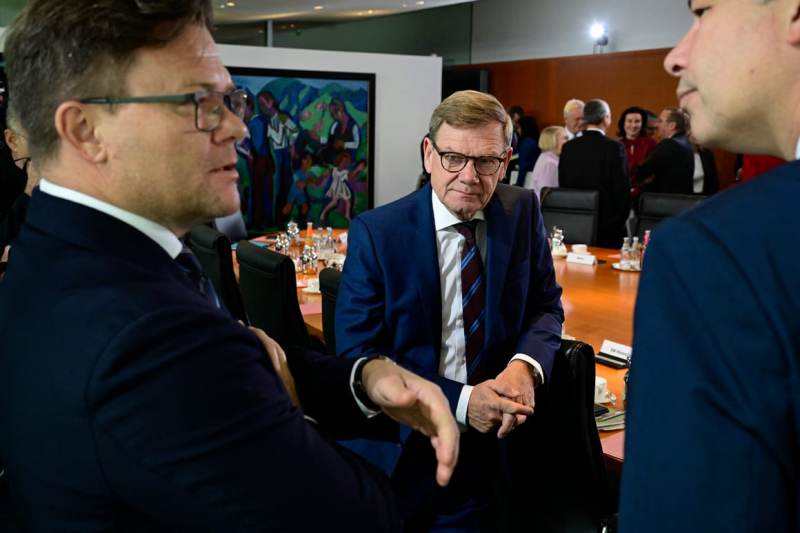

Germany’s foreign minister warns that Europe risks losing credibility in the Western Balkans.
BUDVA, Montenegro — German Foreign Minister Johann Wadephul urged EU countries on Thursday to deliver on enlargement promises to the Western Balkans, warning that the bloc’s credibility and its influence in the region are at stake.
“We are at a crossroads with the EU enlargement process,” Wadephul told reporters following a meeting in Montenegro held as part of the Berlin Process — in which EU and Western Balkan countries discuss economic integration and infrastructure in the region as well as reconciliation among the Balkan countries.
Wadephul argued that the EU had declared the Western Balkans belonged in the bloc at a summit in Thessaloniki in 2003. He added, in a critical assessment of Germany’s own efforts, that former Chancellor Angela Merkel launched the Berlin Process 11 years later, in 2014, to speed up the process, but that another 12 years later and there was still no success.
“We have not delivered,” the minister said, adding: “I would really urge everybody to show them that the promise of Thessaloniki was real, that we are credible, that Europe is reliable.”
Wadephul also referred to “geopolitical adversaries and rivals” vying with the EU for influence in the region — a thinly veiled reference to Russia and China. On Wednesday, Republika Srpska Prime Minister Savo Minić and his predecessor Milorad Dodik visited Russian President Vladimir Putin in Moscow, ahead of elections in Bosnia and Herzegovina on Sunday.
Austria’s foreign minister issued a similar warning: The EU must “understand that the clock is ticking. And the clock is ticking very quickly on a global scale. We can no longer afford to get bogged down in bureaucratic — and, until now, technocratic —processes,” Beate Meinl-Reisinger told POLITICO in an interview.
“If we give any leeway — even just a millimeter — other foreign powers will be here in a flash and will take advantage of it,” she said.
Montenegro is on the frontline of EU enlargement, aiming to become the bloc’s 28th member in 2028. EU Enlargement Commissioner Marta Kos has praised the reform efforts of the country, saying that 18 of the 33 EU accession chapters had already been closed and that “several more” were expected to follow this month.
“There is a realistic chance that Montenegro will conclude negotiations by the end of the year or early next year,” she said, even though ratification would then take another one to two years.
Montenegro’s Foreign Affairs Minister Ervin Ibrahimović told reporters that his government had undertaken many reforms, adding that his citizens must now also be able to reap the benefits of EU membership.
“To be honest, we deserve to be admitted now,” Ibrahimović said.