
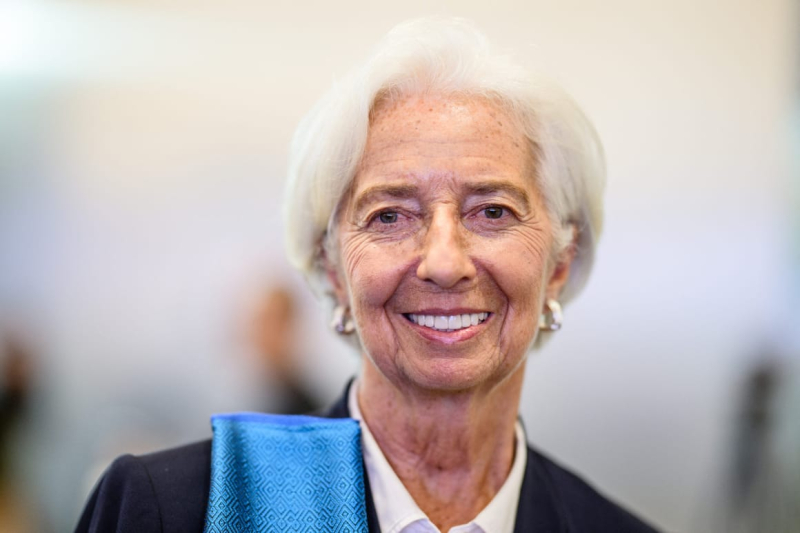

The ECB chief is set to wade back into French politics as her centrist rivals fail to stop the momentum of left- and right-wing populists.
Christine Lagarde said she will step down as president of the European Central Bank on Feb. 7, creating a vacancy at the top of one of Europe’s most powerful institutions and fueling further speculation about a possible return to French politics.
An official familiar with Lagarde’s thinking, granted anonymity to discuss a sensitive matter, said she made her move now, almost a full year before the end of her term, to have “greater freedom to express her views and to engage in non-monetary matters, because she cannot remain neutral when she sees the developments taking place in her own country and in the world.”
The ECB said in a statement only that Lagarde had informed European Council President António Costa of the decision earlier on Thursday.
The announcement clears the way for a package deal among EU capitals over at least three appointments to the ECB’s six-strong Executive Board. Isabel Schnabel, head of the Bank’s markets department, is due to leave in January to take a senior role at the International Monetary Fund, while Philip Lane is due to depart the influential chief economist’s position in May.
Negotiations over the appointments are likely to be intense, given the ECB’s vital influence in international markets, and the never-ending pressure on European government finances. Former Dutch central bank chief Klaas Knot and Spain’s Pablo Hernández de Cos, who heads the Bank for International Settlements, are seen as the two frontrunners in the race for the top job. German Chancellor Friedrich Merz said a decision would be taken by year-end.
The timing of the announcement means that President Emmanuel Macron will have a say in choosing Lagarde’s successor before he himself leaves office next spring. Marine Le Pen, the National Rally leader and a longtime critic of the EU, is currently well ahead in the polls to win the French presidency, and may take a radically different view about who should lead the ECB.
“The EU is trying to guard at least somewhat against the risk that right-wing Marine Le Pen may win the French presidential election,” said Berenberg Bank’s head of research Holger Schmieding.
Jean-Luc Mélenchon, leader of the hard-left France Unbowed party, protested that Macron had already engineered a similar situation at the Bank of France, where François Villeroy de Galhau’s early departure “allowed Macron to install his assistant,” Emmanuel Moulin, as governor.
Speculation has long swirled that Lagarde, formerly finance minister under President Nicolas Sarkozy, may throw herself back into French politics. She has stressed the need for “a pro-European voice” in the French elections, while still being consistently coy about running herself. Thursday’s announcement comes at a time when candidates from mainstream camps in France are all losing ground to Mélenchon, who wants the ECB to “set fire” to its French debt holdings. None looks likely to make the final round of the presidential election in May.
Whoever follows her as ECB president will inherit an increasingly tense situation in Europe’s bond markets, where borrowing costs are hitting their highest level in years due to a cocktail of war-fueled inflation, demographics and competition from capital from Big Tech companies chasing AI-related riches.
The problems are particularly acute in France, the eurozone’s second-largest economy, which faces a political impasse and mounting pressure over its public debt.
Lagarde succeeded Mario Draghi at the ECB in 2019, after leading the International Monetary Fund and, in her time in office, has been a stalwart of the centrist mainstream that is now being squeezed by both wings of the political spectrum across Europe.
“Christine Lagarde has led the European Central Bank through difficult times,” German finance minister Lars Klingbeil said in a statement. “Under her leadership, the ECB has kept the euro stable even during crises: when the coronavirus pandemic hit Europe hard, when Russia invaded Ukraine, and most recently in the face of the economic shocks caused by the war in Iran.”
“Christine Lagarde’s tenure at the helm of the ECB has only strengthened the confidence in the European single currency,” Eurogroup President Kyriakos Pierrakakis said in a statement, promising to give the council a “swift” recommendation on the succession to heads of government.
The ECB gave no details about Lagarde’s plans after leaving Frankfurt. However, she has talked to the World Economic Forum about taking over as chair, according to its founder Klaus Schwab. Reuters reported that the organizer of Davos could announce her appointment as early as this month.
“I leave this institution with a sense of good work done, and an ECB that is fit for the future,” Lagarde said in a video post on LinkedIn.
This story has been updated. Giorgio Leali contributed reporting.