
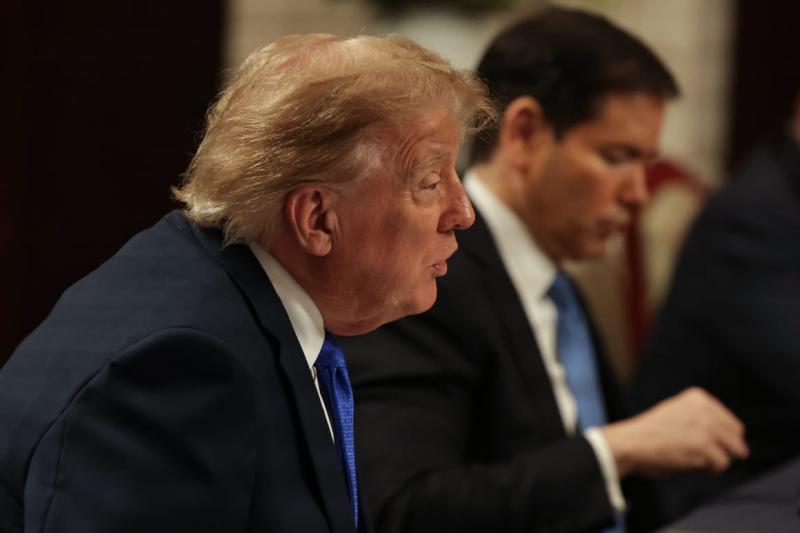

The U.S. president followed up his meeting with Russian and Chinese leaders with a surprise call to Berlin.
BERLIN — U.S. President Donald Trump told Ukraine’s European allies on Thursday they could save money as well as lives by ending the war with Russia, according to five European officials who were briefed on the discussion.
In a call from Air Force One on his way home from meeting with Russian President Vladimir Putin, Trump lamented what he characterized as the waste of billions to provide Ukraine with weapons and cash for a conflict that is killing so many people, according to three of the European officials, who were granted anonymity to describe a private meeting.
Hours after concluding his encounters with the Russian leader and Chinese President Xi Jinping in Shenzhen, China, Trump had one message for the leaders gathered in Berlin: Putin is serious about negotiating a peace deal with Ukraine.
Momentum for a peace deal has grown in recent weeks after a flurry of diplomatic activity and intensive talks in Europe, Russia and the Middle East. Trump’s meeting in China with Xi and Putin alarmed some of Ukraine’s allies and raised fears that the U.S. president could be won over to the Russian argument that Ukraine and its European supporters have prolonged the war, which began with Russia’s 2022 invasion.
Some of the officials familiar with the call described Trump’s tone as strongly critical of Europe’s ongoing support for Kyiv, while others said he was just communicating in his usual forthright style. One person briefed on the call said the president had merely emphasized how much all countries could save if the war ended and Europe no longer had to pay for aid to Ukraine.
A U.S. official briefed on the call said any suggestion that Trump had told leaders to stop funding Ukraine was “not accurate.” The president was making his long-held view clear that he “wants to bring this conflict to a close,” the official said.
A White House official rejected characterizations of the call as critical of Europeans, saying: “President Trump called into the Coalition of the Willing meeting today and was super upbeat about the prospects for peace and praised the leaders in the room. The President emphasized that the war is extremely costly in terms of human life and financing, and everyone should all be striving for peace because it will save lives and money that can be invested in our countries’ own defenses and prosperity.”
Trump’s argument was that if the war ends, European governments could be spending their money on rebuilding Ukraine or on their own people, the U.S. official said. The president sounded “optimistic” about the prospects for peace and praised the European leaders on the call for their efforts, the official added.
When asked at a press conference following the coalition meeting in Berlin whether Trump held too rosy a view of Putin’s desire to end the war, U.K. Prime Minister Andy Burnham said it was “quite the opposite” and that Trump had talked about the “horrific” loss of life in the nearly five-year war.
Trump envoy Steve Witkoff, who attended along with Trump’s son-in-law Jared Kushner, said the U.S. president had “adamantly supported” a peaceful end to this war and this had been his message to Putin and Xi.
“He sent Jared and I here specifically to be a part of the Coalition of the Willing, and he’s given us instructions on doing everything possible to end this war and be supportive of that effort,” Witkoff told reporters in Berlin. “And what I heard from him on the call today, was that he mentioned these very same principles to the other two leaders he was meeting with.”
Kushner emphasized that Trump wanted to make a deal with Europe fully involved in the process and had asked the two U.S. envoys to travel to Berlin to “reassure people” about that. The next talks will involve Europe joining Ukraine, Russia and the U.S. at the negotiating table, Kushner said.
He added that Putin is now ready to accept the notion of security guarantees for Ukraine similar to NATO’s Article 5 — a mutual defense pledge by allies to help defend each other if one of them is attacked.
Speaking to reporters later, Ukrainian President Volodymyr Zelenskyy said he was “not sure” all sides had the same understanding of Article 5 as he did. “Because what does it mean, Article 5? That there are some forces of partners on your land. So, my question is: What about American soldiers?” He said Ukraine “would be happy” if the U.S. would put bases in Ukraine “like in the Middle East.”
Germany Chancellor Friedrich Merz said at the press conference, however, that Europe is providing funding for Ukrainian defense “to enable peace negotiations in the first place and to conduct them from a position of strength.”
Merz added: “We are not providing this strong support to prolong the war. We want to end this war.”
Poland’s Prime Minister Donald Tusk said Trump’s faith in Putin’s goodwill was “unshakeable” but added that he hoped this time it proved to be well-founded.
“We had a call with President Trump, who was just leaving China,” Tusk said in Berlin after the coalition meeting. “He shared his impressions of his meetings with Presidents Xi and Putin and made some remarks that sounded fairly optimistic, although I have to say they were received in the room with very cautious optimism when it comes to Putin’s and Moscow’s intentions regarding peace talks.”
“But I have to say, I’ve heard this very often from President Trump. I mean, his belief in Putin’s goodwill seems unshakable, even though so far there are no facts to support it. But it would be nice, it would be good, if it really turned out, sooner or later, that Russia was genuinely ready to engage in peace talks.”
This article has been updated with additional details. Alex Gangitano contributed to this report from Washington, James Angelos contributed from Berlin and Bartosz Brzeziński contributed from Brussels.