

Contents
- 1 Scaling across Europe after Bundeswehr launch
- 2 Drone warfare is reshaping defence economics
- 3 The cost asymmetry driving urgent procurement
- 4 Scaling production for rapid deployment
- 5 Why European defence supply chains are being rebuilt
- 6 Counter-drone defence as a coordination problem, not a hardware race
- 7 A fragmented market moving toward integration
- 8 When swarms become the norm: defence as a coordination problem
- 9 Autonomy on both sides of the battlefield
- 10 Rebalancing the air defence stack for the drone era
Munich-based counter-drone company opens a 2,000-square-metre site to boost interceptor output, enters a Dutch defence programme, and partners with DeltaQuad to strengthen EU supply chains
Today, counter-drone defence technology company Alpine Eagle announced it is scaling production of its Sentinel system.
Alpine Eagle develops counter-drone (counter-UAS) systems designed to detect, track, and neutralise hostile drones, including increasingly sophisticated autonomous swarms.
Its technology combines multiple sensing modalities —such as radar, radio-frequency scanning, and optical or infrared cameras — to identify aerial threats early, classify them using AI, and monitor behaviour in real time. Rather than relying on a single interception tool, the system fuses these inputs into a unified operational picture, enabling faster, more precise responses.
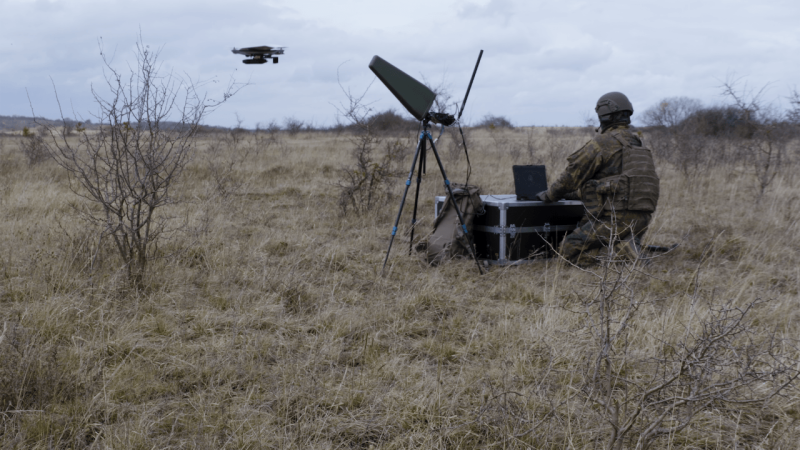
Central to this approach is Sentinel, the company’s flagship platform. A software-defined, layered defence system, Sentinel integrates sensing and interception into a single operational network. It combines Alpine Eagle’s airborne radar and sensor network with a scalable defence architecture to track threats across wide areas and neutralise them using airborne interceptors.
Alpine Eagle is now participating in a defence innovation programme in the Netherlands, and over the past year, it has also conducted counter-drone trials in Ukraine and participated in Project Vanaheim, a counter-UAS trial involving the US and UK armed forces.
To understand the company’s growth and positioning, I spoke to Jan-Hendrik Boelens, co-founder and CEO of Alpine Eagle.
Scaling across Europe after Bundeswehr launch
The company has seen accelerating demand across Europe. Sentinel was first deployed with the German Bundeswehr in 2024 as a launch customer, and Alpine Eagle has since secured contracts with three new European customers and has expanded to the UK and the Netherlands.
Alpine Eagle has expanded its team from 12 employees in 2024 to 50 in 2026, with plans to reach 100 employees this year as production scales.
Drone warfare is reshaping defence economics
Drone warfare reshapes modern air defence — from Ukraine to the Middle East — driving governments to prioritise systems that can be produced and deployed at scale and at lower costs than legacy defence platforms.
For Boelens, Ukraine has been the proving ground.
“It has shown what large-scale, drone-saturated warfare actually looks like and how quickly existing air defence systems can be stretched. The Middle East escalation is reinforcing that lesson in real time, particularly around the economic imbalance of defending against large volumes of low-cost drones.”
At the same time, Europe is increasingly seeing drone incursions around critical infrastructure, airports and military sites.
“That’s turning what was once seen as a battlefield problem into a domestic security issue.”
Alpine Eagle’s technology has already been tested in operationally relevant environments, including trials conducted in Ukraine, where counter-drone systems face constant pressure from mass drone attacks and must function reliably under disrupted GPS conditions.
The cost asymmetry driving urgent procurement
Recent conflicts have underscored the urgency of scalable counter-drone capability. Large-scale drone strikes in Ukraine and across the Gulf show how inexpensive drones can overwhelm traditional air-defence systems and force defenders to expend far more costly interceptors.
In recent attacks in the Middle East, analysts estimate that defenders spent over $1.5 billion intercepting drones that attackers may have cost around $250 million to launch. This imbalance is accelerating demand for systems designed to counter large volumes of low-cost threats. Together, these dynamics are driving a shift from experimentation to procurement. Governments are no longer asking if they need counter-drone capability, but how quickly they can deploy it at scale.
Scaling production for rapid deployment
According to Boelens, defence ministries are increasingly looking for systems that can be delivered quickly and scaled as operational demand grows.
To support scalable production, Alpine Eagle integrates its technology with the DeltaQuad Evo, a UAV platform developed by Dutch manufacturer DeltaQuad.
The partnership gives Alpine Eagle immediate access to industrial-scale manufacturing capacity while reinforcing a resilient European supply chain. By combining proven hardware with its proprietary sensing and defence software, the company can deliver deployable counter-drone systems significantly faster than traditional defence programmes.
“We integrate the DeltaQuad Evo UAV platform, produced by our partner DeltaQuad,” shared Boelens.
“This means the facilities, permits, and production processes are already in place in the Netherlands. As a result, we can scale output rapidly — from several hundred units to more than a thousand per month.”
Alpine Eagle can deliver operational capability within approximately four weeks of contract signature. This is enabled by a robust supply chain and strong component availability, combined with systems designed for rapid deployment. With a small footprint, self-sustaining logistics, and minimal training requirements, customers can move from delivery to operational use almost immediately.
“Rapidly deployable, for us, means weeks — not months,” explained Boelens.
“With supply chains secured and production ready, we can deliver within around four weeks of contract signature, and systems can be brought into operation almost immediately with minimal training.”
The company is also planning to open a 2,000-square-metre production facility for its own-developed interceptor near Munich, supporting its next phase of industrial scaling.
Why European defence supply chains are being rebuilt
Alpine Eagle has made European supply chain sovereignty a core strategic priority, deliberately sourcing and manufacturing a significant share of its system within Europe.
Boelens shared:
“Wherever possible, we prioritise European partners across our supply chain. That’s a deliberate choice.”
The shift reflects a broader recalibration across the defence ecosystem, as recent shocks — from COVID-19 disruptions to the war in Ukraine, rising trade tensions, and the expanding conflict in the Middle East — have exposed the fragility of global supply chains.
Counter-drone defence as a coordination problem, not a hardware race
What sets Alpine Eagle apart is its software-defined, networked approach to defence. Instead of treating counter-drone protection as a standalone hardware problem, the company frames it as a coordination challenge, linking distributed sensors, AI-driven decision systems, and response mechanisms into a scalable defence network. This allows it to handle large volumes of simultaneous threats, particularly in swarm scenarios where autonomy exists on both sides.
With multiple players in the counter-drone space — both incumbents and startups — Boelens sees Alpine Eagle’s biggest advance as a combination of software and speed of deployment, rather than any single factor.
The core challenge in counter-drone defence is not just intercepting a single threat, but managing large volumes of targets in real time. That requires software that can fuse sensor data, prioritise threats and coordinate responses across systems.
At the same time, defence customers increasingly need solutions that can be deployed quickly.
“By building on existing hardware platforms and focusing our innovation on the software and sensing layer, we can field systems faster than traditional defence programmes.”
A fragmented market moving toward integration
According to Boelens, the counter-drone market is still highly fragmented. He explained, “You have companies focusing on individual components — sensors, electronic warfare, interceptors — and others building more integrated systems. That reflects how quickly the space has evolved and how many different approaches are being tested in parallel.”
In the near term, Alpine Eagle expects continued proliferation, particularly as new technologies are validated in Ukraine and other operational environments.
Over time, though, Boelens predicts there will likely be consolidation around integrated architectures.
“Counter-drone defence is ultimately a systems problem — detection, tracking, decision-making and interception all need to work together seamlessly. Alpine Eagle’s focus is on that system layer: building an architecture that can integrate sensors and effectors into a coherent, scalable network.”
When swarms become the norm: defence as a coordination problem
As drone warfare evolves toward fully autonomous, AI-coordinated swarms, counter-drone defence is shifting from hardware to systems-level thinking—where coordination, speed, and scale matter more than any single platform. Boelens argues that the challenge fundamentally changes in nature.
“It becomes a network problem rather than a platform problem.”
Defending against autonomous swarms requires the ability to detect, classify, and respond to large volumes of coordinated threats simultaneously, often with minimal human intervention. This demands distributed sensing, real-time data fusion, and AI-supported decision-making operating in parallel.
“No single interceptor or sensor will solve that challenge. You need layered, software-defined networks that can scale across large areas and adapt in real time.”
Autonomy on both sides of the battlefield
As autonomy advances, it will define both sides of the battlefield—offence and defence alike—raising the stakes on coordination and system integration. “Autonomy will exist on both sides.
The advantage will come from how effectively systems can coordinate at scale.”
As counter-drone technologies mature, the question for Boelens is not which systems disappear, but how the air defence stack is rebalanced.
Rebalancing the air defence stack for the drone era
Rather than rendering existing systems obsolete, Boelens argues the shift will redefine their role within a layered architecture.
“It’s less about systems becoming obsolete and more about how they are used.”
High-end air defence platforms such as Patriot or THAAD will remain critical for countering aircraft, cruise missiles, and ballistic threats. But they are fundamentally ill-suited — both technically and economically — to address large volumes of small, low-cost drones.
“Using multi-million-dollar interceptors against low-cost drones is not sustainable at scale.
What changes, then, is not the relevance of these systems, but the burden placed on them. Tasks they were never designed for—such as countering drone swarms — will increasingly be offloaded to new, lower-cost layers.
In the future, high-end systems will be complemented by scalable counter-drone layers, allowing them to focus on the threats they were built to defeat.”
Boelens concludes:
“I’m incredibly proud of what the Alpine Eagle team has achieved over the past year. The reality is that threats facing Europe are higher than they have been for decades and drones are transforming the battlefield faster than traditional defence systems can adapt.
Our mission is to ensure democracies have the tools they need to defend their airspace in this new era of warfare.”