

Contents
KidsHustle connects teenagers with local paid work through a parent-led marketplace, bringing the age-old teenage side hustle into the digital era.
When I was a young teenager, I was in Girl Guides — essentially the Australian equivalent of Girl Scouts — and went to a school that strongly encouraged civic participation. So I duly knocked on strangers’ doors, offering to do odd jobs and asking for sponsorship for various fundraising efforts. These included the 40 Hour Famine (world hunger) — and the MS Readathon (Multiple Sclerosis). I also did odd jobs in my Girl Guide uniform, like walking and washing dogs.
At the time, nobody seemed to think twice about it from a safety perspective. I think about the potential safety risks now, and I cringe.
From doorstep jobs to a marketplace
Sasha Bagrov is the 14-year-old founder and CEO of KidsHustle, the UK’s first iOS marketplace for teenage employment. He began coding at age 9, had software on the App Store by 12, and spent three years building KidsHustle before its launch in April 2026.
He is a Year 10 student at Hampton School in London.
The idea for KidsHustle came about when his family had a couple of teenagers come to their front door and ask if they could wash their car.
“I was sitting there thinking: they’re going around without their parents, they’re dealing in cash, and their parents have no idea where they are.
They were about 13 or 14, around the same age as me. I just thought, this is so unsafe. What if there were a better way to do this where we could provide safety and financial security?”
KidsHustle is targeting the UK’s 3.6 million teenagers aged 13–17, representing an estimated £1.2 billion casual labour market that remains entirely unplatformed. Every major gig economy platform — TaskRabbit, Fiverr, Airtasker — requires users to be at least 18.
KidsHustle is the first platform to build verified, compliant infrastructure for this market across the UK and Europe.
According to Bagrov, there’s clearly a market of teenagers who want to be entrepreneurial and earn money. But many of the existing entry points lack safeguards and involve posting something in a Telegram or WhatsApp group.
How the platform works
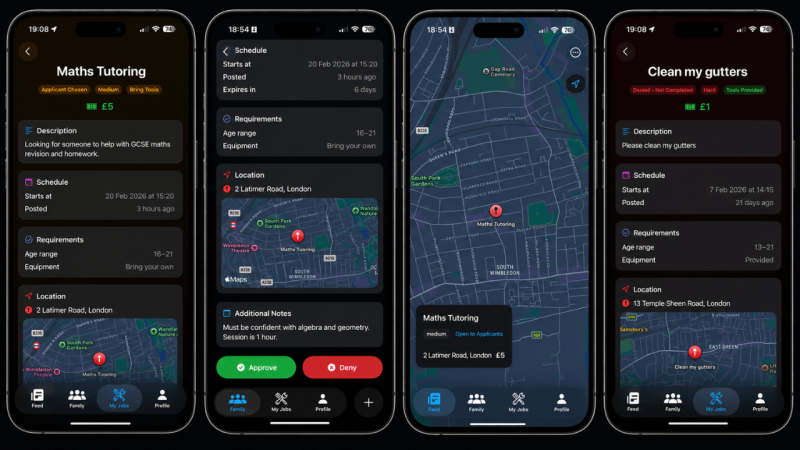
KidsHustle connects teenagers with local paid jobs while keeping parents involved throughout the process. Jobs include gardening, babysitting, dog walking, tutoring, and tech help. A parent creates a Stripe-verified account and posts a job with the task, pay, and location. Teens browse nearby opportunities on a map, with parents retaining approval over applications.
Once a job begins, the teen checks in using a QR code, triggering live GPS sharing with their parent for the duration of the job.
When the work is completed, payment is released from escrow, and the teen receives a CV-ready reference. KidsHustle charges the job owner a service fee on top of the job price, meaning the teenager receives the full amount they were promised.
Keeping parents in the loop
Safety is embedded throughout the platform. Bagrov explained:
“We’re keeping the parent involved before the job owner can see who the teenager is. Once the teenager applies, the job owner can see things like their statistics and reviews, so we want the parent to have approved that first.”
If the parent approves it, the teenager then appears on the job owner’s applicant list. The job owner can approve or deny the application and assess whether the applicant is a good fit.
One of the problems KidsHustle wanted to solve was, “How do we know if a teenager is at the right house? How do we know they’ve gone to the correct person?”
When the teenager arrives, they have to scan a unique QR code belonging to the job owner. That verifies that they’re at the right place. Once they’ve scanned the correct QR code, live location tracking for their parent begins.
KidsHustle also has a geolocation feature coming soon. If the teenager leaves a predefined area, it can send a notification to their parent and activate other safety features.
Once the teenager completes the job, the platform asks them to take photos of the finished work, which the job owner can review.
“That gives us a paper trail of what happened. If there’s a dispute, we have concrete evidence that the work was completed. We also have a system that can review the evidence and provide a confidence score on how well the teenager completed the job,” explained Bagrov.
Can AI decide which jobs are safe for a 14-year-old?
One of KidsHustle’s main uses of AI is content safety. When a job is posted, Google Gemini assesses whether it is appropriate for the teenager’s age.
“For example, let’s say you’re moving house and want someone to help you move boxes. If the target demographic is 14-year-olds and they’re going to be moving heavy boxes, Gemini could identify that as a safety risk and deny the job,” explained Bagrov.
The company previously used less contextual models, but found they were less effective at identifying risks that might be obvious to a human. Parcel deliveries are one example:
“You can’t guarantee what’s inside that parcel. Gemini can identify that context and filter out those jobs.”
Parents are required to complete ID verification and KYC. At the same time, KidsHustle says it has completed a Data Protection Impact Assessment and complies with GDPR and the Children’s Code, including minimising the data collected from minors.
“We don’t try to upsell anything to them, and we use less promotional user interfaces,” said Bagrov.
Teenagers also have in-app safety buttons that allow them to quickly call 999 or contact the safety team during a job, and users, jobs, reviews, and locations can all be reported. So far there have been no safety incidents on the platform.
Building a startup around school
By the time KidsHustle launched, Bagrov had spent roughly three years building it around his school commitments, developing most of the platform himself with occasional back-end help from his friend Gabriel.
“I’ve wanted to rebuild it so many times because I’m constantly iterating. I’m always thinking: could this be faster? Could this be better? Is this efficient? Is this clear? We also have analytics software that lets us gauge what users are doing live.”
Balancing work and school is a challenge. During term, development slows as Bagrov fits KidsHustle around homework, working on it after school and at weekends.
“School and KidsHustle kind of revolve around each other,” he explained.
“Sometimes I’m on the school coach doing stuff because that’s 40 minutes that I don’t want to waste. It’s useful time.”
Bagrov admits that his friends aren’t entrepreneurs, but they are supportive.
“I do a lot of theatre tech at school — lighting, sound and stage management. I spend a lot of time in the theatre, and it’s quite a techie group. They’re supportive because they understand that this is something I want to do and something I find really fun.”
Organic traction, fundraising, and GCSEs
The platform is seeing organic growth with teenagers. Then through its user acquisition funnel, it also acquires parents because the teenagers need their parents to sign up.
“The parents are the ones who post the jobs, so either way we’re bringing in both the demand and supply sides of the marketplace,” he explained.
Bagrov is now looking to raise £500,000 in pre-seed funding to grow KidsHustle into a profitable business and bring more people onto the team. But building a startup still has to fit around school — and his upcoming GCSEs.
“This app is very personal to me because it’s pretty much how I learned to code. All the technologies and platforms I know have come from building KidsHustle,” he said.
That learning has sometimes been very hands-on:
“For example, learning about servers has come from our servers being down at 3 am. It’s a very deeply personal product for me because I’ve learned so much from it, just from a technology perspective.”
When you’re too young for LinkedIn
Some of the biggest challenges for Bagrov stem from being a founder under 18, which he admits makes things “really complicated.”
It’s a problem I saw firsthand when Bagrov was removed from LinkedIn for being underage — I found out via a message from his dad in my inbox.
Bagrov argues that much of the legal and regulatory framework isn’t designed with young entrepreneurs in mind.
“We want to fill that gap. Some teenagers want to earn money, become entrepreneurs, and start businesses, but legally they can’t do much. There are too many roadblocks.”
Those barriers extend beyond entrepreneurship to the relative lack of employment opportunities for younger teenagers.
“Even people I know — my friends — want to earn money. But where can they do that? If you Google how to earn money now, you get things like dropshipping or making different physical products.
They can be good businesses, but they’re not necessarily sustainable in the long term. If you get a massive supplier involved and have to sign a contract, for example, what do you do then when you’re under 18?”