
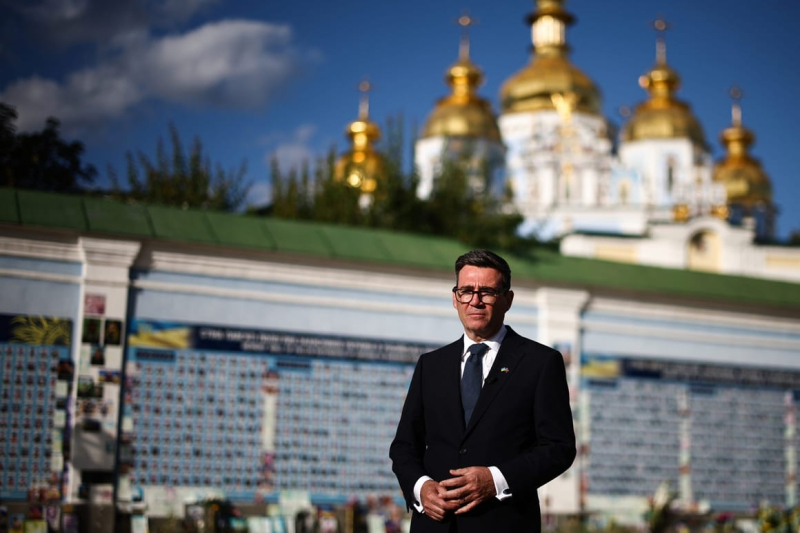

The new British prime minister was the only E3 leader in Kyiv on Monday as he announced a new Anglo-French partnership.
LONDON — Andy Burnham has opted to deepen Britain’s support for Ukraine by boosting their ability to develop long-range missiles, in his first major move on foreign policy since becoming prime minister.
To mark the PM’s visit to Ukraine — his first overseas trip since taking office last month —Downing Street announced that the U.K. government will allow European defense company MBDA to declassify information about British-made components of the Anglo-French Storm Shadow/SCALP missiles in order to help Ukraine build its own version.
The missile initiative puts pressure on German Chancellor Friedrich Merz, who had called for German-Swedish Taurus cruise missiles to be given to Ukraine while he was in opposition, only to backtrack after taking office — and who opted out of attending Independence Day festivities in Kyiv on Monday.
The trip gave Burnham his first chance to show his commitment to the Coalition of the Willing — a grouping of Ukraine’s allies championed by his predecessor, Keir Starmer — as he co-chaired its latest meeting with French President Emmanuel Macron.
Burnham was allowed to enjoy the limelight as the only E3 leader to attend the session in person, with Macron hosting Saudi Arabia’s Mohammed bin Salman and Merz attending to a domestic crisis.
Sitting alongside Volodymyr Zelenskyy, Burnham said Russian threats against the U.K. will not deter him and show British assistance is having an impact.
The British PM said: “It’s clear Russia is running out of options so Putin is now hoping he can win through a campaign of terror using ballistic missiles against Ukrainian civilians.”
The new agreement on missiles is unlikely to have any short-term impact on Russia’s war against Ukraine, but represents a gradual shift in the U.K.’s posture towards deeper cooperation with Kyiv and sharper confrontation with Moscow.
Burnham has also signed a deal allowing the U.K. to access Ukraine’s Avengers AI lab, allowing both sides to collaborate on the development of new battlefield technology, using sensors and cameras to capture and collate information on objects such as tanks, artillery, air defense systems and drone targets.
Speaking in front of St. Sofia Cathedral in Kyiv to mark the 35th anniversary of the nation’s independence, Burnham said: “This is the moment to keep up the pressure on Russia, the moment to squeeze their ability to fund this illegal war.”
He vowed that “despite Russia’s outrageous threats to my country we will continue our support for Ukraine.”
Turning up the temperature
Germany’s Merz is facing fresh criticism of his stance from within his own parliamentary group, from his coalition partner, and from the opposition. “It’s a clear sign that both countries are no longer waiting for Germany or relying on Germany in this matter,” CDU/CSU foreign policy politician Roderich Kiesewetter told POLITICO.
He added that the British-French initiative was “a call to Germany that, unfortunately, will once again have no effect and also highlights our limited credibility.”
Merz most recently justified his refusal to supply Taurus missiles during a government question session in the Bundestag in March, stating that his support for the idea, expressed while he was in the opposition, had been made “in a different context” — specifically, when Germany had more Taurus missiles for its own defense.
Yet the move comes at a particularly fraught moment for British relations with Russia, after The Times reports that Moscow has withdrawn its ambassador in London without appointing a replacement.
Asked about the decision on British missile technology, Kremlin spokesman Dmitry Peskov accused Britain of “methodically and regularly adding fuel to the fire and methodically and regularly plotting to prevent any progress in the peace process.”
Al Carns, a Labour MP who resigned as U.K. armed forces minister earlier this summer over defense funding, told POLITICO the announcement is “a welcome step forward” but should not be seen as an “escalation.” He suggested it is the equivalent of Iran sharing drone technology with Russia.
John Foreman, a former U.K. defense attaché to Russia and Ukraine, said it was “an evolution of position worked out over many months” and “will give Ukraine another string to its bow” at a time when the U.S. is not providing assistance with long-range missiles.
He added: “It shows we won’t be bullied by Russian threats and bluster nor deterred from supporting Ukraine now and in the future.”
A Ukrainian official, granted anonymity because they were not authorized to speak publicly, hailed Burnham’s show of solidarity as “very significant,” backed up by “a great deliverable.”
The prime minister’s spokesman declined to say the U.K. is adopting a tougher posture, telling journalists: “Our position in support of Ukraine has always been clear. We have invested billions of pounds into helping them win the fight against Russia. We’ve cracked down on Russia in terms of economic sanctions, and that this is a continuation of that stance.”
Words or actions?
The U.K.’s latest announcement has been in train for several months, according to two people with knowledge of the process, and will run alongside Operation Brakestop — the U.K.’s project with Ukraine to develop low-cost long-range strike weapons.
U.K. officials played down any heightened risk of retaliation with Russia, with one senior Whitehall figure, also granted anonymity to speak freely, saying that Moscow’s words did not appear to be matched by any tangible change in their actions.
Matthew Savill, director of military sciences at RUSI, said: “The Russians would almost certainly want to try and locate and destroy any such factory [producing advanced missiles,] but this is hardly an escalation given that SCALP and Storm Shadow were launched at targets inside Russia two years ago, and other Western companies are already assisting with repair and production inside Ukraine.”
Dan Bloom and Hans von der Burchard contributed reporting.