
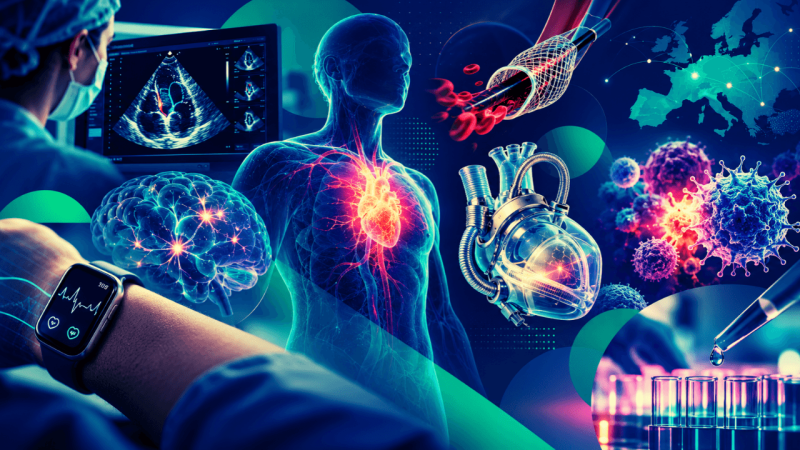

These scaleups are developing tech that transforms how clinicians detect, monitor and treat some of the most challenging medical conditions.
European healthtech scaleups are tackling some of the industry’s most persistent challenges, from delayed diagnoses and overburdened hospitals to complex diseases with limited effective treatments.
While their technologies and business models differ, they face a common challenge: translating scientific and engineering breakthroughs into clinically validated, commercially viable products that can reach patients across Europe and beyond, while navigating regulatory approval, healthcare system access and the substantial capital required to scale.
Here are some companies across a variety of verticals to have on your radar:
Diagnostics, AI and patient monitoring
Earlier diagnosis, more accurate assessments and continuous patient monitoring are critical against ageing populations, growing demand and shortages of medical professionals. However, their adoption requires demonstrable clinical value, clinical integration and the necessary regulatory approval and reimbursement.
Checkpoint Care (Bulgaria)
Check Point Care develops remote patient monitoring tech. Its platform combines wearable medical devices, continuous physiological monitoring and AI-powered clinical decision support. It aims to reduce preventable deaths, hospital readmissions and pressure on healthcare systems by enabling earlier detection and intervention.
The company’s wearable devices continuously collect clinical-grade data, including ECG, blood pressure, oxygen saturation, respiratory rate and body temperature. This information is transmitted to a centralised digital platform, where AI algorithms analyse physiological patterns and generate digital biomarkers.
The system also creates personalised digital twins representing patients’ physiological conditions, helping clinicians identify abnormalities and monitor changes over time.
A 24/7 Virtual Care Centre enables clinical teams to analyse patient data and communicate findings to treating physicians.
Check Point Care’s tech has supported over 95,000 acute patients and analyses over 16.5 million data points monthly.
Ligence (Lithuania)
Ligence develops AI-powered software that automates the analysis of cardiac ultrasound images, helping cardiologists assess heart function and identify potential abnormalities. Its flagship product, Ligence Heart, uses machine learning to analyse echocardiograms, automatically identify anatomical structures, perform measurements and generate structured reports.
The company says its technology can reduce routine examination and reporting workflows from approximately 30 minutes to 15 minutes, potentially allowing hospitals to assess more patients without proportionally increasing staffing requirements.
The technology is designed to integrate with existing hospital imaging systems, reducing the manual work involved in cardiac diagnostics. Ligence has achieved European CE marking and two US FDA 510(k) clearances, the second granted in April 2026 for an updated version of Ligence Heart featuring automated left ventricular strain analysis.
MiMARK Diagnostics (Spain)
MiMARK Diagnostics is developing molecular diagnostic technologies to improve the detection of gynaecological diseases, particularly endometrial cancer. The company is focused on identifying disease-associated biomarkers in gynaecological samples to provide more accurate, less invasive diagnostic methods that can be incorporated into routine clinical practice.
Endometrial cancer is one of the most common gynaecological cancers, yet diagnosis can involve invasive procedures, including endometrial biopsies and hysteroscopy. More accessible testing could reduce unnecessary invasive procedures while supporting earlier identification of disease.
Medical devices and interventional technologies
Medical device innovation is transforming how clinicians treat serious conditions, particularly where conventional interventions are invasive, carry significant risks or have limited effectiveness.
Anaconda Biomed ( Spain)
Barcelona-based Anaconda Biomed develops medical devices to treat acute ischaemic stroke, which occurs when a blood clot blocks an artery supplying the brain. Its technology focuses on mechanical thrombectomy, a minimally invasive procedure in which physicians use catheters to remove clots and restore blood flow.
The company’s ANA Funnel Catheter features a self-expanding, funnel-shaped design intended to improve clot capture, restrict blood flow during retrieval and reduce the risk of clot fragments travelling into smaller vessels. Speed and effectiveness are critical in stroke treatment, as delays in restoring blood flow can result in permanent neurological damage, disability or death.
Anaconda’s tech works alongside existing thrombectomy devices, potentially improving the efficiency of clot removal and reducing complications. Its development reflects the growing importance of specialised neurovascular technologies that can improve outcomes in time-critical medical emergencies.
In September 2026, Anaconda Biomed secured $56 million in financing.
CorWave (France)
CorWave is developing implantable heart pumps for patients with advanced heart failure, using technology inspired by the movement of marine animals. The technology is designed to reproduce more natural, pulsatile blood flow, adapting to the patient’s
Its Left Ventricular Assist System (LVAS) uses a patented wave membrane to propel blood through the device, rather than the rotary mechanisms used in conventional heart pumps. Existing ventricular assist devices can sustain patients for years, but risks such as bleeding, stroke and blood clot formation remain significant concerns.
CorWave aims to address these limitations by preserving the natural pulse and improving the interaction between mechanical circulatory support and the cardiovascular system.
In May 2025 CoreWave’s LVAS was implanted in a patient for the first time at St Vincent’s Hospital in Sydney, Australia. The patient successfully underwent a heart transplant after 84 days of mechanical support, with no device-related serious adverse events recorded at 30 days.
Biotechnology and advanced therapeutics
Advances by European biotech companies in genomics, precision medicine, immunotherapy and cellular reprogramming are creating opportunities to target the underlying biological mechanisms of disease rather than simply managing symptoms.
Arctic Therapeutics (Iceland)
Arctic Therapeutics is developing treatments for complex neurological and inflammatory diseases, drawing on genetic research and population-level health data to identify potential therapeutic targets.
Its approach combines insights from human genetics with drug development to investigate disease mechanisms and identify opportunities for more targeted treatments.
By using genetic insights to understand the biological drivers of disease, Arctic Therapeutics aims to develop treatments that address underlying mechanisms rather than symptoms alone.
The company focuses on rare neurological diseases and forms of dementia.
In 2025, Arctic Therapeutics raised €26.5 million Series A.
Asgard Therapeutics (Sweden)
Asgard Therapeutics is developing a new approach to cancer immunotherapy based on in vivo cellular reprogramming.
Rather than relying solely on conventional treatments that directly attack tumours, the company is investigating how to reprogram cancer cells to stimulate the body’s immune system, potentially enabling it to recognise and target malignant cells. Its technology aims to convert tumour cells into cells with antigen-presenting properties, allowing them to activate immune responses against cancer.
This approach could potentially address some of the limitations of existing immunotherapies, which do not work for every patient or cancer type.
Companies mentioned in this article are members of the EIC Scaling Club, a curated community where 120+ European deep tech scale-ups with the potential to build world-class businesses and solve major global challenges come together with investors, corporate innovators and other industry stakeholders to spur growth.
The EIC Scaling Club is an EIC-funded initiative run in partnership with Tech Tour, Bpifrance (EuroQuity), Hello Tomorrow, Tech.eu (Webrazzi), EurA and IESE Business School.