
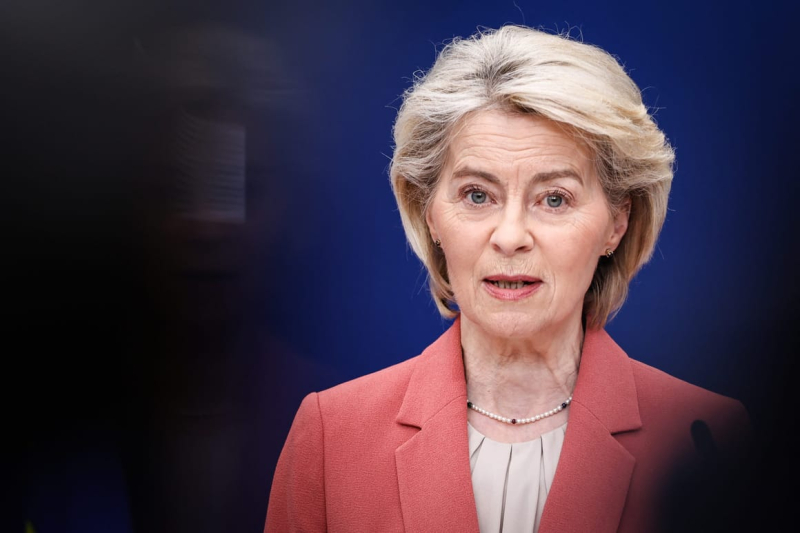

The European Commission president calls for a “credible transition” that reflects “the democratic aspirations of the brave people of Iran.”
European Commission President Ursula von der Leyen on Sunday called for Iran to ditch its authoritarian Islamist constitution and make “a credible transition” to democracy after the death of Supreme Leader Ayatollah Ali Khamenei.
Her call for an end to the dictatorial Islamic Republic signals a hardening line on Tehran’s ruling mullahs. On Saturday she had called on all parties in the war over Iran to exercise “maximum restraint” and to “fully respect international law.”
Iran hawks have long criticized the EU for taking a soft line on Tehran and for engaging in diplomacy — particularly over Tehran’s nuclear program — while the clerical regime commits flagrant human rights abuses.
“A credible transition in Iran is urgently needed,” von der Leyen posted on X after a call with Sheikh Tamim bin Hamad Al-Thani of Qatar. “This must mean the halt of Iran’s military nuclear and ballistic missile programmes and the end of destabilising actions on air, land and at sea. Above all, it must reflect and support the democratic aspirations of the brave people of Iran.”
The transition to a new supreme leader under the current Iranian system is being handled by 88 clergymen in the country’s Assembly of Experts.
Qatar has come under heavy barrages from Iran, which is retaliating against a U.S.-Israeli attack on its territory, launched on Saturday, that aims to destroy its nuclear facilities and ballistic missile capabilities in addition to toppling the Islamist regime.
“With the region in deep upheaval, Qatar can count on strong European solidarity,” von der Leyen said in her post on X Sunday.
Qatar shot down waves of Iranian missiles fired at targets within its territory over the weekend. On Saturday the resulting shrapnel injuring 16 people, according to Al Jazeera. On Sunday a small fire caused by falling debris was quickly contained.
Von der Leyen called the Iranian strikes on Qatar “reckless and indiscriminate.”
What an Iranian power transition, if any occurs, will look like is unclear, not least because the country lacks a unified opposition.
Reza Pahlavi, son of the pro-Western Shah toppled in Iran’s 1979 revolution, is positioning himself as a potential candidate to lead the country away from dictatorship toward democracy.