
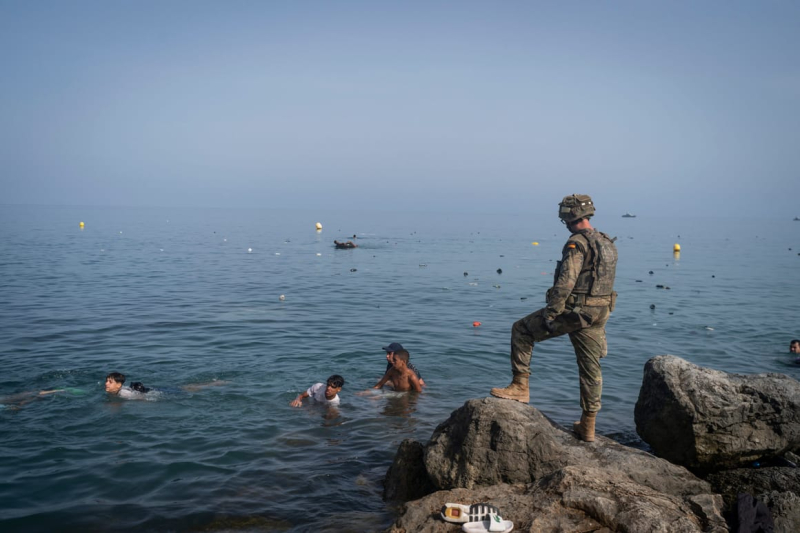

Madrid will press its case for more solidarity, as ministers discuss lessons learned, tighter external-border controls and possible new EU measures this fall.
BRUSSELS — After days of recriminations over the sudden arrival of tens of thousands of migrants in the Spanish exclave of Ceuta last week, the EU’s 27 home affairs ministers are expected to use an emergency meeting Tuesday to express solidarity with Madrid and focus on how to prevent a repeat.
However, Spain will also criticize some governments for turning the crisis into an attack on Prime Minister Pedro Sánchez instead of supporting a fellow EU country facing an emergency, according to an official familiar with Madrid’s plans, granted anonymity to speak freely. Interior Minister Fernando Grande-Marlaska will present Madrid’s assessment of the events and make the case for a common European response, the official said.
After initial criticism of Spain, the mood among EU capitals has softened as the immediate crisis eased, according to six diplomats from different countries who were granted anonymity to speak freely. Almost all the migrants who entered the exclave last week have returned to Morocco, Spanish authorities say, and there has been no reported onward movement into mainland Europe.
The groundwork for Tuesday’s meeting was set on Monday when EU ambassadors held talks that lasted around two and a half hours. The Spanish envoy gave Madrid’s account of the Ceuta crisis, during which more than 70 people died, and reprimanded some capitals for spreading disinformation, according to one of the diplomats. The ambassador was asked for verification of Madrid’s figures on returned migrants and for the situation to be closely monitored, two other diplomats said.
Concerns were also raised that Spanish government policies may have been used by people-smugglers and gangs to encourage the events in Ceuta.
“There’s a concern that … the legalization of a million irregular migrants, that it’s been possible [for people-smugglers] to use that to give the impression that the door was open,” said one diplomat from a country that has been critical of Spain.
But the Spanish ambassador criticized Italy for amplifying false claims about the migrant regularization program, such as Foreign Minister Antonio Tajani’s suggestion on social media that it automatically grants EU citizenship. The program provides legal residency to eligible migrants but does not confer Spanish nationality.
Rallying to support Spain
Commission President Ursula von der Leyen set the tone of conciliation on Monday by writing to Sánchez to praise Spain and Morocco for their handling of the crisis and calling for a united European response. She said the episode showed the need for stronger controls at the EU’s external borders, closer cooperation with partner countries, better early-warning systems, action against smuggling networks and more effective returns.
The interior ministers are expected to seek further rapprochement. Tuesday’s discussion will focus on lessons learned from Ceuta, ways to beef up controls at the bloc’s external borders and how to respond to potential future episodes of instrumentalized migration, rather than assigning blame for the crisis, three of the diplomats said.
“Everyone is both very willing and very eager to help, and acknowledged this has been a very difficult situation for Spain,” one of the EU diplomats said after the ambassadors’ gathering. The diplomat said Monday’s meeting had been calmer than the weekend’s public exchanges.
Twenty-two national leaders, in a letter initiated by Italy and Denmark, had on Saturday called for tougher external borders and warned against policies that could act as “pull factors” — an apparent reference to Spain’s plan to grant legal status to more than 1 million undocumented migrants. Madrid saw the letter as an attempt to blame the Spanish government for a crisis not of its making.
Tuesday’s videoconference will be chaired by Ireland’s Justice Minister Jim O’Callaghan. Officials from EU border agency Frontex, the EU Asylum Agency, Europol, the European External Action Service and Schengen-associated countries will also participate.
The crisis has already pushed migration higher up the EU agenda. The issue was already meant to feature at the October European Council summit, but officials now expect it to play a much more prominent role in the run-up to that meeting, the diplomats said.
The Commission is expected to consider possible new migration measures in September, after examining what caused the sudden influx and whether social media or other actors helped organize or amplify it, three of the diplomats said. Strengthening Frontex is one option, with the Commission indicating to ambassadors Monday that it could propose additional steps to reinforce the agency’s role, according to the diplomats.
Max Griera contributed reporting.