
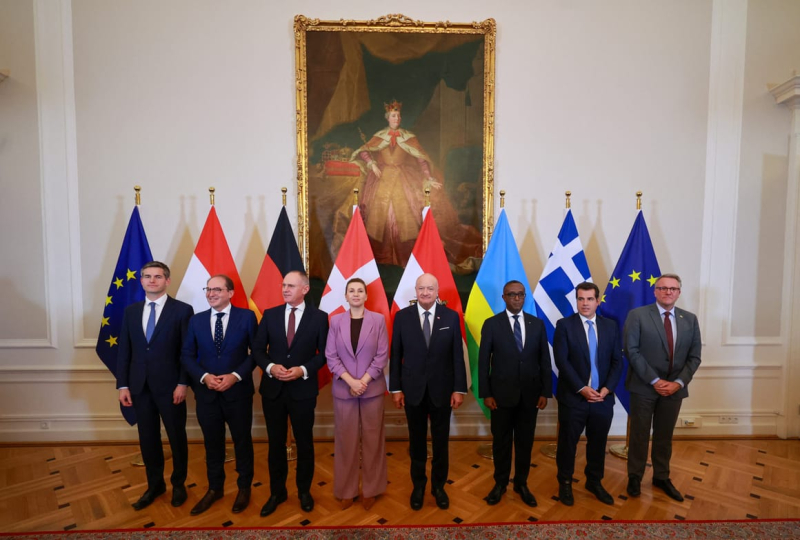

Austria, Denmark, Germany, Greece and the Netherlands plan to open the deportation hubs in 2027.
VIENNA — Five European Union countries plan to open a deportation hub in Rwanda for rejected asylum seekers, Austrian Chancellor Christian Stocker said Monday.
“If people without the right of residence in the EU cannot be removed, our entire asylum system is made a mockery of. And we are not going to allow that,” Stocker said.
Stocker, Danish Prime Minister Mette Frederiksen and government ministers from those two countries plus the Netherlands, Germany and Greece announced the plan at a press conference. The ministers stopped short of confirming they had cemented a deal, but said the hub would become operational during 2027.
There are still some “technical things” that have to be “sorted out,” Frederiksen said. “But the framework, the idea and the partnership is now in place.”
A reform of EU legislation adopted earlier this year made it possible for countries to negotiate deals to set up such deportation centers — as long as they comply with fundamental rights obligations.
The five countries plan to transfer people to Rwanda who have already gone through full asylum proceedings and were ordered to leave the EU.
The countries said they intend to target adults without children, and specifically people who don’t cooperate — or whose home countries don’t collaborate — in the deportation process.
“For me, today marks a crucial step towards a new migration system; a system that safeguards the cohesion of our societies and answers the concerns of our citizens. To put it very short, it needs to be a democratic decision who can enter and who can stay in our societies,” Frederiksen said.
Staying in Rwanda
The five countries want to set up a reception center with the capacity to register and process 100 people at a time. Rejected asylum seekers who decide to stay in Rwanda rather than return to their country of origin would be given a residence permit and support to find a job and learn the language.
Rwanda’s Interior Minister Vincent Biruta said he expected few would opt to stay, but insisted that those who do “are not going to be kept in a camp … they’ll be integrated in our society.”
“Those transferred to Rwanda will have the opportunity to settle, integrate into Rwandese society and build a new future,” said Dutch Foreign Affairs Minister Tom Berendsen.
When sending migrants to Rwanda, their protection would remain a “key priority,” he said. The partnership would also have to meet the principle of non-refoulement, which forbids countries from forcing people to countries where they might be under threat, as well as other principles of international and European law, Berendsen added.
Rwanda has “considerable experience in hosting refugees” and a “strong track record of working with international organizations, including the International Organization for Migration (IOM) and the United Nations High Commissioner for Refugees(UNHCR),” the Dutch minister said, adding that the five countries want to continue working with these organizations.
It’s not yet clear whether the IOM will be involved. In a statement Monday, the U.N. organization confirmed it had received a request from Rwanda to support EU return hub arrangements. “IOM has indicated that it can support in principle, provided its mandate and international standards can be upheld,” the organization said.
Civil society groups are not convinced.
In a joint reaction, 47 human rights, civil society and trade union groups warned that European authorities had previously reported “torture in detention, arbitrary arrests and impunity within the security services” in Rwanda, as well as a “real risk” of refoulement.
EU countries’ partnership “signals that Member States accept the risk of serious human rights violations against one of the most marginalized groups in society, in return for a deterrence goal that evidence clearly suggests they will not reach,” they wrote in a call on the EU to protect human rights.
“I think we need to go beyond the existing cliché,” Biruta said on Monday. Rwanda is hosting more than 150,000 refugees “from as far as Afghanistan, from Sudan, Congolese, Burundians, and their rights were respected,” and it’s asking for a return hub system that meets “international law, European law and our national laws.”
The country wants to bring on board international organizations and put an independent monitoring mechanism in place, he said: “Everyone will be welcome to witness and monitor what’s happening.”
But civil society groups are worried return hubs would move vulnerable people far away from genuine oversight.
“Looking at what we know from previous agreements with third countries, it has proven to be very difficult to guarantee any kind of human rights standard,” Meron Ameha Knikman, senior EU advocacy adviser at the International Rescue Committee, said ahead of the announcement. “It doesn’t matter what you put on paper — as long as it’s not under your jurisdiction, it’s extremely difficult if not impossible to enforce … any kind of guarantees.”
More hubs to follow
The ministers indicated that a deal with Rwanda could be the first in a string of return hub partnerships. “We are already exploring other partner countries, and I think other European countries will participate as well,” Frederiksen said.
Return hubs aren’t just about ramping up deportations, but also about sending a signal, she argued, adding that if people don’t assume they’ll get to stay after entering the EU irregularly, many would rethink their decision to attempt it.
Frederiksen also pushed back against human rights concerns in the partnership with Rwanda.
“You have to remember that we are talking about people who don’t have a legal reason to be in Europe. It’s people who have entered illegally and that have no right to be protected in Europe or to stay,” Frederiksen said in a response to a question from POLITICO.
“What is the alternative? Is it to continue the system we have today?” she asked. “Because if you believe in human rights, I don’t like the current system. It’s broken. I have been to refugee camps outside Europe and seen with my own eyes that some of those who are most fragile … will never come to Europe because it demands a lot of money and strength to travel.”
“If the prospect of dying in the desert, being raped and tortured in Libya, or drowning at sea doesn’t deter people, it’s hard to see how the possibility of being sent to Rwanda would dissuade people,” Judith Sunderland, senior associate director in the refugee and migrant rights division of Human Rights Watch, told POLITICO.
This article has been updated