
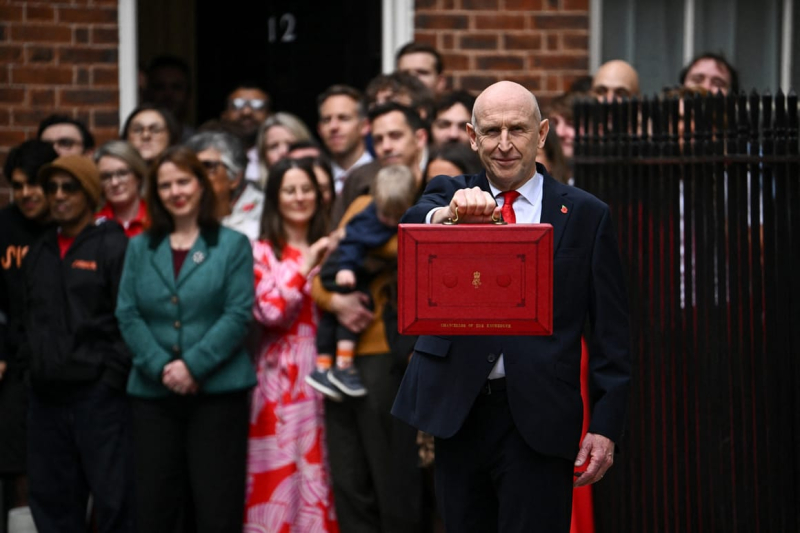

Britain’s chancellor unveils first budget of the Andy Burnham era — as watchdog reveals decade-long pressure on living standards.
LONDON — Britain’s top finance minister reduced his fiscal breathing space and slapped fresh taxes on banks Wednesday as he tried to slash energy costs and show that his boss is homing in on the cost of living.
Chancellor John Healey used the first government budget under Prime Minister Andy Burnham to promise a £100 energy payment for millions of Brits over the winter — and repeatedly pointed to uncertainty stemming from war in the Middle East to justify the move.
“We did not want this war,” Healey said. “We rejected calls from the leader of the opposition [Tory Leader Kemi Badenoch] to jump two-footed into it. It’s a war that has driven up costs on British families and businesses.”
Around 20 million households will be targeted for the energy payment “directly into people’s bank accounts to deal with rising energy bills,” Healey said. The scheme comes with a £2.6 billion price tag — and will arrive against a grim backdrop. Annual household energy bills are expected to rise by around £450 in January because of higher global gas prices.
Since coming to power as a self-styled “cost-of-living government” earlier this year, Burnham and Healey have tried to offer a raft of targeted, small-scale policy interventions to show that the government has a grip on rising costs — without spooking the financial markets.
Analysis of the budget by the U.K.’s Office for Budget Responsibility watchdog on Wednesday laid bare the scale of that challenge.
The OBR expects continued “weak growth” in living standards — with real household disposable income for Brits expected to be just 1 percent higher by the end of this decade than it was in 2020.
The watchdog’s David Miles told journalists at a briefing in London that a series of shocks — including Brexit, Covid, and the war in Iran — had led to a “dismal period in British economic history.”
Banks raided
Other measures unveiled by Healey Wednesday include the scrapping of standing charges on Brits’ gas bills, a hike in the minimum wage and a new tax-free allowance for poorer pensioners.
On the revenue-raising side, Healey has opted to target Britain’s banks — albeit by slightly less than feared in the sector.
While praising their “huge contribution” to the economy, the chancellor will hike an existing surcharge on bank profits by three percentage points, taking it to 6%. The increase will last for 15 months starting in January.
The tax on the banks was widely expected despite major pushback from Britain’s powerful financial sector. But it has been pared back compared to previous reports that the surcharge could hit 8%, with accompanying documents vowing that the measure “will not be extended.”
Bank share prices, including big British lenders like Lloyds and Barclays, were initially buoyed by the reduced sweep of the raid.
Healey has in part funded his plans by lowering his amount of fiscal headroom — the buffer between his projected tax and spending plans and the limits set by the government’s own fiscal rules.
The Office for Budget Responsibility watchdog predicts Healey’s fiscal headroom will fall to £15 billion by 2029/30. A March projection from the OBR put that figure at £24 billion.
The buffer is then projected to climb back to £22 billion in 2030/31. That was broadly in line with City forecasts. “That is what a buffer is for. Use it when you need it, rebuild it when you can,” Healey argued.
Badenoch: UK overspent, overborrowed, overtaxed
The broader U.K. economic picture is mixed. GDP growth this year is now forecast at 1.2% – revised up from 1.1% at the March statement.
But growth is now projected to fall to 1% in 2027, down from the 1.6% predicted in March. It is projected to return to 1.6% in 2028 — in line with the previous OBR forecast.
Inflation is meanwhile expected to rise to 3.75% in early 2027, the Office for Budget Responsibility said – higher than its last forecast in March. The watchdog cautioned that the picture on price rises remains “highly uncertain,” and that hikes could be sharper.
Healey has opted to reduce the scale of tax rises planned by his predecessor Rachel Reeves, according to documents published alongside the budget. There are now some £7bn in net tax rises planned for the final year of the forecast period, compared to £26bn on Reeves’ plans.
Opposition parties were quick to charge Healey with a lack of ambition.
Conservative Leader Kemi Badenoch said: “We are overspent, overborrowed, overtaxed, and drowning in an out-of-control welfare system. And this is his answer: it is simply not enough, not good enough, not strong enough, not bold enough.”
Badenoch argued Healey had “delayed until tomorrow difficult decisions he should have taken today” in a bid to leave Burnham — who passed his first 100 days in office this week — “the option of an early general election open, putting his party’s interests before the country’s.”
Reform economics spokesperson Robert Jenrick branded the statement “an exercise in fiddling while the economy burns” and a “nothing-burger budget.” The Liberal Democrats wanted that Healey’s continuation of perpetually-frozen income tax thresholds would create a “massive stealth tax.”
This story was updated with further reporting. Dan Bloom and Elliot Gulliver-Needham contributed.