
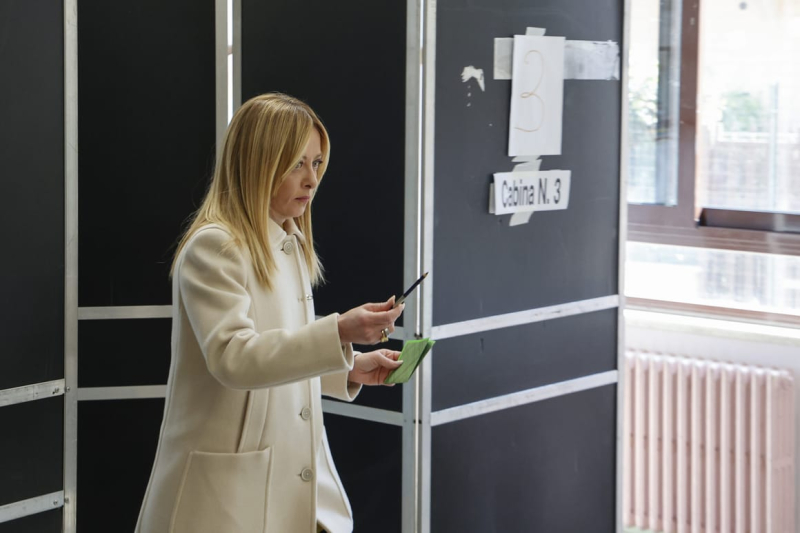

In losing a referendum, the prime minister showed she is vulnerable. But the opposition will need to unite if it is to seize the political momentum and topple her.
ROME — Right-wing Prime Minister Giorgia Meloni’s defeat in a high-stakes referendum offered a rare sign that she can be beaten, but the question now is whether Italy’s fragmented opposition can seize that momentum by uniting against her.
Since coming to power in 2022, Meloni has appeared politically untouchable, with little to fear from her divided opponents.
But the failure of her referendum on judicial reform on Monday revealed a strong groundswell of discontent that her rivals now want to harness. Turnout was high, and younger voters were especially determined to vote against her.
The rebuff to Meloni presents a ripe opportunity for her main challengers: the center-left Democratic Party led by Elly Schlein, and the populist 5Star Movement of former Prime Minister Giuseppe Conte.
On Wednesday Schlein said she was aware of the stakes, calling the referendum “an extraordinary victory for the people … that proves that we will begin to defeat the nationalist right.”
But repeating such a victory in a general election — probably next year, although there is speculation Meloni could move earlier — will require molding the opposition into a common front, a difficult prospect given tensions over topics such as military aid to Ukraine.
Polls have shown that support for Italy’s main parties has remained remarkably static since mid-2024, with Meloni’s Brothers of Italy currently on 29 percent, the Democratic Party on 22 percent and the 5Star Movement on 12 percent. To have any hope of beating Meloni and her allies on the right, the opposition will need to work together.
For this reason, pressure is increasing to hold opposition primaries to select a unifying leader who can build a joint platform — something both Conte and Schlein support.
“Citizens are demanding primaries and we cannot avoid them,” Conte said after the referendum result. It was “too early” to say whether he would run again, he maintained demurely — even though he is widely seen as eyeing a return to the Chigi Palace. He encouraged Schlein to join the race; she agreed she would be “available.”
Impromptu alliances
Campaigning against Meloni’s judicial reforms was an easy rallying point for the opposition, as they could all pile on the prime minister for attacking independent state institutions.
In Rome’s Piazza Barberini on Monday night, opposition leaders and activists from several centrist and leftist parties gathered to celebrate a result few had considered likely just weeks earlier. Supporters waved party flags and chanted as leaders from across the political spectrum shared a stage in a rare display of unity.
But the fraternity shown on the piazza masked deeper divisions: The coalition that came together to defeat Meloni in the referendum remains far from agreeing on a common national program, or a shared candidate for prime minister. The on-again-off-again grouping often diverges sharply on issues such as military spending and support for Ukraine, as well as economic policy, with a significant gap between the radical populist left and the more centrist Democratic Party.
Schlein argued on Wednesday that the opposition must focus on concrete proposals. “We can’t just be against the government, we have to stand for things,” she said, before listing proposals on a minimum wage, a shorter working week and shared parental leave.
Schlein also pointed to recent regional and municipal successes, including in the southern regions of Campania and Puglia, as evidence that cooperation can translate into electoral wins. “We know we can do it because we have done it repeatedly over the past two years, put together a progressive coalition, and in some regions we have beaten the right.”
Nicola Fratoianni, leader of the Italian Left party, agreed that these alliances have been successful since the last general election — and said there was significant agreement among the opposition parties on topics such as a minimum wage, healthcare, the green transition and opposition to a NATO target of spending 5 per cent of economic output on defense.
“The referendum accelerates [alliance building],” he told POLITICO. “It creates an opportunity but also a responsibility not to disappoint people who are asking for an alternative to Meloni and the right.”
He conceded, however, that there were still major divisions inside the opposition camp over the war in Ukraine and the provision of military aid to Kyiv.
Wanted: A leader
The next hurdle will be leadership.
Having united behind a “no” vote in the referendum, opposition parties now face the thornier task of agreeing on a single candidate to challenge Meloni.
There is no obvious consensus figure. Schlein leads the largest opposition party and has positioned herself as the natural standard-bearer of a broad progressive alliance, but the fact she grew up in Switzerland and is perceived as hailing from an elite background has reduced her popular appeal.
Former Prime Minister Conte, who leads a smaller but still decisive bloc, retains strong personal recognition, particularly in the south. He can also point to his record in government, during which time he introduced social security benefits and secured €200 billion in EU pandemic aid.
Neither, however, has shown they can unify the opposition fully.
Potential compromise candidates have been flagged in the past, including Silvia Salis, a former Olympic hammer-thrower, and Gaetano Manfredi, who were elected to the post of mayor in Genoa and Naples, respectively, backed by a wide spectrum of leftist opposition parties. But both have poured cold water on the idea of participating in the primaries.
Illusion of strength
Analysts also warn the referendum result may have overstated the opposition’s strength.
“The challenge for the center left is how to capitalize on this political victory,” said Lorenzo Pregliasco of YouTrend. “Within the 53 per cent who voted ‘no’ there were many different groups and reasons.”
“’No’ voters don’t necessarily mean center-left voters,” Pregliasco continued, noting that even in simultaneous local elections, some voters backed the referendum, but didn’t back opposition parties.
He warned that a significant share of the “no” vote came from disengaged or low-propensity voters. “There is still a gap between ‘no’ voters disaffected with the government and concrete tangible support for the center left,” he said. “It would be unwise of the left to think they had acquired these voters.”
Timing could prove decisive.
Analysts and pollsters say there is a persuasive argument for Meloni to call an early snap election before economic conditions worsen. (The counter-argument is that she should hold on, at least past the crucial September threshold, by which time she will have served the longest term of any Italian prime minister.)
A vote held sooner rather than later could also allow her to catch a still-fragmented opposition off guard, before it has agreed on a program or a candidate.
Opposition leaders insist that won’t work. “Whenever the elections are, we will be ready,” Schlein said.