

Contents
The startup is developing causal "world models" trained on synthetic data that can adapt to new situations from only a handful of examples, targeting applications from robotics to healthcare.
AI systems need constant, costly retraining. European AI startup kausable raises €12 million in a seed funding round to solve this problem by developing reasoning-first frontier AI that adapts efficiently to changing context without further retraining. The European frontier lab kausable has ties to Heidelberg University and Black Forest Labs (BFL), one of Germany’s most prominent AI companies.
The round is led by the German and Belgian investors UVC Partners and Entourage, with follow-on from the German investors HTGF and Mätch VC.
kausable is also backed by various private angel investors from the AI industry and academia working at Black Forest Labs, OpenAI, Google DeepMind, Noxtua, and the European Laboratory for Learning and Intelligent Systems (ELLIS), including:
- Robin Rombach & Andreas Blattmann (Co-Founder, BFL),
- Sandro Gianella (International Strategy & Operations, OpenAI),
- Dorothy Chou (Strategic Advisor, DeepMind),
- Dr Michael Bolle (Ex-Board Member, Robert Bosch),
- Dr Andreas Nauerz (CPO IONOS),
- Dr Jens Buchner (Lead, Neura Robotics),
- Johanna Claussen & Cornelius Claussen & Dr Marco Möller (Co-Founder Pionix),
- Prof Dr Matthias Bethge (Uni Tübingen, Co-Founder ELLIS),
- Prof Dr. Marco Aiello (Uni Stuttgart),
- Georg Schwarzkopf (Campione Venture),
- Alexander Schlensog (Ex Secunet),
- Dr Clara Herdeanu (Chief Communications Officer, Noxtua),
- Juliette Ast (Deeptech VC),
- Hans Ramsl (Weights & Biases),
- Jeroen Van Hautte (CTO, TechWolf),
- Christopher Craig (Google Cloud),
- Sebastian Stark (TUM Venture Labs), and
- Sebastian Spitzer (HPE),
The financing round comes at a time of increased momentum for strategic digital sovereignty, as current geopolitical instability demonstrates the need for AI frontier models and sovereign systems developed in Europe.
From Heidelberg University to frontier AI
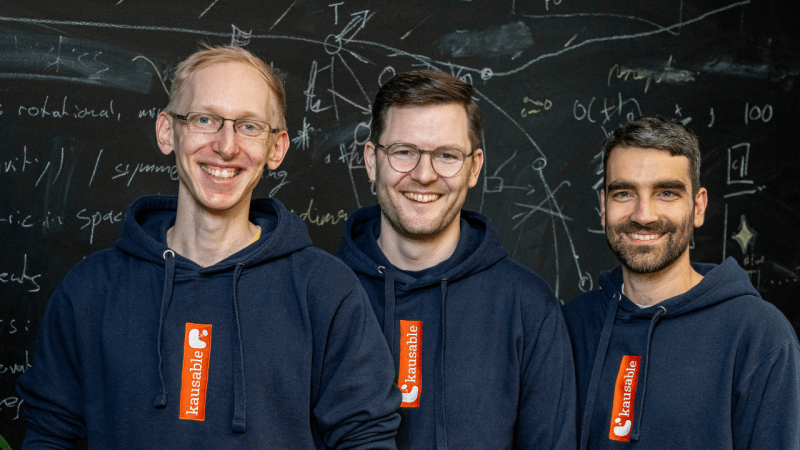
Johannes Haux (CEO), Dr Benjamin Herdeanu (CTO), and Gregor Ramien (COO) founded the European frontier AI lab kausable in 2025 based on their research at Heidelberg University and their working experience at start-ups as well as in highly regulated industries such as cybersecurity and the banking sector.
kausable began developing its idea in 2024, incorporated in early 2025, and worked with the Startup BW Pre-Seed programme before raising approximately €1.5 million in pre-seed funding.
Teaching AI to reason, not retrain
A reasoning-first model is designed to learn and adapt more like humans. At the heart of kausable’s approach is what it calls a ‘world model’ — a robust set of causal intuitions that allows the AI to adapt quickly to changes in its environment using very little new information.
Haux explained:
“Humans don’t need to repeat the same task a million times to learn it. If you show someone how to open a door once or twice, they can usually figure out how to open a different door without starting from scratch.
Today’s AI doesn’t work that way. It often requires huge amounts of data and constant retraining whenever conditions change.”
Instead of continually updating a model’s internal weights, kausable trains a foundation model once and enables it to learn new tasks from just a handful of examples. This allows it to adapt quickly to new situations without requiring another costly training cycle.
Ramien detailed:
“Large language models build an understanding of the world from language. Our models instead learn directly from causal relationships. Rather than inferring how the world works from billions of text examples, we train on abstract cause-and-effect structures.
That gives us a much more direct representation of how systems behave, allowing the model to transfer what it has learned across many different domains.”
The team recently also co-authored a research paper with experts from Columbia University , validating the causal reasoning architecture underlying its frontier model.
Synthetic data, real-world intelligence
One of kausable’s biggest departures from conventional AI development is how it trains its models. Rather than relying on vast quantities of customer data, the company teaches its models using synthetic causal data, enabling them to learn how systems behave before being adapted to real-world applications.
Haux argues that while additional data can improve model performance, it is not the determining factor. “More data certainly helps,” he said.
“Our approach is based on Bayesian learning, so the model continually improves as it receives additional evidence.”
However, he says the key advantage is that the system requires far fewer examples than conventional AI models to achieve useful performance, making it significantly more data-efficient than today’s foundation models. Further, beyond the privacy benefits, he said this approach gives the company “much greater control over the kinds of systems our models can understand,” creating what he believes is “a very defensible” commercial advantage.
Predicting black swans before they happen
One of the first demonstrations of the technology is TipPFN , a zero-shot forecasting model for complex dynamic systems that predicts tipping points and other “black swan” events across domains including medicine and energy before they happen.
Herdeanu explained:
“We tested the model across 15 different domains, including ecological systems, biomedical data and energy infrastructure. For example, it can predict epileptic seizures from EEG data or anticipate power grid blackouts before they occur.
The important point is that it learns these behaviours from only a handful of examples.”
Ramien thinks of kausable’s models as learning instincts about how the world works.
“They’re trained entirely on synthetic causal systems rather than real-world data, but they can transfer that understanding to real applications.
For example, our blackout prediction model had never seen an electrical grid during training. It simply received frequency data from the grid and was able to predict how close the system was to a critical transition.”
That ability to personalise quickly is especially interesting for areas like healthcare, where every patient is different.
From research lab to commercial AI
The same rapid adaptation that makes the technology useful in healthcare also opens opportunities across robotics, forecasting and industrial systems. kausable has published research, submitted additional papers and demonstrated the first proof points.
The next phase is working closely with early customers and testing the technology in real-world applications. Physical AI is one of the company’s biggest priorities because collecting enough training data is difficult, and robots constantly encounter situations they’ve never seen before.
“Our technology is particularly valuable in environments where models need to adapt quickly without retraining. We’re also interested in areas such as demand forecasting, where the problems are lower dimensional and can be commercialised earlier while we continue developing the broader platform,” shared Herdeanu.
While the company is still primarily a research company, it plans to become more product-focused over the next year through customer pilot projects.
Herdeanu credits kausable’s rapid progress to its research team:
“We have exceptional people who can quickly absorb new ideas and continually push the boundaries of what’s possible,” he said.
While increased competition helps advance the field, he believes the company’s edge comes from its ability to produce genuinely novel research.
He also highlights the role of kausable’s investors and angel backers, describing them as “extremely engaged” partners who contribute far more than capital and have become an important extension of the nine-person team. Many deep-tech founders struggle with the transition from academia into entrepreneurship.
According to Haux, having three founders with complementary strengths has made a huge difference.
“Herdeanu leads the research, Ramien brings extensive experience managing engineering teams, and I focus more on communicating the vision to investors, partners and customers. That balance allows us to keep advancing the technology while simultaneously building the company around it.”
According to Andreas Unseld, Partner at UVC Partners:
“Nearly every industrial company runs on complex systems it struggles to predict and control – and today, applying AI to each one is slow and expensive.
kausable makes that effort collapse. That turns AI from a series of costly one-off projects into something that can be rolled out across an entire industrial landscape – which is why we led this round.”
“Most AI models are trained to remember the past. kausable is building AI that can reason about the future. Instead of relying on ever-larger datasets and constant retraining, they’re developing a fundamentally different approach: systems that adapt, infer causality and solve problems they have never seen before. It’s an ambitious scientific bet, and exactly the kind of foundational AI company we’re excited to back,” emphasised Pieterjan Bouten, Co-Founder, Entourage.
According to Haux, the company offers a fundamentally different way to build AI.
“Today’s systems often require continuous retraining whenever sensors change, environments shift, or new data appears. We’re building technology that can adapt to those changes almost immediately from only a handful of examples.
Ultimately, we see this becoming a foundational intelligence layer that other AI systems can build upon.”
Ramien predicts that future AI systems will consist of specialised models working together.
“Language models, vision models and other components will provide interfaces to the world, while this causal reasoning layer becomes the core intelligence making decisions and predictions.
Because our approach is much more efficient, we also believe it offers a path towards dramatically reducing the computational cost of AI, making future systems both more sustainable and more economically viable.”
kausable will use the new funding to expand its current nine-person team and to advance its rapid-learning frontier model.
Lead image: kausable co-founder: Johannes Haux, Gregor Ramien, and Dr Benjamin Herdeanu.