
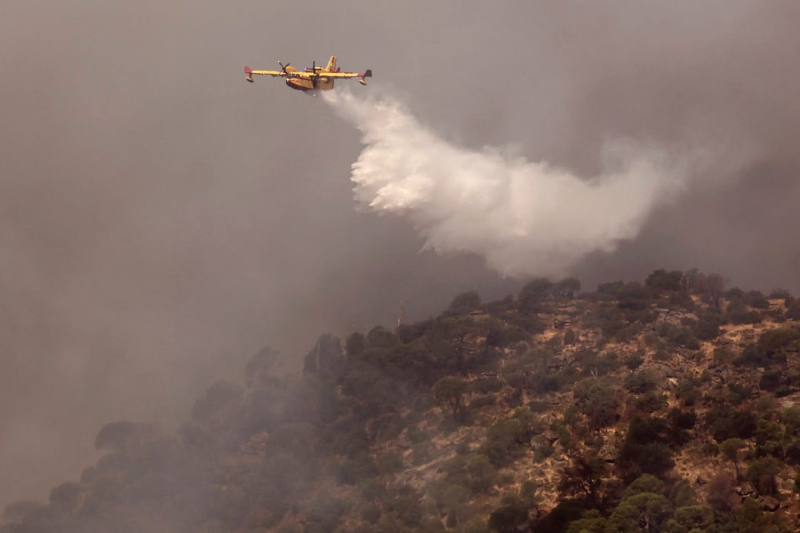

Devastating blazes raging around Madrid, Ávila, Toledo and Castellón have displaced more than 100,000 people, exposed gaps in firefighting capacity and reopened a familiar feud between the left and the right.
The massive wildfires that have forced the evacuation of more than 100,000 people in Spain are reviving the domestic political infighting that is usually dormant during the summer months, when the country’s parliament is on recess.
More than 45,000 hectares have been scorched by the fires raging across the Spanish regions of Madrid, Ávila, Toledo and Castellón. At least one person is confirmed to have died, and the proximity of the fires to the capital have prompted authorities to advise the public to stay indoors or wear facemasks due to the elevated presence of smoke and ash in the air.
The scale of the crisis is such that Prime Minister Pedro Sánchez’s government has declared a national emergency, a legal move that enables the country’s ministry of the interior to assume control of coordinating all actions and resources at the national, regional and local levels.
The measure is notable because it has only been enacted once before, when the entire Iberian Peninsula suffered a massive blackout in April 2025. It is also a source of political tension, because the emergency declaration was made at the request of one of Sánchez’s most aggressive critics, Madrid’s center-right regional president, Isabel Díaz Ayuso.
Spain’s regional authorities normally have legal jurisdiction over disaster management, and are only meant to petition the government to declare a national emergency and take charge of response operations when they cannot handle them on their own.
Ayuso’s decision to request the declaration prompted center-left figures like Transport Minister Óscar Puente to slam the center-right leader and her People’s Party, and to argue her policies had undermined the Madrid region’s firefighting capabilities.
“We all know that the Military Emergency Unit [the branch of the Spanish Armed Forces responsible for providing disaster relief ] has become the new firefighting service for the autonomous communities governed by the People’s Party,” Puente wrote in a post on X. “They cut taxes for the rich, slash public services, and then ask the central government to solve their problems.”
Manuela Bergerot, spokesperson for the left-wing Más Madrid party, similarly criticized Ayuso, highlighting that firefighters have spent years demanding the regional government invest more in staff and equipment.
Madrid Forest Fire Prevention and Extinction Service is meant to have a staff of 124 firefighters, but 64 of the positions are currently vacant. Staff members complain of having lower salaries than those offered in the rest of Spain, and of being obliged to work with expired respiratory equipment and suits that haven’t been proven to be fireproof.
“This is a clear example of what the underfunding of public services and precariousness mean when critical moments arrive,” Bergerot wrote on X, pointing out firefighters were asking for “basic materials like the vehicles to reach the areas that are burning and firefighting gear with which to work safely.”
Avoiding Mazón’s mistake
Ayuso’s decision to seek national support to address the crisis contrasts sharply with that taken by another People’s Party leader a year and a half ago.
After massive floods hit the Spanish region of Valencia in October 2024, center-right regional President Carlos Mazón declined to request Sánchez’s government declare a national emergency, arguing the regional authorities could manage the response. A petition to deploy military personnel in the devastated region was only made several days after the unprecedented disaster in which 237 people died.
Mazón’s botched handling of the Valencia floods became a major embarrassment for the People’s Party and deeply damaged his political standing and eventually led to his departure from office. But keen to avoid being linked to a similar debacle, Ayuso has moved swiftly to place the crisis response operations under the control of the national government and brushed off criticism of her decision, insisting “coordination is good and absolutely necessary.”
In a bid to downplay the move, she also compared her decision to hand over the disaster response coordination to the national authorities to the Spanish government’s activation of the EU’s Civil Protection Mechanism. Although the instrument helps organize emergency aid between the bloc’s members, it does not assume control of the affected country’s emergency response.
Although the collaboration between national and regional authorities appears to be smooth, the political tensions between Ayuso and Sánchez were evident on Saturday, when the two coincided at a press conference and only exchanged a brief handshake.
Despite that, the teamwork was lauded by Spain’s King Felipe VI on Sunday, who on Sunday celebrated the “exemplary coordination” between the different administrations and said “united we can face any risk.”