


Contents
By manipulating light with extraordinary precision, these companies are developing the optical technologies that will underpin the next generation of computing, communications and industrial innovation.
From faster internet and more secure satellite communications to next-generation semiconductors, quantum technologies and energy-generating greenhouses, photonics is becoming one of Europe’s most strategically important deep tech sectors.
Europe is home to a new generation of photonics scaleups translating decades of scientific research into commercially viable products.
By generating, transmitting and manipulating light, photonic technologies deliver higher performance while reducing the size, weight, power consumption and cost of complex systems.
As demand for AI infrastructure, high-performance computing and resilient digital networks continues to grow, photonics is emerging as a foundational technology for the next generation of innovation, strengthening Europe’s technological sovereignty and creating globally competitive businesses.
Here are some companies to have on your radar:
EFFECT Photonics (Netherlands)
EFFECT Photonics develops integrated photonic semiconductor chips and optical communication systems that enable faster, lower-cost, and lower-power data transmission across telecom and data centre networks.
Its technology integrates multiple optical functions—including lasers, modulators, photodetectors and digital signal processing—onto a single chip, reducing the size, cost and complexity of optical networking equipment.

Image: EFFECT Photonics.
Cailabs (France)
Cailabs develops advanced photonic systems that control and shape laser light.
The company’s core technology is Multi-Plane Light Conversion (MPLC), a proprietary beam-shaping technology that precisely manipulates laser light. This enables more reliable, higher-capacity optical communications and more precise industrial laser applications.
Its solutions include optical ground stations and laser communication systems for satellites, beam-shaping technologies for defence applications, photonic components that boost the capacity and reliability of fibre-optic networks, and optical systems that improve the precision and efficiency of industrial laser welding, cutting and additive manufacturing.
Wooptix (Spain)
Wooptix develops advanced optical metrology equipment for the semiconductor industry, helping chip manufacturers measure and inspect silicon wafers with extremely high precision.
At the core of Wooptix’s products is its proprietary Wavefront Phase Imaging (WFPI) technology, derived from adaptive optics originally developed for astronomy. The technology analyses how light changes as it passes through or reflects from a surface, enabling single-shot measurements of wafer shape, nanotopography and surface roughness with exceptionally high resolution and speed.
This allows semiconductor manufacturers to improve process control, increase manufacturing yields and support increasingly complex chip architectures such as advanced packaging and 3D integration.
Mbryonics (Ireland)
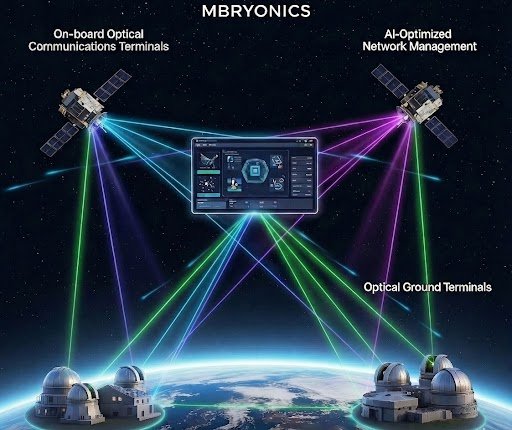
Mbryonics develops advanced optical communications technologies for the space sector, designing optical terminals, laser communication payloads and photonic integrated circuits that enable satellites to transmit far greater volumes of data than traditional radio-frequency systems.
Its free-space optical communication technology uses lasers instead of radio waves to create secure, high-bandwidth links between satellites and from space to Earth for applications including satellite constellations, Earth observation and deep-space missions.
The company specialises in integrated photonics, combining optical components onto compact semiconductor chips to reduce the size, weight and power requirements of satellite communications equipment. Its integrated photonics platform also improves the performance, manufacturability and cost efficiency of optical systems.
Quside (Spain)
Quside develops quantum tech that enhances cybersecurity, high-performance computing and scientific research through the generation and manipulation of quantum light.
The company’s core products are quantum random number generators (QRNGs), which use the inherent unpredictability of quantum physics to produce truly random numbers. These provide a higher level of security than conventional software-based random number generators and are used in applications including encryption, secure communications, data centres, cloud infrastructure and financial systems.
Quside also develops single-photon sources for quantum computing, quantum sensing and quantum communications.
Its integrated photonics technology is designed to deliver scalable, compact and energy-efficient quantum hardware.
Brite Solar (Greece)
Combining photonics, materials science and solar technology, Brite Solar develops transparent photovoltaic glass for greenhouses, allowing growers to generate renewable electricity while maintaining the optimal light conditions for crops. Its patented solar glass uses advanced optical coatings to selectively transmit the wavelengths plants need for photosynthesis while converting the remaining sunlight into electricity.
This enables greenhouses to reduce energy costs and carbon emissions without compromising crop growth or yields.
Collectively, these scale-ups highlight Europe’s strength in photonics, transforming advances in light-based technologies into commercial products that address some of today’s most pressing technological and industrial challenges.
Companies mentioned in this article are members of the EIC Scaling Club, a curated community where 120+ European deep tech scale-ups with the potential to build world-class businesses and solve major global challenges come together with investors, corporate innovators and other industry stakeholders to spur growth.
The EIC Scaling Club is an EIC-funded initiative run in partnership with Tech Tour, Bpifrance (EuroQuity), Hello Tomorrow, Tech.eu (Webrazzi), EurA and IESE Business School.