
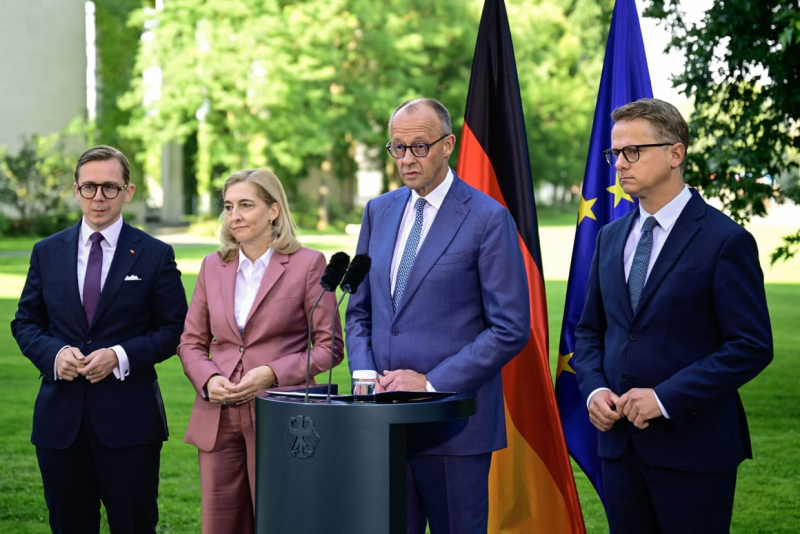

Health Minister Nina Warken will be the first woman to hold the powerful chancellery chief post.
BERLIN — German Chancellor Friedrich Merz on Friday unveiled the first stage of what will be a comprehensive reshuffle of top positions within his center-right Christian Democratic Union (CDU) intended to save his rock-bottom popularity ratings.
The reshuffle comes amid historically low ratings for the chancellor and his centrist coalition and weeks before crucial regional elections in eastern Germany, which could put the far-right Alternative for Germany (AfD) — currently also the most popular political force in the country — in charge of a region for the first time.
“All personnel decisions that I am able to announce to you today are guided by a premise: to continue striving for and achieving what is best for our country,” Merz told reporters at the chancellery in Berlin.
“These personnel changes follow a clear guiding principle,” he added. “We want a government that works with the greatest enthusiasm and joy, while also reflecting the diversity of our society and political landscape. We are a reform-oriented government, and we intend to continue demonstrating that.”
Merz has often been publicly criticized for surrounding himself with men at top adviser level. With the appointment of Nina Warken, the current health minister, as chancellery chief he is putting a woman in charge of the chancellery’s inner workings for the first time in Germany’s postwar history. The position is of strategic importance as it is key to behind-the-scenes brokerage work, for example when mediating between the chancellery and ministries as well as with lawmakers and at state level.
“She is assertive, and she is also well-versed in security policy issues, which are, after all, coordinated here in this house,” Merz said of Warken. “She will therefore be one of the most important — if not the most important— pillars of support for me in the day-to-day work of the government, as well as my primary point of contact.”
The cabinet reshuffle allows Merz to make a political reset before crucial regional elections in September. Polls show that the AfD has a chance of winning an outright majority in Saxony-Anhalt on Sept. 6 and is poised to perform well in Mecklenburg–Western Pomerania and Berlin later that month.
To fend off the rise of the far right, Merz has promised to bring much-needed reforms, for example to the pension system, through parliament this fall. In doing so, he would show voters that the political center is indeed the only viable option to get things done, or at least that’s how the thinking goes in the government.
The current general secretary of Merz’s CDU, Carsten Linnemann, is set to take over as health minister from Warken. He will be tasked with bringing one of the key reforms, the health reform, through parliament later this year.
But his move is also understood by observers as an attempt to save his political career should the CDU lose the regional elections in September. At the same time, Philipp Amthor, state secretary in the digital ministry and one of the few senior CDU figures from eastern Germany, is to move to the chancellery to coordinate relations between the federal and state levels. He is replacing Michael Meister — and more restructuring is to come.
“There will be further changes in the federal cabinet,” Merz announced. “But these decisions will take a few more days — and perhaps even longer — not least in light of the summer recess. However, I will make these decisions without time pressure, with due care, and after holding the necessary discussions,” he said.
One of the remaining positions expected to be affected is that of transport minister, currently held by the CDU’s Patrick Schnieder, according to German media reports.
Merz has a lot of ground to claw back politically. Only 13 percent of Germans are satisfied with his performance, according to the latest benchmark ARD-DeutschlandTrend poll released earlier this month. That is the lowest rating for a sitting chancellor in the survey’s nearly 30-year history.
The strategic reset follows the resignation of Jens Spahn, the parliamentary group leader of Merz’s CDU, and the proposed appointment of chancellery chief Thorsten Frei as Spahn’s successor.
Lawmakers from Merz’s conservative bloc will gather in the Bundestag next Wednesday to vote on the appointment of Frei as their new parliamentary group leader.
The new ministers will also need to be formally appointed by the Bundestag during a plenary session, although this is expected to take place only after the summer recess in September. The new ministers can, however, begin serving in their roles on an interim basis following an initial appointment by the German president.
This story has been updated.