
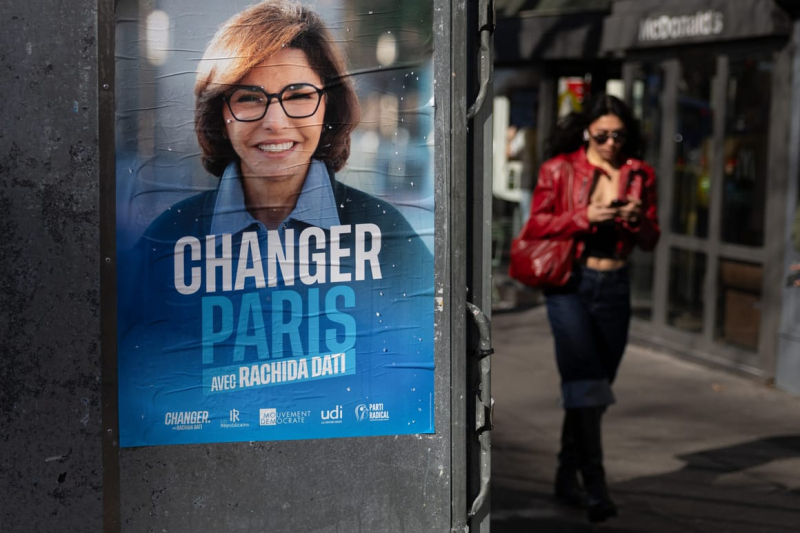

A disciple of ex-President Nicolas Sarkozy, she has a reputation as a tough operator but will probably have to persuade one of her rivals on the right to step down.
PARIS — If Rachida Dati realizes her long-held dream of becoming Paris mayor in the coming days, her victory will represent the culmination of a remarkable journey from her childhood in an impoverished social housing complex to the gilded chambers of City Hall.
The pugnacious former culture minister from the conservative Les Républicains party is running neck-and-neck with the Socialist Emmanuel Grégoire in polls running up to municipal elections on March 15 and 22.
A disciple of former right-wing President Nicolas Sarkozy — and sharing his reputation for acerbic, combative politics — she has campaigned by appealing to voters seeking to pull Paris away from 25 years of left-wing leadership. She has vowed to hire more local police and arm them with guns, end current Mayor Anne Hidalgo’s efforts to get cars out of the city and involve the private sector more in fixing the housing crunch.
“My plan to change Paris is like a boxing match: It takes a lot of commitment, you get hit, and you need perseverance to win,” she said on social media, alongside a video of her visiting a martial arts studio full of sparring fighters.
A victory for Dati in the mayoral race would hand her battered party a symbolic boost ahead of next year’s presidential election, in which the far-right National Rally of Marine Le Pen is currently tipped to triumph.
But the race is going to be close. Five candidates are now expected to progress from the first round on Sunday, making the electoral arithmetic complex. Including Dati, there looks likely to be a trio of candidates from the center right, the conservatives and the far right in the runoff, which risks splitting the vote and gifting victory to Grégoire on the left.
To win decisively, Dati must convince at least one of her opponents on the right that she is the only consensus candidate who can beat Grégoire, and that they should drop out.
The problem? Dati isn’t known in France as a consensus-builder, and her attack-dog instincts once led her to threaten to turn the prime minister’s puppy into a kebab. The 60-year-old is known as a frequent target of gossip magazines due to the intrigue over the paternity of her first child and over her glitzy tastes — an anti-corruption probe into her alleged failure to declare a €420,000 jewelry collection is underway. She denies any wrongdoing.
Dati’s backers say this image is a caricature and that her campaign is successfully hitting home in less affluent parts of the capital — partly thanks to her own rags-to-riches story. Her father was a construction worker of Moroccan origin.
One government minister who is bucking his own party’s candidate to support Dati said her ability to communicate in a direct, forceful manner is “extraordinary” and “allows her to transcend traditional political divides.”
Geoffroy Boulard, the incumbent conservative mayor of Paris’ upscale 17th arrondissement, praised Dati as a “highly recognizable candidate who, through her personality and political background, is making our message heard in less well-off districts where we didn’t perform the last two times.”
Tough math
The passage to the second round, however, puts Dati in a tough spot.
If current polls hold steady, five candidates will net 10 percent of the vote and make the runoff. That would set up a slugfest featuring Dati, Grégoire, Pierre-Yves Bournazel from the center-right party Horizons, Sophia Chikirou of the hard-left France Unbowed and Sarah Knafo, a far-right member of the European Parliament.
PARIS LOCAL ELECTION POLL OF POLLS
All 3 Years 2 Years 1 Year 6 Months Smooth Kalman
For more polling data from across Europe visit POLITICO Poll of Polls.
Dati is expected to outperform Bournazel and Knafo in the first round and wants at least one of them to bow out and back her in the runoff.
“With all due respect for other candidates, this is an election between Dati and Grégoire,” said centrist MEP Sandro Gozi, who is running alongside Dati to be a city councilor.
Teaming up with a firebrand like Knafo could alienate other centrists and Dati supporters, so convincing Bournazel to step back is the safer bet.
Knafo said in an interview with Le Figaro Sunday that she would be opening to joining forces.
Bournazel, however, said late last month that he wouldn’t leave the race to swing it in favor of Dati — whom he accuses of “brutalizing” the public debate through her polarizing style — or Grégoire.
But Bournazel’s candidacy has struggled to get off the ground and to marshal support from the centrist camp, which includes President Emmanuel Macron’s party Renaissance. Though Renaissance nominally backs Bournazel, Macron himself has stayed out of the public fray.
Three officials close to Macron, who like others in this story were granted anonymity to speak candidly, suggested that Dati enjoys the president’s support.
One of the trio said last week that Macron views Dati as a “remarkable person” who “gets things done.” Dati herself said in late February that she is “the candidate for mayor of Paris supported by Emmanuel Macron.”
The head of Bournazel’s party, former Prime Minister Édouard Philippe, spoke with Dati on the phone about the contest last month, according to two elected officials backing Dati’s campaign and a friend of Philippe’s.
The individual close to Philippe — a former conservative who is a presidential candidate next year — cautioned reading too much into the call. One of the individuals working for Dati, however, is convinced Philippe “will never take the risk of letting the left win” by letting Bournazel siphon off potential Dati voters in the second round.
Path to victory
Dati has a path to victory, albeit a narrower one, even if neither Bournazel nor Knafo drop out.
She is campaigning on a made-for-politics life story that sounds like a French version of the American dream, in which robust social safety nets such as free university and public housing helped catapult her to stardom from a mid-sized city in Burgundy, where she grew up sharing her room with several of her 10 siblings.
Her candidacy has been relatively undisturbed by her upcoming trial on charges of illicit lobbying as an MEP and as well as the undeclared jewelry allegations. (She denies wrongdoing in both cases.)
She also enjoys strong name recognition thanks to her tenure as justice minister and, more recently, as culture minister.
Accepting the role two years ago required a political transformation from fierce critic of President Emmanuel Macron to vociferous ally. But that was a small price to pay for the media exposure that followed.
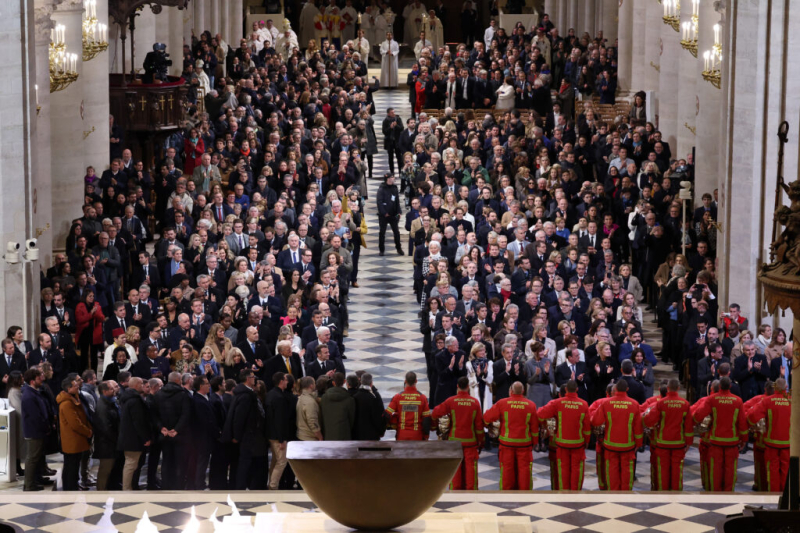
As culture minister, Dati was front and center at some of France’s most iconic events, including a second-row seat at the reopening of the Notre-Dame Cathedral.
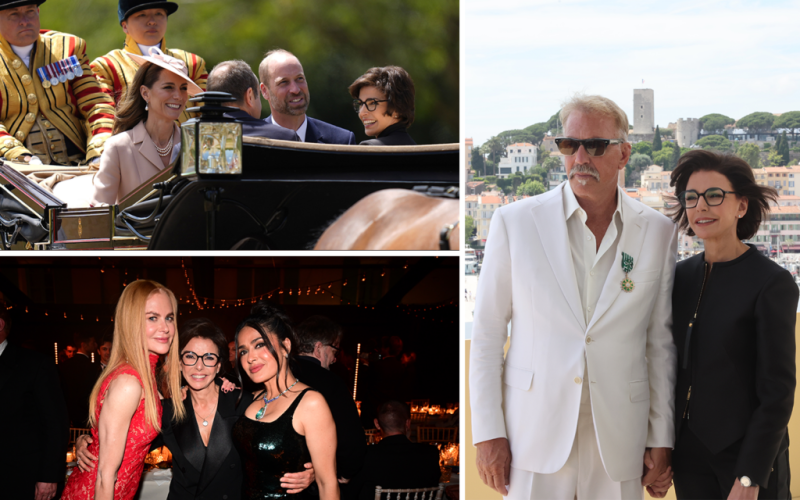
Dati was a mainstay at the glitzy Cannes film festival, photographed hand-in-hand with Hollywood royalty such as Kevin Costner.
And during Macron’s state visit to the United Kingdom over the summer, she rubbed shoulders with actual royalty, joining Prime Minister Sébastien Lecornu for a carriage ride with Prince William and Princess Kate.
Dati’s critics allege she sacrificed her principles to join Macron’s cabinet in 2024 with an eye on boosting her profile and securing the French leader’s support for her candidacy early on. The audio of a group call between her and a group call with conservative Paris city councilors obtained by France’s public broadcaster suggested the contours of a deal with Macron’s camp were in place.
Although Dati batted down those accusations, she has developed a reputation for being ruthlessly strategic. She reportedly kicked up a fuss within Les Républicains last year over a Parisian by-election in order to leverage the conservative party into supporting her mayoral bid.
That notoriety is a problem for a candidate trying to sell herself as a unifier treating the moment with humility.
So, on the stump, Dati has tried to frame her ambition as that of a passionate civil servant — even invoking a conversation she had with her mentor Simone Veil, the famed Holocaust survivor who led the charge in France to decriminalize abortion, about the dangers of “getting drunk on power.”
Yet Dati also calls Paris “the fight of my life,” so few expect her to pull punches.
Victory, in that case, will depend on delivering a convincing message about who she is actually fighting for.