
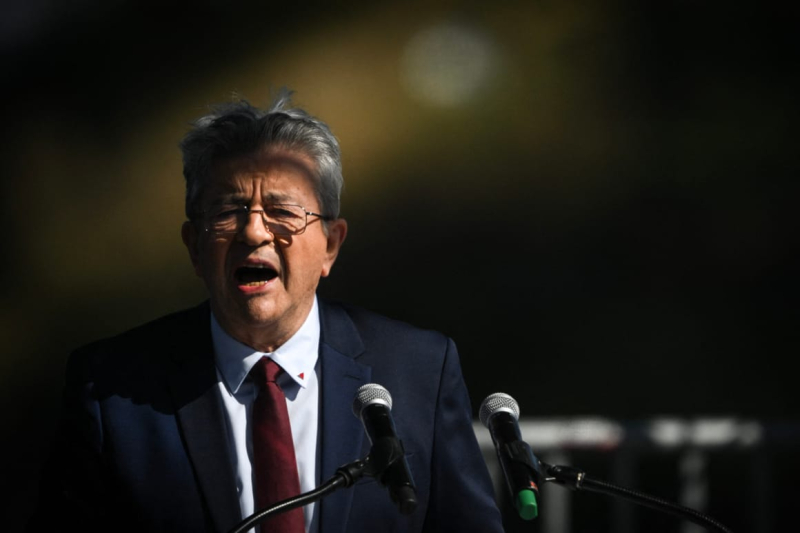

The France Unbowed leader’s strong polling numbers are forcing the Greens to consider an alliance.
CHÂTEAUNEUF-SUR-ISÈRE, France — Jean Luc-Mélenchon’s strong start to his presidential campaign has pushed key figures from the French Greens to publicly discuss whether the best way to advance their agenda is to sit out next year’s election and instead back the increasingly popular leftist.
Were the Greens to throw their weight behind Mélenchon — who wants to pull France out of NATO and views the European Union as a vehicle for unbridled German-style capitalism — it would solidify his position as the race’s dominant left-leaning candidate and increase his chances at advancing to the contest’s second round, where he’d likely face far-right front-runner Marine Le Pen.
The French presidential election goes to a two-candidate runoff round if no one receives an outright majority in the first round of voting, and the second spot often comes down to the wire. In France’s last two presidential elections, Mélenchon missed the runoff by less than 2 percent of votes.
Rumblings of a Mélenchon-Green alliance began over the weekend when influential Greens attended the annual conference for his party, France Unbowed. Green presidential candidate Marine Tondelier did little to tamp down the speculation at a press conference Wednesday when asked about Mélenchon and center-left contender and MEP Raphaël Glucksmann’s platforms.
“Neither Jean-Luc Mélenchon nor Raphaël Glucksmann are the worst enemies of ecology in France,” Tondelier said. “It’s the power of the ecologists to see that the debate on the left is now focusing on who is the biggest environmentalist.”
Tondelier is making history as France’s first pregnant presidential candidate, but she has struggled to break through among a crowded field. She is polling in the low single digits, far from the vote share needed to advance to the runoff — but potentially enough to push Mélenchon into second place, if current polls hold.
At her Wednesday press conference, Tondelier said she would be giving birth “imminently” but was eager to keep pushing her policy proposals until then.
Were Tondelier to stay in the race and split the left-wing vote, it could mean France has a third consecutive presidential election without a left-leaning option in the second round. A few voices from the Green party’s centrist wing are looking toward Glucksmann, but the loudest calls have been in favor of partnering with France Unbowed.
The Greens’ top lawmaker Cyrielle Châtelain is among those leading the charge in favor of partnering with Mélenchon.
Châtelain attended France Unbowed’s summer event along with seven other party officials, where she told reporters that “there is common ground” between the Greens and Mélenchon. She even appeared before cameras flashing a wide grin beside Mélenchon — a strong political signal given her key role as the party’s top lawmaker in the National Assembly.
“We are at two crossroads at once,” she said, referring to the rise of the far right and the climate change-fueled heat and wildfires that engulfed France over the summer. “What matters now is finding the most effective way for the Greens to put their ideas forward.”
L’écologie est un bien commun. Ravi d’accueillir Cyrielle Chatelain aux #AMFIS2026. pic.twitter.com/laVEhYp4eq
— Jean-Luc Mélenchon (@JLMelenchon) August 21, 2026
On paper, Mélenchon has some of the credentials needed to convince the Greens. He has defined himself as an “eco-socialist” for over a decade and stressed the need to “unite the red with the green.” Even Monique Barbut, the former head of WWF France who now serves as ecology minister in France’s current center-right government, said in a recent interview that Mélenchon is the candidate who “incorporates climate issues most fully into his proposals.”
The foreign policy split
There are, however, sticking points. Mélenchon is a vocal critic of the European Union in its current form, which he sees as an engine for unregulated capitalism, while the French Greens have long advocated for European federalism.
“[The EU] is a fundamental issue, because our project conflicts with European regulations,” said Clémence Guetté, who is in charge of writing Mélenchon’s presidential platform. “We know where our disagreements [with the Greens] are.”
Mélenchon and the Greens have also clashed on support for Ukraine. Mélenchon is against Ukraine joining the EU and said his goal was to “bring Russia back into the European family,” while the Greens have been much more adamant in their support for Kyiv in its war against Russia. The Greens also see Mélenchon as too friendly toward China.
Yet key officials from both parties say the differences can be managed.
Paul Vannier, a lawmaker who is in charge of electoral matters for France Unbowed, told reporters last week that his party was “ready to discuss” policy changes with the Greens and promise the them cabinet roles in a Mélenchon presidency.
The Greens, loyal to their calls for left unity, don’t disagree.
“Those who say that the different factions of the left can’t be reconciled are lying,” Léa Balage El-Mariky, who is Tondelier’s campaign director, told reporters last weekend — while attending the France Unbowed conference.
Aude Le Gentil contributed to this report.