
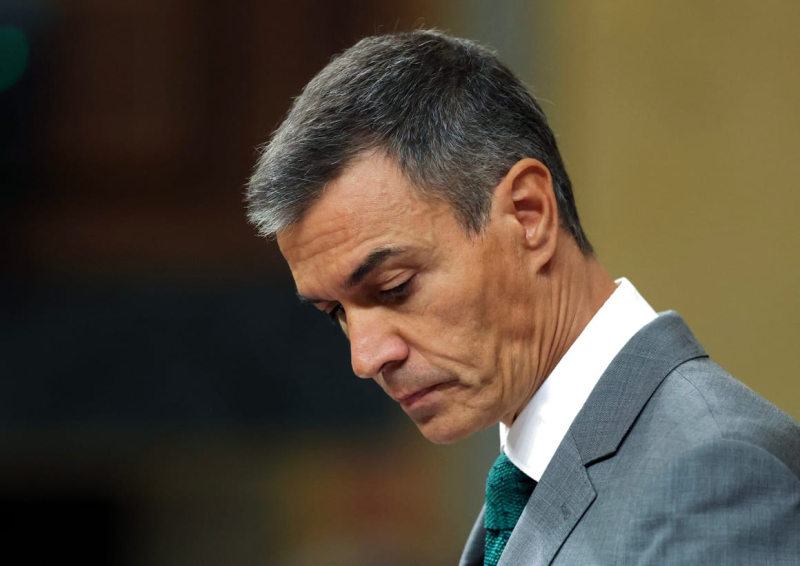

The prime minister could seize on a looming parliamentary defeat to campaign on housing, an issue that has fueled protests across the country.
High-ranking members of the Spanish government suggested Friday that Prime Minister Pedro Sánchez could call a snap election if key housing decrees fail to pass in the morning’s emergency parliamentary session.
Sánchez’s government unveiled two long-delayed housing decrees Tuesday to curb speculative practices, extend eviction protections for vulnerable tenants until 2030 and automatically renew existing rental contracts, following nationwide demonstrations after 87-year-old Maricarmen Abascal’s eviction from the apartment in which she had lived since 1956.
There initially appeared to be enough parliamentary support to pass at least one decree. But late on Thursday, the Catalan separatist Junts party, which is conservative on landowners’ rights, announced that it would oppose both measures, ensuring their defeat.
Sánchez responded defiantly, saying on X that he would not withdraw the decrees and casting the parliamentary vote as a breaking point: “The hour of truth has arrived,” he wrote, adding that lawmakers were obliged to cast “votes that will define them for generations to come.”
Ahead of the parliamentary session, anonymous government sources told Spanish newspaper El País that Sánchez was leaning toward calling a snap election if the decrees failed. In an interview with Cadena SER, Deputy Prime Minister Yolanda Díaz said she had spoken with Sánchez and declined to rule out an early vote.
Spain’s current legislative term is due to end next summer, and speculation has been mounting that the prime minister — who is under pressure over the ongoing migrant crisis in Ceuta, as well as corruption cases involving members of his family and close political allies — could seek an opportune moment to call a snap election.
With housing consistently ranking among Spaniards’ top concerns, Sánchez may seek to capitalize on popular discontent by casting the opposition as an obstacle to addressing the crisis.
The center-right People’s Party currently leads in electoral polls, with 34% support. Vox is polling at 18%. Both parties oppose measures that challenge landlords’ property rights and instead favor deregulation and incentives for private owners.
At the request of Sánchez’s Socialist Party and far-left Sumar, which make up Spain’s coalition government, Friday’s vote is being conducted by a show of hands, forcing lawmakers to publicly reveal their positions on the government’s housing measures — potentially giving the prime minister an opportunity to portray opponents as standing in the way of efforts to tackle the crisis.
Friday’s parliamentary vote comes amid nationwide demonstrations over the housing crisis, with protest encampments set up in major Spanish cities. As the session began, protesters in Madrid marched toward the Spanish parliament, where they were met by more than 1,000 national police officers deployed to protect the building.
The Spanish Tenants’ Union, which is leading the protests, is calling for a general strike and vowing to continue occupying the capital’s central Puerta del Sol until their demands are met.
Spain’s national government has so far declined a request from Madrid’s local and regional governments to clear the square. Center-right Regional President Isabel Díaz Ayuso has filed suit in court demanding Sánchez’s government be ordered to clear the protest in Madrid; a ruling is expected this afternoon.