
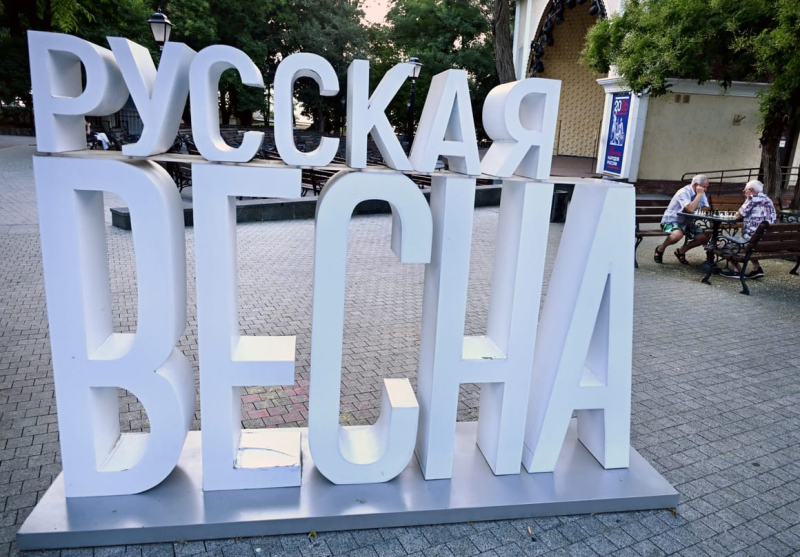

As discriminatory Russian policies permeate every aspect of residents’ lives here, many wonder what, if anything, Ukrainian will remain.
No political rights. No freedom of expression. No protection from secret detention without access to family, an attorney or a physician. No protection from deportation.
Welcome to Russia-occupied Ukraine.
For the second year running, U.S.-based democracy tracker Freedom House has listed Ukraine’s occupied eastern and southern territories as the most unfree places in the world — outranking South Sudan, North Korea and the Gaza Strip.
Inhabitants here are subject to repressive Russian legislation, including forcibly imposed citizenship and the use of antiterrorism laws against political dissidents and religious minority groups, Freedom House says. And it is this system of surveillance, repression, indoctrination and state theft that pushes occupied Ukraine to the top of the list.
Discriminatory policies publicly encoded in Russian law permeate every aspect of residents’ lives — measures that appear to be changing the region’s demographics. Russia is “deliberately changing the ethnic composition so as to destroy a culture or tip the political balance in favor of another group,” the report notes.
International humanitarian law forbids any occupying power from introducing permanent changes to territories it occupies, particularly in demographic, social and economic domains. But Moscow claims these areas are not occupied — they are simply a part of Russia, and therefore subject to Russian law.
“This occupation is one of the most well-documented systems of repression, oppression and human rights violations because so much is put on the public record,” said Danielle Bell, head of the U.N. Human Rights Monitoring Mission to Ukraine. “This is a systemic approach to restricting people’s rights and fundamental freedoms.”
Since 2022, HRMMU has noted at least 16 Russian laws and decrees limiting the rights of Ukrainian citizens in these territories. Schools teach a Russian version of history, instilling Russian identity and values. “Ukrainian nationalism,” which includes expressing sympathies with Ukraine or using the Ukrainian language, is punished as “extremist.” And resettlement from Russia to these areas is actively encouraged.
The regime has “all the signs of cultural genocide,” said journalist Andrii Dikhtiarenko, a native of now-occupied eastern Ukraine.
From passportization to deportation
Starting from 2014, Russia has occupied about 20 percent of Ukraine in the country’s south and east — land Moscow calls “new historical territories.” And one of the processes aiding the Russification of these areas is passportization.
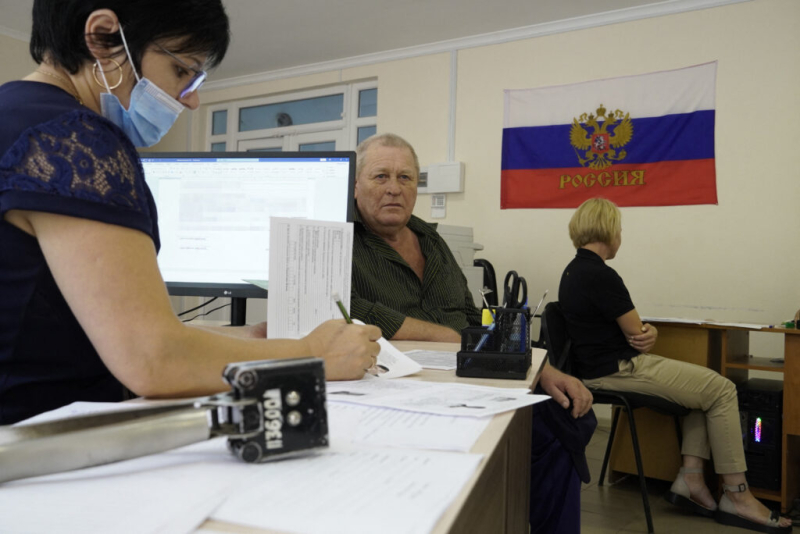
By officially designating Ukrainians living in Russia-occupied territories as “foreigners,” occupation authorities compel them to obtain Russian citizenship — which they can do through simplified procedures — in order to access essential rights, such as health care, social services, employment or property ownership.
For Liudmila Chub, it all began with her job. Speaking to POLITICO, Chub said that in 2023, she was told by her employer in Melitopol — located in the occupied Kherson region — that she had to obtain a Russian passport to keep working in his shop, or he would be fined. Chub went to the passport office, where she recorded an angry video about being forced to get a “chicken passport” — a dig at the two-headed Russian eagle emblem. The office’s security guard marched her straight to the occupation police.
Chub spent the next eight months in detention in Kherson, with the courts regularly extending her arrest, alleging she was breaking military curfew. She was eventually given a statement to read out on camera, saying she did not want to live in Russia, then was allowed 15 minutes to collect items from her apartment and transported under armed guard to Russia’s border with Georgia.
Deported from the home she lived in her whole life, Chub still considers herself fortunate. She said others she encountered in prison had gone through the process of obtaining Russian citizenship only to be charged with spying or treason under Russian law, which carries huge sentences.
“They tie this passport to you, and then with it, they make you traitors to their country,” she said. “Everything in me was opposed to getting that passport, and it’s lucky I didn’t get it. That saved me.”
HRMMU has so far documented over 400 such detentions involving treason- and espionage-related charges in Russia-occupied territories, but it’s impossible to track numbers for incommunicado detention.
That is what happened to 59-year-old IT specialist Serhii Gryshchenkov from Sevastopol in occupied Crimea. After Russian security forces took him from his home in May 2025, Gryshchenkov’s family was unable to find out where he was, his daughter Darina told POLITICO. Her father, who did not hide his pro-Ukraine position, was held incommunicado and tortured for a year before eventually being charged with treason in June 2026, she said. The family does not know the details of the charges.
According to Darina, when her father reappeared in pretrial prison, he spoke of fellow prisoners who were still being secretly held after three or four years. “Their relatives don’t even know whether they are alive.”
Some residents Russia claims to have deported are actively missing and may be in prison like Gryshchenkov, says HRMMU. Thousands of others have been indirectly deported, forced to leave via intimidation, violence and discrimination.
No home to go back to
One strategy encouraging demographic change in Ukraine’s occupied territories is the official confiscation of homes belonging to residents who fled the war, ensuring they cannot return.
New laws established since the occupation allow Russian authorities in these areas to seize empty, “ownerless” property unless they have been re-registered in person by the owner, who must also be a Russian citizen.
Ukrainians who try to comply with this new rule and travel back home have fallen afoul of Russian “filtration,” faced with arrests and entry bans at Moscow’s Sheremetevo airport — the only possible entry point to get to occupied territories, as land borders are closed to them.
Journalist Olena — who was granted anonymity over security concerns regarding her relatives living under occupation — told POLITICO she had fled occupied Donetsk with her family in 2014. Helped by a sympathetic condominium manager, she had paid the utility bills for her own and her parents’ apartments for the next 12 years, hoping one day they could come home.
Later, Olena found out via occupation media that she had been publicly blacklisted as an “enemy.” Meanwhile, an acquaintance of hers was served a 50-year entry ban at Sheremetevo when trying to get back to her home in occupied Ukraine.
With this new law, “nothing can help us,” said Olena.
According to HRMMU monitoring, more than 60,000 private properties in occupied Ukraine have been identified as “ownerless” as of July this year. At least 6,500 of those properties have been expropriated, often given to veterans of Russia’s “special military operation” or sold to immigrants from Russia under preferential terms.
Rewriting history
Personnel records in occupied territories show that administrative, civil service and governance structures are steadily being taken over by newcomers from Russia.
The effect of this has heavily impacted education in the region, with the introduction of a militarized Russian curriculum in schools. New textbooks teach the Kremlin’s official narrative that the occupied regions never supported Ukrainian independence and were always Russian. Parents who refuse to enroll their children in these schools, or enroll them in online Ukrainian education, are fined and threatened with losing parental rights.
These educational institutions can sometimes funnel students straight into the Russian armed forces. Once an individual holds a Russian passport — which the enforced system makes almost impossible to survive without — they can be drafted to fight against Ukraine. A practice that, like deportation, is explicitly prohibited by the Geneva Conventions.
The cumulative effect of all these measures has been the eradication of visible expressions of Ukrainian identity and wider dissent, said journalist Dikhtiarenko. “People who want to survive have to accept the rules of the game.”
Over at HRMMU, Bell’s worst fear is that the world will stop hearing about or noticing these violations. “When the climate becomes that coercive and that restrictive, and people are that silenced, that’s when we stop seeing the reports because people stop daring to speak out,” she said.
As more time passes, some inhabitants wonder whether there will be anything Ukrainian left, even if their home ever comes back under Kyiv’s control. However, despite their enforced Russian citizenship, Dikhtiarenko said the majority of residents still hold on to their Ukrainian passports, hiding them under floorboards or buried in the garden.
“It’s their little ticket to freedom,” he said.