
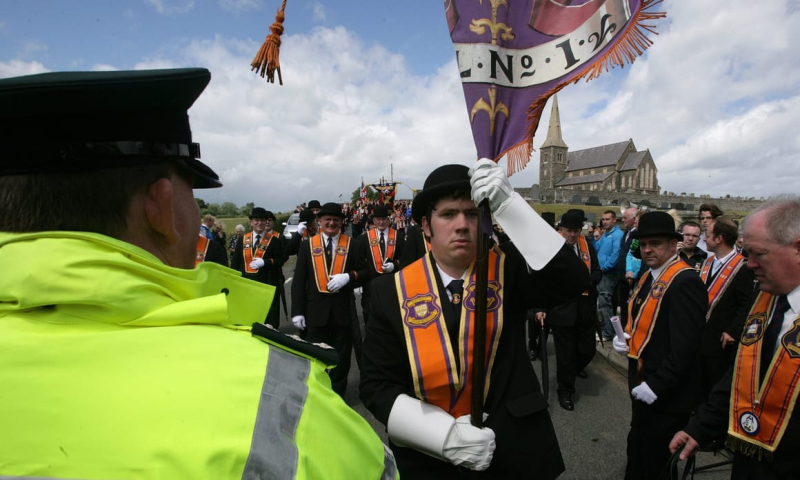

After a 13-day standoff in Portadown, the reversal thrills Irish republicans and enrages Northern Ireland’s unionists, who had hoped to complete a parade blocked since 1998.
DUBLIN — The U.K. government has reversed a decision to permit a parade by Protestant hard-liners through a Catholic district in Northern Ireland, a U-turn that overjoyed Irish republicans and infuriated the region’s British unionists.
After a nearly two-week standoff in the predominantly Protestant town of Portadown, Northern Ireland Secretary Chris Bryant announced late Friday that the Orange Order would not be allowed to parade through the town’s main Catholic district for the first time in 28 years.
The Orange Order, a Protestant fraternal group reviled by many Catholics, had been barred from the route since 1998 following years of widespread violence triggered by the annual sectarian showdown.
“I call for all protests, rallies and demonstrations to be stood down. There is no excuse for a continued ratcheting up of tensions,” Bryant appealed in a statement explaining why he was reversing the original decision by the Parades Commission, Northern Ireland’s independent body for managing the region’s chronic conflicts over Orange Order demonstrations.
Street fighting over those traditional marches helped to trigger the onset of Northern Ireland’s three-decade conflict, known as “The Troubles,” which left nearly 3,700 dead before a 1998 peace accord.
Hundreds of Catholic locals backed by Sinn Féin, the Irish republican party that leads Northern Ireland’s fraying cross-community government, gathered along the Garvaghy Road in Portadown to cheer the reversal.
First Minister Michelle O’Neill, who has been accused of breaking the law while helping locals block the Orangemen’s intended path since Sept. 27, went on Ireland’s flagship TV talk show, the Late Late Show, to express relief on behalf of the residents of Garvaghy Road.
“For the last 13 days they’ve been living with this constant fear and a cloud hanging over them that this unwanted sectarian march was going to be forced down that road,” she said.
But the main pro-British party in the coalition, the Democratic Unionists, denounced Bryant’s move as a capitulation to mob rule. Some DUP lawmakers called for Northern Ireland’s police chief, who had recommended the policy reversal, to be fired.
Democratic Unionist leader Gavin Robinson said the U.K. government had sent a dangerous message that Northern Ireland “should be run on force of numbers and who shouts the loudest.”
Northern Ireland’s nearly three-decade system for managing conflict over parades “now lies in tatters,” he said, “and the rule of law has been fundamentally undermined.”