


Contents
"Most AI features stall because nobody redesigned the work around them. Map the workflow first, put AI on high-volume steps that can be checked, keep people on decisions and agree baselines before building." 7 hours ago
Most AI features that stall between demo and production fail for a reason that has little to do with the model: nobody redesigned the work around them. The AI features I’ve seen earn their cost started with the workflow, mapping where data arrives, which checks repeat and where a person has to decide, and only then put AI on the slow, high-volume steps that can be checked.
The demo that impresses and then stalls
Most companies I talk to have an AI demo, and it usually proves that AI can do the task. What it rarely proves is that the task was worth doing, and the difference between the two is a business metric someone cares about. This is the year a lot of those demos are being asked to pay for themselves.
The pattern behind that gap is familiar. A team picks a model, builds something that answers questions or extracts data convincingly and shows it around. Then it meets the real work: inputs messier than the test set, edge cases nobody listed, a reviewer who doesn’t trust the output and a process that was never changed to make use of it. The demo was built around the model, while the work it was meant to change stayed exactly as it was.
Having built demos and products, I’d put the difference down to the order of the work more than to the choice of model. The AI features I’ve seen pay off began with a few weeks spent mapping the workflow they had to fit: where the data comes from, which checks repeat and where a person has to decide. Only then did anyone choose where AI should go. Two projects aren’t a study, but the pattern they show has held across our other AI work. Here is what that order looked like on two of them, one already in use and one still being built.
Two projects that started from the work
A US-based energy intelligence platform onboarded each new client by hand. Customers sent years of consumption and billing data as PDFs and spreadsheets, and analysts cleaned, validated and normalised it before the product could do anything useful with it. Onboarding often took more than six months per client. We began with a product design phase, working with the platform’s own experts to map how onboarding really ran, and only then designed and prototyped a pipeline in which AI agents handle extraction and validation. That first phase has already halved onboarding time, and the rest of the pipeline is still being built.
A major academic publisher had a different bottleneck. Every submission went through pre-peer-review checks done by hand across several systems, while integrity risks such as paper mill submissions (fabricated papers produced to order) and AI-generated text kept getting harder to spot. Here too we started with the workflow: workshops with the editorial operations and research integrity teams mapped every check and handoff before anything was automated. AI came in after that, flagging warning signs such as mangled paraphrasing or an inconsistent author list, while the checker kept every decision. The first version reached checkers in five months and has since been rolled out across the portfolio in batches, with more than 30 journals onboarded in a single wave.
What mapping the work found
In both cases the mapping shaped what we built. At the energy platform, it showed that the data arrived in as many formats as there were utilities: each one structured its invoices and reports differently, and every figure had to stay traceable for compliance. A general-purpose extraction model would have looked good on a sample and struggled with everything outside it, so the pipeline was designed around models tuned to those specific formats, with a validation step on every figure.
At the publisher, the mapping showed that the problem was as much the workspace as the checks. Checkers moved between several systems for each submission, and supervisors had little view of who was working on what. So the first version brought every check into a single workspace with assignment and progress tracking, and automation went only to the checks that carried the most manual load and the highest integrity risk.
Neither finding is something a model could have told us. Teams that skip this stage still have to find these things out, only later and in production.
For a founder building a new product, there is often no internal workflow to map yet. The work to map is your customer’s, and a few weeks spent on it settles more than any model comparison will. Start by watching a handful of target customers do the task your product replaces, step by step, including the spreadsheets and workarounds they would never put in a requirements document. Collect real samples of the data your AI will see, from several customers, before choosing a model, because your test set should be as messy as their inbox.
The cheapest test comes last. Prototype the whole workflow with a person standing in for the AI step and put it in front of customers before building the pipeline. If the workflow doesn’t hold up with a person doing the AI’s job, a model won’t rescue it.
Where AI goes and where people stay
In both projects, AI went to the steps that were high in volume, repetitive and checkable, such as extracting figures from a utility invoice or checking an author list against flagged names. People kept the steps that needed judgement or carried accountability. In between sit two things that rarely appear in demos: validation and fallback paths for when the AI gets it wrong, and a way to adjust the rules as the work changes. For the energy platform, the checks on every extracted figure are what will make the data safe to rely on. For the publisher, the editorial team can edit the integrity lists and step instructions themselves, so the checks keep up with policy without waiting on a development cycle.
This is also where trust comes from. At the publisher, every automated check points the team to something worth a closer look and leaves the decision with them. Feedback from checkers in weekly demos decided what got built next, so the tool grew around how they actually worked.
We run our own delivery the same way. On our projects, AI agents write a measured share of the code and every change they make goes through human review. After each sprint, the team turns reviewers’ comments into written rules the agents follow from then on, so reviewers aren’t correcting the same thing sprint after sprint.
Decide what good looks like before building
One habit sits underneath both projects, and it’s the least glamorous: before building, agree on the baseline and the threshold. That means how long the task takes today, how accurate the output has to be and what result would justify the cost. The energy platform knew onboarding took more than six months per client, and that baseline is what makes the halving a result anyone can check. Without those numbers, every later conversation about return turns into a matter of opinion, and a feature that works well can still be cancelled because nobody can show what it changed.
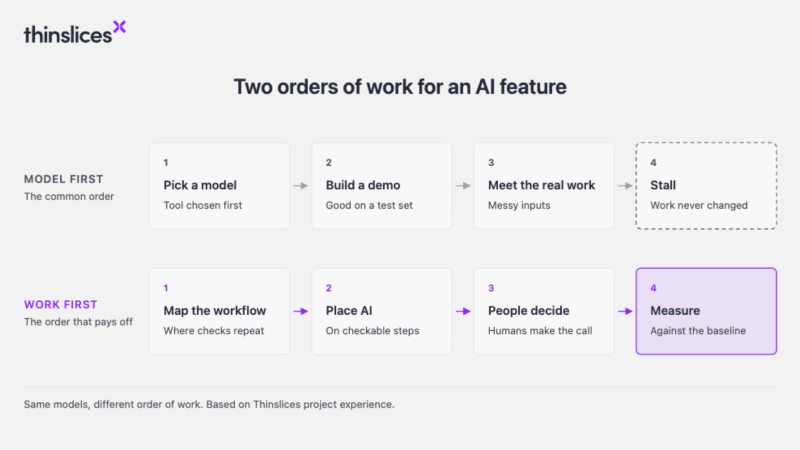
Questions to ask before funding an AI feature
Whether the work happens in-house or with a partner, a few questions separate a feature that will pay off from a demo that won’t.
- Which step in the workflow does this replace or speed up, and how is that step measured today?
- What happens when the AI is wrong, and who catches it?
- Who has the final say, and can they see and override what the AI decided?
- What result, agreed now, would justify the cost?
Start with the work
Models get better and cheaper every few months, which leaves the work around them as the part that decides whether an AI feature pays off. Teams that fund the mapping first rarely end up funding a demo.
At Thinslices, AI features start the way every new build does: with a product design phase.
Author: Tudor Iordache, CTO at Thinslices
About Thinslices
Thinslices is a product development company that designs and builds digital products and AI for funded startups, scaleups and corporate innovation teams in the US, the UK and DACH. Since 2010 it has delivered more than 220 projects, with a client NPS of 91 for the first half of 2026. Its work starts with a product design phase of three to five weeks, which leaves founders with a prioritised scope, a clickable prototype and an estimate range before development begins.
About the author
Tudor Iordache is CTO at Thinslices. He joined the company 13 years ago as an iOS intern, worked his way through engineering and technical lead roles and still acts as technical lead on many of its product design phases. He also leads the company’s work on agentic software delivery. He writes about AI in production, software architecture and the cost of building digital products.