
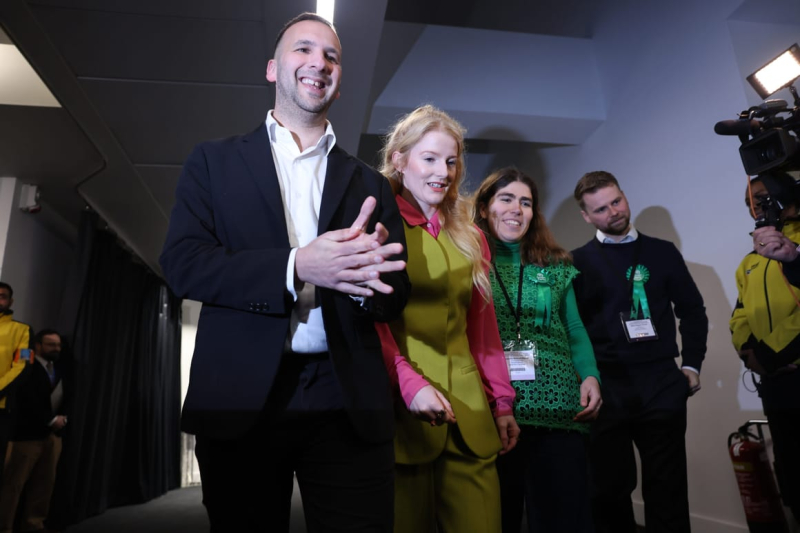

The eco-populist promised to take on both Keir Starmer and Nigel Farage — but the Greens have faced claims of stoking division.
LONDON — The self-styled “eco-populist” leader of Britain’s Greens rose to the top of his party with a promise to take on both Keir Starmer and Nigel Farage — and win.
This morning, in one corner of north-west England at least, Zack Polanski and his newest MP, Hannah Spencer, have done just that.
Spencer convincingly won Thursday’s Gorton and Denton by-election with 40.6 percent of the vote, keeping Farage’s Reform in second place and pushing the governing Labour Party into third.
The Green vote climbed 27.4 percentage points on 2024’s result — and the win marks their first-ever by-election victory.
It caps six months in which Polanski has presided over a leap in his party’s poll ratings and sought to retool its message. He has actively channeled Farage’s UK media strategy by putting himself front and center of an argument for change painted in primary colors — but faced accusations of stoking division in the process.
“I don’t want everyone to agree with what I or the Green Party is saying,” Polanski told POLITICO in an interview in October. “What I do want everyone to know is, I’ll always say what I mean.”
‘Reaching the ceiling’
Polanski won a landslide victory in the Greens’ heated leadership election last year, handing him the reins of a party that had already made inroads at the last election.
“We were reaching a ceiling of where you could get to by [the] ground game alone,” Polanski reflected of the Greens’ past performance when speaking to POLITICO last year. “What maybe was holding us back was not being heard in the national media.”
Polanski has said he wants to “make sure that the media have an easy access point” to the party, and the Green leader seems willing to go to places where he’ll have to put up a fight, too — including a colorful on-air battle with Piers Morgan.
He has overseen a steady polling uptick for the left-wing outfit, as borne out in POLITICO’s Poll of Polls. “There’s a definite and obvious increase,” says YouGov’s Head of European Political and Social Research Anthony Wells. “He’s already far better known than [predecessors] Carla Denyer and Adrian Ramsay were.”
“It’s not like the public are in love with him, but the public do … dislike him less than most of the party leaders,” Wells added.
‘We know how it feels to be looked down on’
Friday’s victory speech by Spencer, the party’s newest MP, shows how Polanski has also tried to foreground cost-of-living concerns, at the expense of the Greens’ traditional eco message.
Spencer — a borough councillor, plumber and self-described “pretty normal person” — mixed attacks on billionaires with a direct appeal to Britain’s “white working class.”
“We know how it feels to be looked down on, maybe because we didn’t do well at school, maybe because … we are shut out of places we should be in,” she said. “To people here in Gorton and Denton who feel left behind and isolated. I see you and I will fight for you.”
The Greens campaigned hard, flooding the constituency with up to 400 volunteers a day. But Spencer and Polanski have also faced claims that they have pushed a “sectarian” message in directly appealing to the seat’s Muslim vote over the war in Gaza. “We are losing our country,” said Reform’s second-placed candidate Matt Goodwin in response to Spencer’s victory Friday. “A dangerous Muslim sectarianism has emerged. We have only one general election left to save Britain.”
Green volunteers on the campaign trail were surrounded by boxes of leaflets draped in the Palestinian flag. They focused on Gaza as an issue, and the party actively highlighted comments by Starmer that had previously inflamed tensions between Labour and Muslim supporters. Leaflets were handed out to worshippers at the mosque at prayer times.
Spencer rejected the charge of running a divisive campaign Friday morning, saying that “whilst our communities may sometimes be labeled in different ways, the thing everyone seems to have underestimated here, especially over the last few weeks, is how similar we all actually are.”
Conviction politics
As Farage bids to eclipse the Conservatives as a right-wing force in British politics, he has used regular defections to Reform UK to show he’s on the march. Polanski has tried similar, crowing about defections by ex-Labour councilors from the left.
In video campaigning, too, Polanski has taken a leaf out of Reform’s book. He peppered his leadership run with arresting monologues to camera, and has opted to weigh in on — rather than duck — the divisive issue of immigration.
Praising the contribution of migrants when polling shows the public want lower levels is a risky bet. The Green leader argues voters will respect a clear stance, even if they disagree. “People who know that their politicians are telling the truth and are speaking with conviction are always preferred,” he says.
Speaking to POLITICO in February, Spencer argued that the Greens were already neutralizing one Labour attack: that a vote for Polanksi’s party would simply let Reform in.
“The whole Labour strategy sort of seems to be the tactical one again of vote Labour to keep Reform out, but everyone’s used to hearing them saying that about the Tories,” Spencer said. “And I think now people are thinking: why would we keep just doing that as a threat rather than voting for who we actually want to vote for?”
Whether the victory Friday translates into electoral success beyond Gorton, however, remains an open question. May’s local elections will offer the first, broad-scale ballot box test of Polanski’s pitch.
Sam Blewett and Matt Honeycombe-Foster contributed reporting.