

Anzen Industries is developing cell-free biomanufacturing technology to produce complex chemicals more efficiently and strengthen global supply chain resilience.
UK-based deeptech startup Anzen Industries has raised $2.2 million in pre-seed funding, led by LocalGlobe and Creator Fund, with participation from strategic angel investors across the UK, EU, and US, including Konstantin von Unger and early-stage investor Cory Levy.
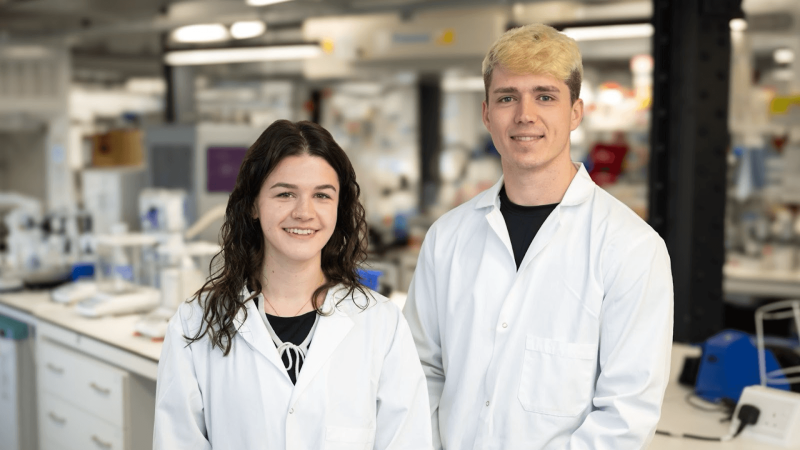
Founded by scientists Amy Locks and Pedro Lovatt Garcia, Anzen Industries is a biomanufacturing company focused on producing high-value chemicals using cell-free enzyme systems.
The company develops reusable, low-infrastructure enzyme reactors designed to manufacture complex molecules more efficiently than traditional chemical synthesis, plant extraction, or fermentation-based methods. Its goal is to improve the resilience, scalability, and economic viability of global supply chains for critical chemicals across multiple industries.
Anzen’s platform combines proprietary enzyme reactor technology, enzyme immobilisation techniques, and AI-driven design to enable biochemical reactions outside living cells. This first-principles approach allows highly specific and tunable enzymes to operate within small, modular reactors, supporting more flexible and cost-effective scaling while reducing reliance on capital-intensive infrastructure.
Co-founder and CTO Pedro Lovatt Garcia outlined the company’s technical vision, saying:
We started Anzen Industries because we believe that, from first principles, the future of manufacturing will be cell-free. If enzymes can be kept robust outside of the cell, we can carry out the same manufacturing reactions at a fraction of the infrastructure, energy and cost.
Existing approaches to manufacturing complex chemicals face several constraints. Organic synthesis can be difficult to scale, plant extraction depends on variable agricultural supply, and fermentation typically requires significant infrastructure and downstream processing, leading to high capital costs. Anzen’s cell-free system is designed to address these limitations by improving efficiency and shortening time to market.
Commenting on the investment, Julia Hawkins, General Partner at LocalGlobe, said Anzen is rethinking how critical molecules are produced from first principles, to improve speed, resilience, and control across global supply chains.
CEO and co-founder Amy Locks highlighted the role of Europe’s scientific ecosystem in the company’s early development, noting:
Europe’s strong scientific heritage and innovation community allowed us to take our breakthrough from scientific discovery to a viable commercial venture.
She added that the United States offers an environment well-suited to the company’s next phase of growth, as Anzen looks to scale its technology globally.
The company plans to use the funding to relocate operations to the United States, establish its first manufacturing facility, and expand industrial collaborations and partnerships as it scales its biomanufacturing platform.