
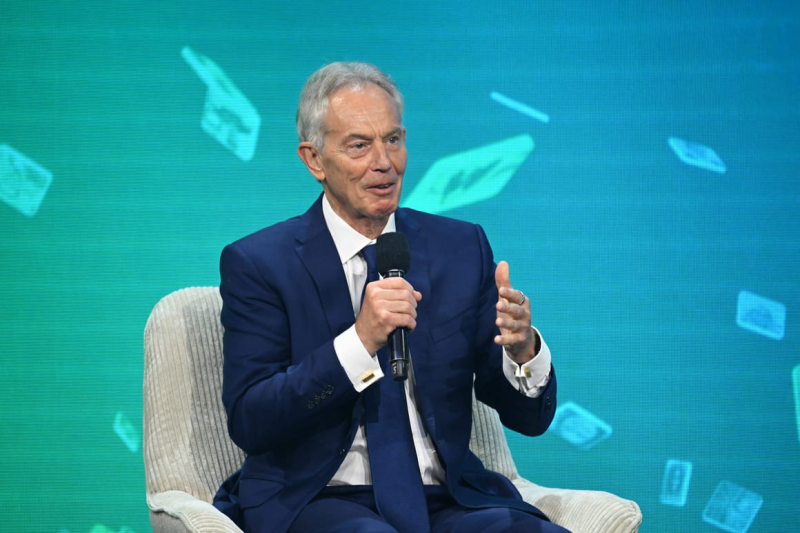

Potential leadership contenders raced to critique the former PM’s diagnosis of what’s gone wrong with the party.
Former British Prime Minister Tony Blair intended his bracing meditation on the state of the nation to land as a shock to the center-left system and its inadequacy to face up to urgent problems for the U.K. at home and abroad.
That aim has been fulfilled: His essay, in excess of 5,000 words, published late Tuesday, has dominated the political airwaves in the run-up to a crucial by-election in June and a potential summer leadership challenge to his Labour successor Keir Starmer.
But the question of what the party can achieve and who it should target deeply divides Labour as it weighs up alternatives to Starmerism in the form of Andy Burnham’s “Manchesterism” or the left-right melange of Wes Streeting’s leadership bid. Blair, Labour’s most electorally successful prime minister, dismissed these options as downgrades from the late ‘90s “New Labour” approach.
Already, Blair’s dense text has been pored over by senior officials in a Cabinet divided about the direction of government and the causes of a poor local election showing in May.
“Some will mistakenly believe it will be good positioning to define themselves against this intervention,” said one senior Cabinet minister, hitherto loyal to Keir Starmer, who spoke to POLITICO on condition of anonymity to comment on areas beyond his ministerial fief.
“It is, in one word, motivational. It is like a forensic test on the leadership contenders, in that it makes them seem backward-looking — a kind of Labour fundraiser greatest hits, rather than conveying serious ambition for the times we live in,” this minister added. They noted that Blair’s essay, more than anything, called for ambition matching his own earlier record. “The question is: why is it not materializing? Everyone knows that is the question we need to answer.”
The minister also predicted, accurately, that Blair’s analysis would lead to fresh divisions: “I fear some will mistakenly believe it is good positioning to define themselves against the TB intervention — or think being called out by him will help with the membership.”
And sure enough, by late Wednesday, both Burnham and Streeting had responded with their own broadsides, knocking Blair’s enduring commitment to market-first solutions.
Simmering tension
The frustrations behind Blair’s intervention have been simmering for a long time before the current run of insubordination against Starmer. The prime minister has faced heavy criticism for losing the voters who powered Labour’s 2024 landslide through repeated policy U-turns and a lack of vision. He has also drawn fire for appointing the now-disgraced Blair-era grandee Peter Mandelson as Britain’s ambassador to the U.S.
Relations between Blair and Starmer have been remote in recent months, according to a senior figure at the Tony Blair Institute for Global Change, the ex-PM’s sprawling policy and strategy consultancy. Having given up having much influence on the Starmer operation, Blair now “wants to rise above right or left and talk about the center much more broadly — what are the ideas Britain needs to thrive? He wants politics to look upwards and outwards. And whoever wants to take that forward, that’s up to them,” this person said.
It’s hard to take the raw politics out of a Blairite clash with the Labour Party. The essay contains coded messages for Burnham, who is hoping to make his way back to Westminster via a forced June by-election. It also targets the ex-health secretary Streeting, who resigned after the disastrous local elections earlier this month in protest at the drift under Starmer.
“Andy has defined himself against 40 years of neoliberalism which also included the New Labour era. We would push back strongly on that,” the TBI senior figure added. “Even Wes has been critiquing the New Labour. We are trying to say: that’s not the best way to look outward to a changing world and what that means for the Labour Party today.”
Tony unzipped
The intervention was conceived long before the present leadership standoff. In the event, it has become a hot potato in the contest of ideas between the holdout camp, which supports Starmer’s attempt to hang onto office, and a suite of hopeful challengers who want a change at the helm.
Jack Straw, who served as home and foreign secretary in the Blair years, also interpreted the Blair manifesto statement as a tough intellectual critique of its current leadership offer — and defended his old boss against criticism that he has lurched rightwards in his political afterlife.
“I strongly support what Tony said,” Straw told POLITICO. “He kept his mouth zipped for the local elections, and most people know that this government made serious, unforced errors like failing to properly prepare for government. It is useful because it forces people to discuss the issue of what has gone wrong, and something has, pretty plainly. We have three years to turn this around. Talking as Andy [Burnham] does about 40 years on the wrong path is interesting. I don’t remember him saying that when we were in government together.”
The framing of the ex-premier’s contribution and calls for more supply-side market reforms and lighter regulation clash with many Labour plans to return to nationalizations and a higher tax base to address voters’ frustrations over the state of public services. It is also a gauntlet thrown down to center-left think tanks seeking to reboot the government’s policy offer.
“Inevitably, interventions from Tony Blair produce antibodies as well as expressions of support,” Ed Owen, a former special adviser in the Blair years who is now head of policy at the centrist Think Labour organization (formerly Labour Together), told POLITICO. “I’m unsure about the timing of this, but his analysis of the challenges is right — Labour does need more debate on the big issues. We cannot retreat to the comfort zone.”
One way or the other, a blast from the Labour past suggests more discomfort than harmony.