
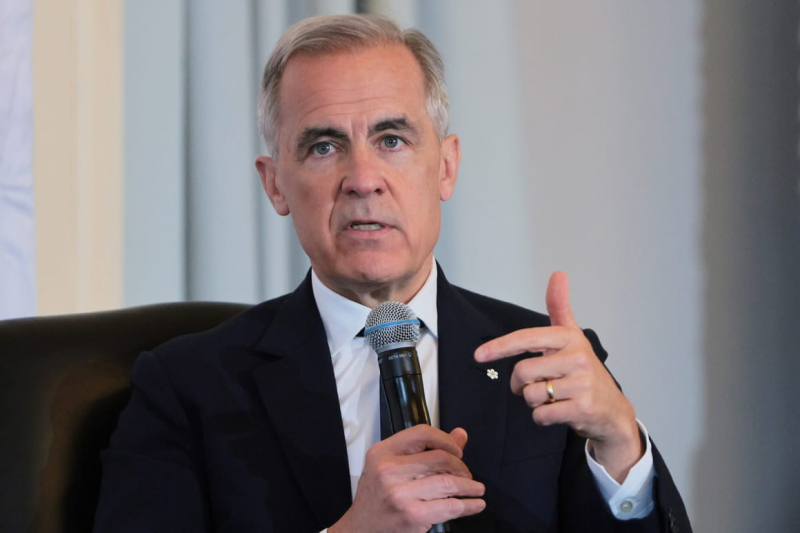

Mark Carney’s trip to Ireland aims to shore up relations with a key ally — and dodge mentioning President Donald Trump at all costs.
DUBLIN — The upcoming G7 summit could be well-timed to cement an emerging peace agreement on Iran — but only if the deal includes a ceasefire in Lebanon too, the leaders of Canada and Ireland stressed on Saturday.
Canadian Prime Minister Mark Carney, speaking at the start of a two-day visit to Ireland, looked ahead to his much more challenging next stop: the G7 summit in France alongside his frequent foil on the world stage, U.S. President Donald Trump.
Standing beside Irish Taoiseach Micheál Martin outside his central Dublin office, Carney said he was “encouraged by recent developments,” referring to the yo-yoing hopes of a potential U.S.-Iran agreement.
Carney touted “the possibility of a more durable ceasing of hostilities,” and he described G7 host France’s planned inclusion of the leaders of Egypt, Saudi Arabia, Qatar and the United Arab Emirates in an expanded summit format as “timely.”
But Carney emphasized any credible deal would require “a broader cessation of hostilities, including in Lebanon.”
Martin — whose government has been sharply critical of Israel, which shut its Irish embassy in protest — concurred, saying it would be “extremely important that Lebanon is included in the peace process. Lebanese sovereignty is absolutely essential.”
Lebanon is of particular importance to Ireland, a non-NATO member, because the Irish contribute troops to the United Nations peacekeeping force in south Lebanon — and have lost 48 soldiers on duty there since 1978.
Carney’s trip to Ireland seeks, in part, to promote his agenda of building Canadian cooperation with Europe as a counterbalance to the tension the country has experienced with its southern neighbor under the Trump administration. And Ireland is about to become a particularly influential ally, since it’s taking over the rotating presidency of the European Council on July 1 and will consequently be hosting scores of EU events over the coming six months.
But his swing through Ireland also looks like a bid to build the political brand of Carney, a policy wonk and former central banker who’s been an elected lawmaker for barely a year. His family story will come into focus Sunday when he visits his ancestral home in a County Mayo village from which his paternal grandparents emigrated to Canada in 1925.
For most of Saturday’s joint presser with Martin, a politician like Carney known for a demure disposition, both leaders seemed determined to avoid criticizing Trump — a global leader with a very different public persona — by not mentioning him.
Neither of their speeches mentioned the United States, never mind Trump. And when the reporters’ questions inevitably focused on Trump’s role in international conflicts and apparent unreliability as a trading partner, Carney and Martin stumbled over themselves avoiding a direct reply.
Carney even acknowledged the verbal gymnastics, capping one lengthy response that didn’t mention Trump by conceding: “That is a very oblique answer.”
Martin — whose own country is loath to draw Trump’s ire because it profits so handsomely from nearly 1,000 U.S. multinationals — softened his tacit criticism of the Trump administration with his only invocation of the T-word.
“President Trump is democratically elected as president of the United States and I’ll always respect that,” Martin began, before cautioning: “We must always understand the limits of power.”
Martin noted his own two most recent St. Patrick’s Day visits to the White House and observed that relations between any two countries can always improve — “once there’s mutual respect.”