
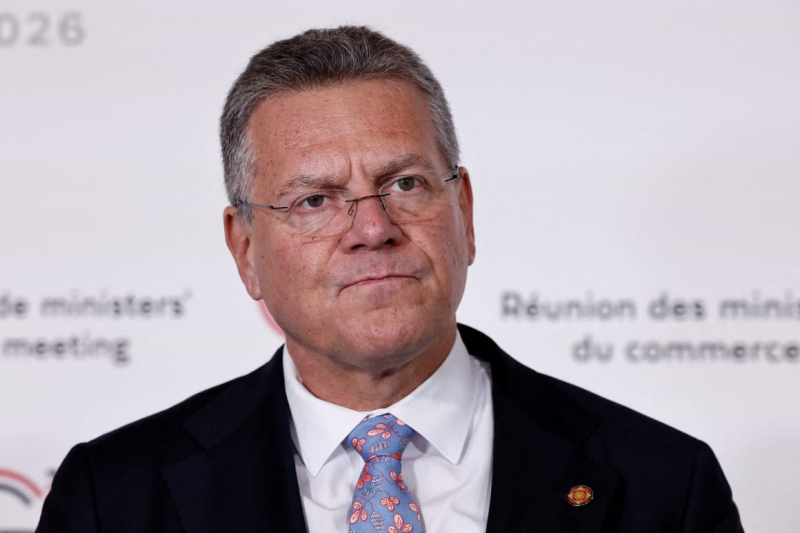

A new diversification instrument would compel companies to seek different suppliers in critical sectors, says Maroš Šefčovič.
BRUSSELS — EU trade chief Maroš Šefčovič has called for a new “diversification instrument” to help ensure that industry is not dependent on single sources of supply in sensitive sectors such as chips and rare earths.
“Diversification requires a dedicated instrument,” Šefčovič said at the European Policy Center’s Brussels Economic Security Forum on Friday.
“The model I have in mind is the Energy Union — a crucial undertaking for Europe,” said the EU trade chief, citing an initiative that he previously led to break the EU’s reliance on Russian energy after Vladimir Putin’s annexation of Crimea in 2014.
“If it’s critical supplies, you have to have three different suppliers to make sure that you cannot be punished because of a political reason or there might be some kind of industrial problem or something,” said Šefčovič. “It’s a collective mindset.”
EU leaders plan to discuss how to tackle China’s industrial overcapacity and subsidized exports during a June 18–19 summit — with the EU executive expected to take forward the leaders’ guidance. Šefčovič will also meet with his Chinese counterpart Wang Wentao at the end of the month in Brussels.
“Recent industrial cases, in particular supplies of chips and rare earths, have reinforced my conviction that a step change is necessary,” Šefčovič said. “We understand the urgency for critical minerals, but every high-risk sector must be weaned off single-supplier dependence.”
The European Union’s vulnerability was exposed last year when Beijing imposed export controls in strategic sectors.
China imposed restrictions on rare-earth magnet exports in October in a tariff dispute with the United States. It also halted shipments from Chinese-owned chipmaker Nexperia after the Dutch government took control of its local operations, disrupting supplies of critical chips to European carmakers.
The EU, which relies on China for over 90 percent of its rare earth supplies, has since teamed up with Washington and other nations in search of alternative sources of supply.
“We have to specify what to really do with the legal proposal,” Šefčovič told reporters.
The speech comes a day after Šefčovič called on Brussels and Beijing to step up their engagement to address the EU’s “unsustainable” trade deficit with China, following a meeting with Chinese trade envoy Li Chenggang in Paris. The bilateral trade deficit widened to €360 billion last year.
This report has been updated.