

The song contest’s existential moment over Israel’s participation is far from over.
VIENNA — Questions aren’t going away for the Eurovision Song Contest.
No matter the result of Saturday night’s Eurovision grand finale, the broadcasting union behind the contest is facing tough questions about how countries are cleared to compete.
In a hair-raising finish last night, Bulgaria’s underdog entrant DARA leaped past Israel’s Noam Bettan to take the top prize.
The earworm dance anthem “Bangaranga” earned Bulgaria its first Eurovision win, produced the biggest victory margin ever seen at the song contest, and marked the first time in almost a decade that national juries and the public chose the same winner.
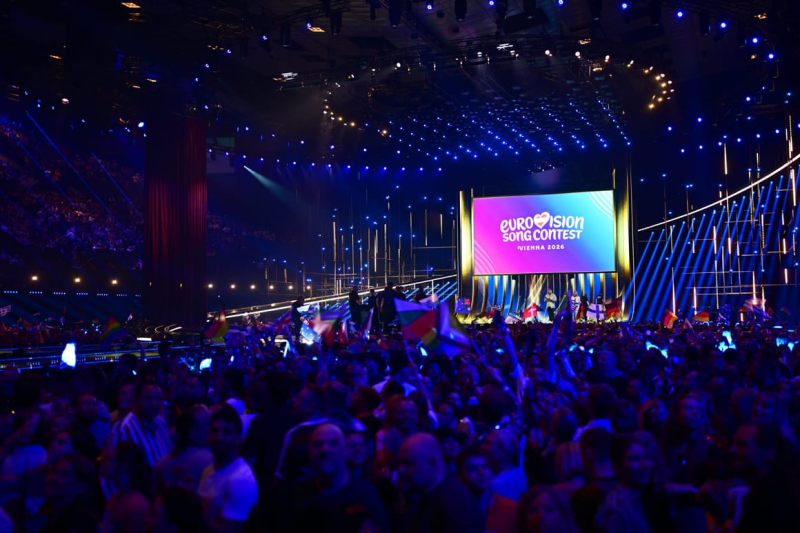
While this year’s final brought some incredible firsts, it also saw a repeat of last year, when Israel climbed to second place with a huge boost from the public vote. It also marks another year of the Eurovision contest that was overshadowed by controversy surrounding Israel’s participation.
Eurovision is organized by the European Broadcasting Union (EBU), an alliance of 113 public service media across 56 countries, with all member broadcasters allowed to take part.
Five countries boycotted the 2026 edition because they did not want to share a stage with Israel: Spain, Ireland, the Netherlands, Slovenia and Iceland. Those national broadcasters say their decision is due to Israel’s war in Gaza — sparked by the October 2023 attack on Israel by Hamas militants — and the resulting humanitarian crisis it triggered.
Just as the final began on Saturday night, Spain’s public broadcaster RTVE pushed out a message calling for “peace and justice for Palestine” and saying there is “no room for indifference” in the Eurovision Song Contest.
Seeking a reckoning
Also moments before the final started, Belgium’s Flemish broadcaster VRT said it is unlikely it will send an artist to next year’s Eurovision stage in Sofia, unless there’s a reckoning within the EBU about how decisions are made on who gets to compete in the contest.
“We ask for a clear framework for participation, an open debate and a direct vote among EBU members,” said VRT spokesperson Yasmine Van der Borght. She said VRT has not received an “adequate” answer from the EBU on this or a “signal that the EBU hears our concerns.”
Israel’s public broadcaster KAN, meanwhile, has warned about the dangers of a “cultural boycott” of Israel in Eurovision, which it said could harm “freedom of creation and freedom of expression.”
Amid the continuing criticism, Israel’s foreign ministry congratulated Bulgaria on its win in an X post on Sunday. “So much love from across Europe and around the world last night,” the post said, adding that “judging by the votes” it “looks like Europe couldn’t get ‘Michelle’ [Israel’s entry] out of their heads.”
The EBU late last year avoided holding a full vote among members on Israel’s participation, and instead introduced an overhaul of the voting system to address concerns that countries could unfairly influence results.
A New York Times article published this week made fresh allegations that Israel’s government orchestrated a campaign to garner votes in 2025, echoing concerns raised last year. Israel’s KAN broadcaster has emphasized that it was “not involved in any prohibited campaign intended to influence the results.”
VRT’s Van der Borght said the Flemish broadcaster’s comments are not targeted at Israel, but are more “general.” She said VRT expects the EBU to make a “clear statement against war and violence and for respect for human rights.”
Extra pressure
The prospect of more country boycotts next year over Israel’s participation piles extra pressure on the EBU to be more consistent and clear in how it applies its own rules.
During the final week in Vienna, Eurovision officials became increasingly terse when fielding questions about Israel being allowed to participate, and whether it reflected a double standard given that Russia was banned from the contest in 2022 after it invaded Ukraine.
A top EBU official explained the reasoning to POLITICO, that as long as national broadcasters follow EBU rules — like being sufficiently independent from the government — they should be allowed to compete. The official said Israel’s KAN is independent enough, while Russia’s RTR, Channel One and RDO are not.
That wasn’t the reasoning outlined in 2022, when Russia’s public broadcaster was expelled from the EBU and as a consequence banned from Eurovision. At the time, the EBU said that the decision was made “in light of ongoing events in Ukraine,” and the fact that allowing Russia to participate “would bring the competition into disrepute.”
In a press briefing ahead of Saturday’s final, Eurovision chief Martin Green acknowledged that the contest is “going through some challenging times,” and said organizers conducted a number of “listening sessions” with fans this week to hear their feedback. He said they will spend the summer “reviewing everything.”
Green also made a heartfelt appeal for viewers to “enjoy the show,” which is “about expressing yourself, about music, at the end of the day.”
“It’s a terrific, brilliant, wonderful, heartfelt show, with true emotion. It is an unbelievable spectacle, and just for a moment, or maybe four and a half hours, maybe close the curtains to the outside world and dream that something else is possible,” he said.
But for a self-proclaimed “apolitical” song contest that has long been hijacked by politics, the outside world is getting harder to ignore.