
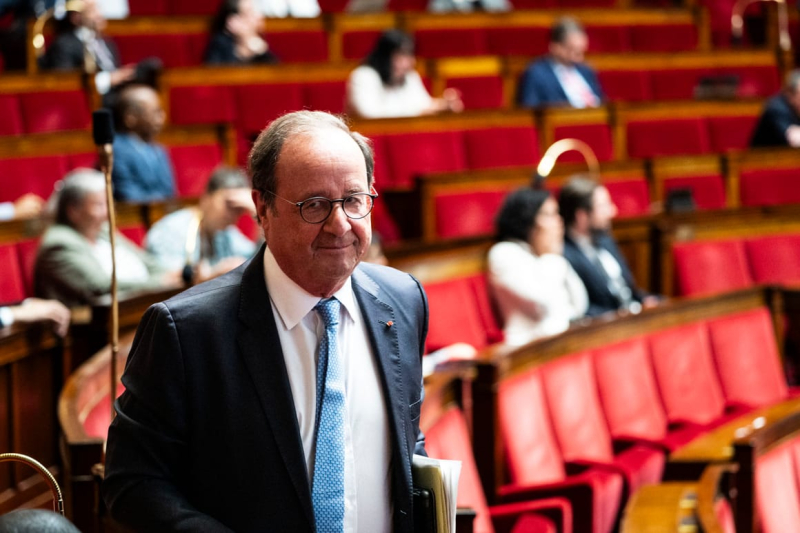

François Hollande’s path back to the presidency is a long shot, but his party’s internal divisions provide an opening.
PARIS — François Hollande ended his only presidential term in 2017 just months after netting a dismal 4 percent approval rating, and his time in office is now best remembered abroad for his notorious adulterous scooter trip to conduct a croissant-fueled affair with an actress.
But the 71-year-old Socialist — nicknamed “Flamby” by his critics, after a wobbly custard dessert — is now eyeing a long-shot ride back to the Elysée.
Hollande returned to frontline politics in 2024 by winning a seat in parliament and has, in recent weeks, dropped not-so-subtle hints that he’s preparing to run for president again in next year’s election, which the far-right National Rally has a strong chance of winning, according to most polls.
“I’m getting ready,” Hollande told the weekly magazine Marianne, which splashed the quote across its front page last month.
“What’s at stake in the [2027] presidential election is major, historic. For France, but not just for France,” Hollande said last month in a clip posted to social media. “How the French vote will decide the future of Europe, and maybe even global stability.”
He faces a steep climb. Two polls have explored the possibility of a 2027 comeback — and in both, the former president was projected to receive less than 10 percent of the vote, far below the current front-runners and thereby failing to qualify for one of the two spots in the runoff.
But Hollande does have a narrow path forward: becoming king of the ashes of what’s left of his Socialist Party. The Socialists are so riven by infighting that they can neither agree on a candidate to put forward nor how to choose one. And competition is also rife on the center-right, where several candidates have already joined the race.
Hollande’s hope is that with the Socialists divided and the field already so crowded with candidates across the political spectrum, he’ll appear to be the most reasonable option for moderate voters.
“If the right is divided, there will be an opening for a social-democratic candidate to make the runoff,” said André Vallini, a former state secretary under Hollande who has remained close with the former French leader.
“I believe he is the best candidate,” said Vallini, pointing to Hollande’s experience in handling crises including the 2015 wave of terror attacks which hit France and dealings with heads of state, including Russian President Vladimir Putin.
Ideological fault lines
Vallini, however, appears to be in the minority. A Hollande candidacy doesn’t elicit much excitement in Socialist circles.
“I don’t believe in Hollande’s return. Comebacks are difficult. And it’s not like there’s much nostalgia,” said one party heavyweight, granted anonymity to speak candidly.
Another party operative, also granted anonymity to candidly speak about Hollande’s reputation, said it was still unpopular to publicly align with the former president given how his atrocious ratings at the end of his term — one poll notoriously showed that only 4 percent of the population was satisfied with Hollande’s presidency — weighed on the center-left party in the years after he left the Elysée Palace.
The Socialists’ performance in the last presidential election, which saw former Paris Mayor Anne Hidalgo score less than two percent of the vote, was so weak that it forced the party joined a broad left-wing alliance with more radical forces, including Jean-Luc Mélenchon’s hard-left France Unbowed movement, to help rebuild a stronger presence in parliament.
The party still remains split over to what extent it should work with other left-wing forces.
Current Socialist leader Olivier Faure wants the party to take part in an open primary to avoid vote-splitting and improve the left’s chances of reaching the runoff, likely against either Jordan Bardella or Marine Le Pen of the National Rally. The far-right party is waiting on the verdict of Le Pen’s appeal of an embezzlement conviction to see if she can run for the presidency next year.
That proposal is opposed by large swaths of the party — including Hollande — which insist the Socialists need to field their own champion. Faure, who lacks the backing of a majority within the party, has so far refused to put either the nomination of a Socialist candidate before the summer or participation in a primary process to an internal vote.
Last month, roughly one-third of the party’s leadership — led by Boris Vallaud, head of the Socialist group in parliament and an opponent of the pan-left primary — resigned from their internal roles in protest over what they described as a lack of internal democracy in the party.
Some party members have instead called on the Socialists to endorse center-left MEP Raphaël Glucksmann, who is not formally a member of the party but led its list in the last two European elections and is currently polling as the strongest center-left contender.
But a new generation of Socialists wants to push the party further left.
Last month, the party unveiled its “project for the 21st century,” a document laying out the Socialists’ updated ideological roadmap. It called for “radical justice policies on taxation,” lowering the minimum retirement age and a higher minimum wage.
“We believe that the era of social democracy is behind us because the world that gave rise to it no longer exists,” MEP Chloé Ridel, who helped draft the document, said at a press conference.
Hollande disagrees.
The former president, who still proudly labels himself a social-democrat, broke with the party line on lowering the retirement age and insisted on the need to move beyond what he called “easy policies.”
“Everyone wants the minimum wage to be increased, but there are economic conditions to respect,” he said last week on French public television.
The key question for a Hollande candidacy may indeed be timing ahead of the presidential election, which is expected to take place in April 2027. If no strong center-left candidacy emerges an unpopular but well-known and experienced figure may be the strongest card in a weak hand.
“It’s in December that candidacies must be declared, and in January or February that the strongest one emerges,” Hollande said last week.
“Everything before that is preparation.”