

Contents
- 1 From one route to a platform
- 2 How Walk15 turns steps into value
- 3 Why motivation — not tracking — is the core product
- 4 “You can promote anything, but if people are not motivated, it doesn’t work.”
- 5 A platform for companies, cities, and communities
- 6 The challenge of categorisation
- 7 A global movement, one step at a time
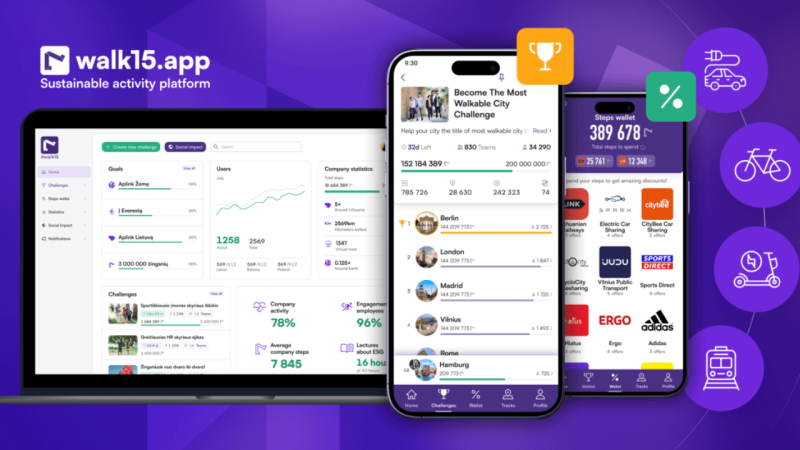
Walk15 is a mobile app and engagement platform that encourages people to walk more by turning everyday movement into something measurable, social, and rewarding.
What began as a simple walking route created by a frustrated parent has grown into a global movement platform. In Lithuania, Walk15 has reached around 31 per cent of the population. Last year, it generated around €1 million in revenue.
Founded by Lithuanian entrepreneur Vlada Musvydaite Vilciauske, Walk15 is rethinking how people engage with health, sustainability, and community, by turning steps into currency.
From one route to a platform
Vilčiauskė was born in Ukraine, but lived most of her life in Vilnius. She was originally an athlete, a 400-metre runner, and became a Lithuanian and European-level champion.
“Sport has always been part of my life,” she recalled.
“My mother was a 100-metre champion, and my father ran 800 metres. So I was almost like a ‘designed’ 400-metre runner.
Growing up, everything felt like a competition. But the most important lesson came from my mother — she always told me that the most important thing in life is whether you are happy, not how much money you make.
That philosophy stayed with me, and it’s one of the reasons I created Walk15.”
The idea for Walk15 emerged from a very simple, personal problem. As Vilčiauskė recalls:
“In 2016, I felt like a bad mother because I didn’t know where to walk with my kids.”
So she created a 15,000-step walking route together with a woman from a regional park. In the process, she realised that walking with a clear goal transforms the experience. “You stay engaged, you stay motivated,” she says.
One participant even lost 15–20 kilos simply by following the route—“that was a big moment for me.”
It also raised a new question: how could she share this with others? The answer was to build an app, initially centred on that single 15,000-step route.
“Maybe one day it will be international… so let’s call it Walk15.”
After the app, they started organising physical walking events where people could come with their families, friends, or dogs and walk 15,000 steps together.
How Walk15 turns steps into value
From a user perspective, the app is simple: you connect your phone or wearable device, your steps are tracked—without collecting location data—and they accumulate in a digital “step wallet.”
Users can then join challenges created by companies, cities, or organisations, ranging from workplace wellbeing initiatives to large-scale public campaigns, all designed to motivate participation rather than competition.
Why motivation — not tracking — is the core product
Vilčiauskė quickly realised something important: motivation is everything.
“You can promote anything, but if people are not motivated, it doesn’t work.”
So she created the idea of a “steps market” where you could exchange your steps for something tangible, like fruit or vegetables.
With the steps market, everyday movement becomes something valuable: users can exchange steps for rewards such as discounts, products, or experiences — for example, trading 20,000 steps for a grocery discount on healthy items, or unlocking perks like airport fast-track access and discounts at Adidas through challenge milestones.
A platform for companies, cities, and communities
Walk15’s aim is to motivate people — “especially children and teenagers, where around 80 per cent don’t move enough every day,” shared Vilčiauskė.
However, the startup also has a clear business model. Companies and organisations pay to create step challenges for their employees or communities. Behind the scenes, the platform operates primarily as a B2B and B2G solution, enabling organisations to run customised, goal-driven campaigns that combine health, sustainability, and behavioural change at scale.
In just five years, the team has impacted over 1,500 companies and 1,000,000 app users worldwide, helping them improve their well-being, change mobility habits, and create a positive environmental impact, and has expanded with an additional company formed in Berlin.
Walk15 recently launched a large initiative with the European Central Bank. People walk while receiving educational content, such as financial literacy topics explained in a simple, accessible way. At the end, users from different countries compete based on total steps.
Walk15 also creates community-driven initiatives, like:
- Walking challenges that support animal shelters
- Dog-walking competitions
- Campaigns tied to donations
Vilčiauskė is at pains to clarify that Walk15 is not a step counter.
“We are a motivation and initiative platform. What we realised is that every organisation — whether it’s a company, a city, a sports club, or even a government — has the same challenge: how do you engage people?”
In response, they created initiatives that allow people to walk for the city, school, or cause. It works like a social platform — but instead of posting, you participate by moving.
Vilčiauskė asserts, “For me, this is very important because it connects movement with education. I always say: 10,000 steps are for your health, 5,000 steps are for your education. This is where we can really create impact.”
The challenge of categorisation
But scaling the platform hasn’t been without its challenges. For Vilčiauskė, the biggest challenges have been fundraising and positioning.
“We are not a typical SaaS company, and we’re not a simple consumer app either. That makes it difficult for some investors to categorise us.
Some see us as a community project, others as a health app — but we’re building something different. That said, we do have investors who believe in the long-term potential.”
A global movement, one step at a time
Walk15 is further building out its B2B platform to integrate AI, so companies can automatically create campaigns.
“For example, an HR manager could request a challenge, and our system would generate everything — from messaging to engagement. We already know what motivates people, so we can use that data to improve outcomes,” explained Vilčiauskė.
It is also working to further support NGOs with donation features so that people can contribute to causes through their activity. Long-term, Vilčiauskė wants to create a global movement.
“We want people everywhere to move more, feel part of a community, and contribute to something meaningful. It’s not about walking 15,000 steps. It’s about taking the first step—and changing behaviour over time.”