
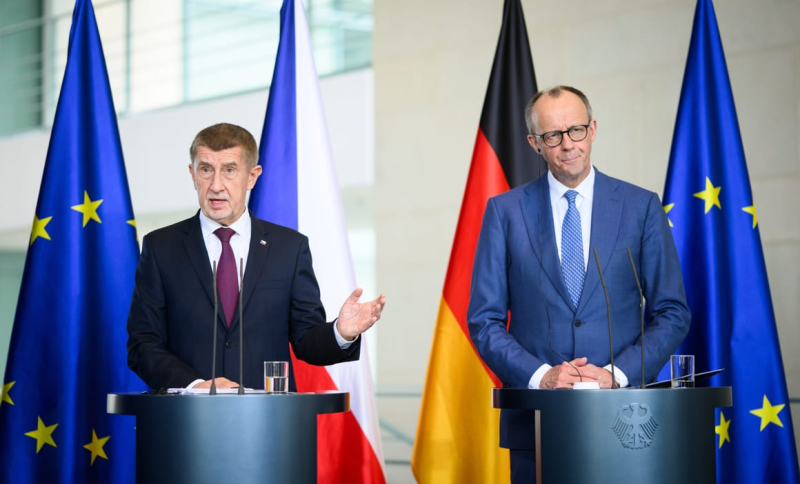

The German chancellor expressed concern that there’s no “common plan for bringing this war to a swift and convincing conclusion.”
BERLIN — German Chancellor Friedrich Merz said Tuesday that he is increasingly worried about the apparent lack of a strategy by the U.S. and Israel for winding down their war on Iran.
“With each day of war, more questions arise. What concerns us most is that there is clearly no common plan for bringing this war to a swift and convincing conclusion,” Merz said, speaking alongside Czech Prime Minister Andrej Babiš in Berlin. “We have no interest in an endless war,” the chancellor added.
Merz’s comments come as the U.S. and Israel continue to strike Iran, while Tehran has responded by striking Arab Gulf countries. The spiraling regional conflict is roiling global energy markets, raising concerns across Europe of the kind of inflationary spiral seen after Russia’s full-scale invasion of Ukraine in 2022.
Merz has sent mixed messages on the U.S. and Israeli war on Iran. The day after the attacks were launched, Merz expressed doubt that they would succeed in toppling the regime in Tehran, while also saying Germany was in no position to “lecture” its allies. Since then, the chancellor has repeatedly said he supports the U.S. and Israeli goal to topple the regime, a stance that earned him the praise of U.S. President Donald Trump during Merz’s Oval Office visit last week.
But Merz is under growing political pressure at home to take a tougher line on the Iran attacks. The majority of Germans oppose the attacks, according to surveys. Merz’s coalition partner, the center-left Social Democratic Party (SPD), are also putting pressure on the chancellor to take a less accommodating stance on the U.S. and Israeli strikes.
That could explain why Merz on Tuesday took a harder tone, warning that a long war could lead to a quagmire that disrupts Europe’s energy supply and sparks another refugee crisis.
“A scenario such as we have seen in Libya, Iraq, or other countries in the region would also harm us all,” Merz said. “This affects our security, our energy supply, and possibly also the situation surrounding migration.”
Merz also stressed that Russian President Vladimir Putin is seeking to take advantage of the Iran conflict in order to gain an upper hand in the Kremlin’s war on Ukraine.
“While other partners are withdrawing capabilities from NATO’s eastern and northern flanks, we are staying there,” Merz said. “This burden-sharing is important, otherwise we will give Moscow an opportunity to weaken Ukraine and Europe. We know that the Kremlin is closely monitoring where Iran is opening up opportunities.”
Merz warned against calls to loosen sanctions against Moscow in order to bring down energy prices.
“When faced with the choice between sanctions and solidarity, our position is clear: We stand with Ukraine and are prepared to see this through,” Merz said.
EU leaders were set to conduct a video conference Tuesday hosted by Germany, Belgium and Italy focused, among other things, on how to tackle rising energy prices across the bloc.