
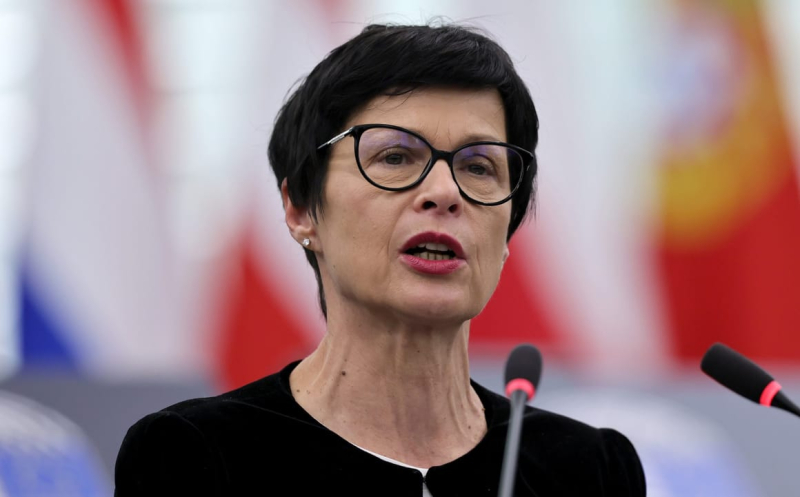

With Ankara likely to play a key role in a post-war Ukraine, EU Enlargement Commissioner Marta Kos is traveling to Turkey to revive relations.
BRUSSELS — After years of looking at Turkey as a problem, the European Union is now viewing it as part of the solution.
As negotiations for peace in Ukraine gather momentum, Turkey’s potential role in the post-war order — particularly as a peacekeeper and regional powerbroker in the Black Sea —makes it a critical partner for the EU. However, Brussels is taking baby steps with a country that has been backsliding on democracy and whose Islamist leader, Recep Tayyip Erdoğan, has jailed high-profile political opponents.
In an attempt to thaw relations, Enlargement Commissioner Marta Kos will visit Turkey on Friday. Ahead of her trip, Kos told POLITICO in a written statement: “Peace in Ukraine will change the realities in Europe, especially in the Black Sea region. Türkiye will be a very important partner for us.”
“Preparing for peace and stability in Europe implies preparing a strong partnership with Türkiye,” she added.
Turkey is a military heavyweight. It has the second-largest armed forces in NATO and holds a crucial strategic position in the Mediterranean and Middle East. Ankara’s control of the Bosphorus gives it immense sway over regional security, and it played a key role in brokering the Black Sea deal in July 2022 that granted safe passage to ships carrying Ukrainian grain.
The country of 88 million people has also said it is willing to send peacekeeping troops to Ukraine if a deal is struck with Russia, and that it would take a leading role in Black Sea security.
However, relations between the EU and Turkey have deteriorated over the years, and have hardly been helped by Erdoğan’s lurch to autocracy and his crackdown on opposition mayors. Although officially a candidate to join the EU, the negotiations have been frozen since 2018.
“In the latest EU enlargement reports we have seen steps away from EU standards, especially on the rule of law and democracy,” Kos said. “I know Türkiye has a very long democratic tradition and also a strong civil society, and this is what we need to see strengthened to build trust between the EU and Türkiye.”
In Ankara, to take the first steps to a rapprochement, Kos will attend a ceremony in which the European Investment Bank and Turkey will sign off on €200 million in loans for renewable energy projects. The EIB suspended new lending to Turkey in 2019 because of a dispute over oil and gas drilling off Cyprus.
Also on Friday, the Commission will unveil a study on “advancing a cross-regional connectivity agenda” with Turkey, Central Europe and the South Caucasus. The study, seen by POLITICO, maps out how investment is needed to strengthen transport, trade, energy and digital connections along the Trans-Caspian Corridor, which links China, Central Asia, the South Caucasus and the Black Sea.
These are symbolic first steps toward bringing Ankara back into the fold, but they’re not what Turkey really wants from the EU — that would be an updated customs union agreement. The old deal was signed in 1995.
New trade agreements signed by Brussels with India and the Mercosur group of South American countries put Turkey at a competitive disadvantage. Once they’re in place, Ankara will be forced to grant tariff-free access to goods from those countries, but that benefit won’t be reciprocated.
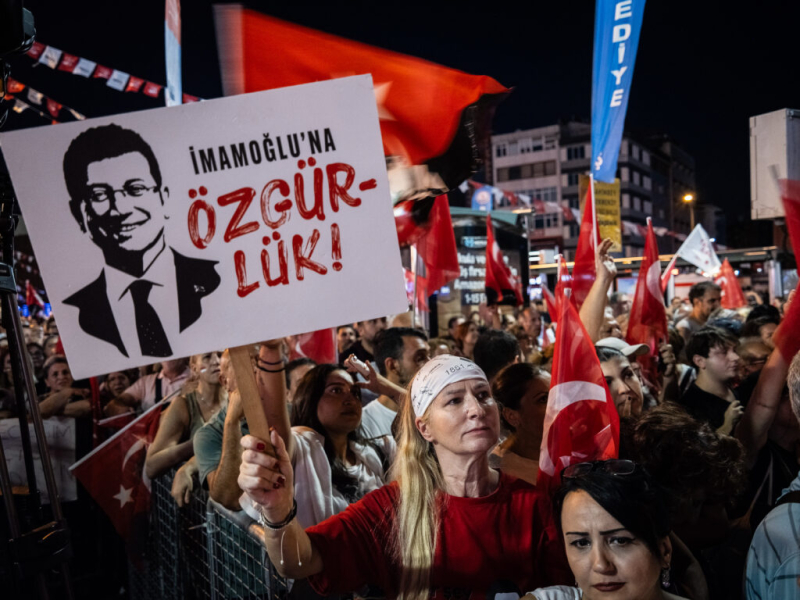
Even Ekrem İmamoğlu, the democratically elected mayor of Istanbul, whose arrest last March triggered massive nationwide protests and international condemnation, weighed in in favor of upgrading the customs union deal.
In a plea sent from his prison cell to European Commission President Ursula von der Leyen, European Council chief António Costa and Parliament President Roberta Metsola, İmamoğlu asked the EU to modernize the customs agreement with Turkey.
“The Customs Union remains the only rules-based and normative framework underpinning Türkiye–EU relations,” İmamoğlu said in a social media post Thursday. “In the wake of EU free trade agreements with Mercosur and India, the asymmetrical consequences for Türkiye have become increasingly visible.”
Updating Turkey’s deal would require buy-in from the European Council. However, Greece and Cyprus are staunchly opposed to warming relations without a goodwill gesture first from Ankara.
Cyprus wants Ankara to allow its ships into Turkish ports, according to an EU official. Ankara does not recognize Cyprus due to the 1974 division of the island following a Turkish military invasion.
“The strength of any future partnership needs to be underpinned by good political relations with our member states, and especially good neighbourly relations and relations with Cyprus,” Kos said.
Cyprus’ deputy minister for European affairs, Marilena Raouna, told POLITICO that the country’s presidency of the Council of the EU “can be an opportunity” for EU-Turkey relations.
She said Cyprus “has been constructive. And we look to Türkiye to also engage constructively.”
So far, Ankara has shown little appetite to extend an olive branch. Last year it rejected Cyprus President Nikos Christodoulides’ proposal that Turkey open its ports to Cypriot-flagged ships in exchange for easier access to European visas for Turkish businesspeople.
But U.S. President Donald Trump’s reshaping of geopolitical and trade relationships could push Europe and Turkey back toward one another.
“The world is changing and history is accelerating. Türkiye-EU relations also need to adapt,” Turkey’s ambassador to the EU, Yaprak Balkan, told POLITICO.
“The way these relations can become stronger is by building on mutual interests. We hope that we can build upon this philosophy in a very concrete manner. Türkiye’s strategic objective continues to be accession to the European Union and this should be the guiding light in our relations.”
Restarting EU membership negotiations is not in the EU’s thinking just yet. Still, Kos said that “we need to look with fresh eyes at our relations” with the country. “My visit to Ankara … is about rebuilding trust and exploring how we can make our economic relationship work better for both sides.”