
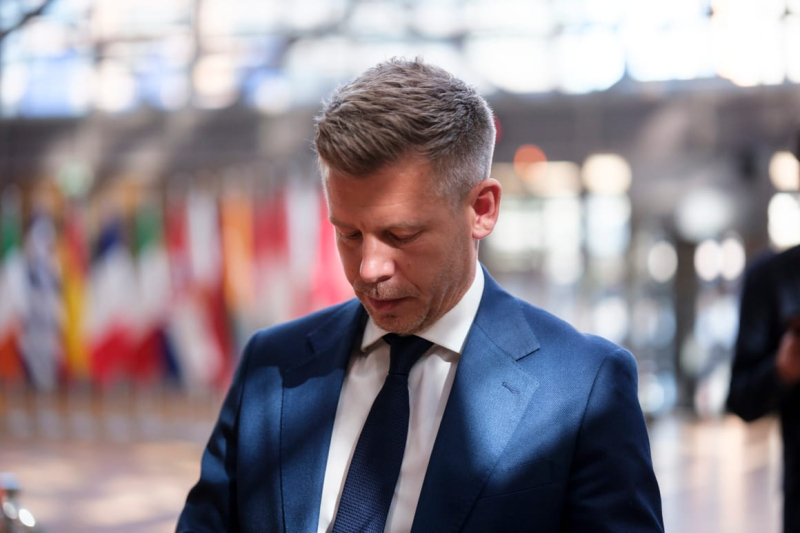

Brussels has urged Budapest to drop demand for €3.9 billion in loans to speed up EU payments.
BRUSSELS — Hungary’s incoming Prime Minister Péter Magyar is at loggerheads with the European Commission in the first real test of the post-Viktor Orbán reset: How much of Budapest’s frozen EU funds can he bring home?
Over the past few days, talks have intensified over the €10.4 billion Hungary is entitled to under the EU’s post-pandemic recovery fund, according to two EU and one Hungarian official. The money had been withheld over Budapest’s breaches of EU law under Orbán, who was prime minister since 2010 and lost the election last month.
In a highly symbolic move, Magyar met European Commission President Ursula von der Leyen in Brussels last week to reset relations after years of conflict with the previous government.
But despite the good intentions, Brussels and Budapest are at odds over how much money Hungary should get from the post-Covid fund allocation, according to the officials, who have knowledge of the negotiations and were granted anonymity to discuss the confidential talks. The Commission recommended requesting only the grants, while Hungary wants to claim the full amount.
“We are very optimistic about releasing all the blocked funds,” said Kinga Kollár, an MEP from Magyar’s Tisza party.
The allocation is split between €6.5 billion in grants, which would not need to be repaid, and €3.9 billion in loans, which need to be paid back at a favorable interest rate. Magyar’s incoming administration has until Aug. 31 to formally request the money, while the Commission has a deadline of Dec. 31 to make the payments.
The Commission is arguing there isn’t enough time to release the full €10.4 billion, since payouts are contingent on Hungary meeting specific reform targets. Funds in the form of loans would also add to Budapest’s strained public finances, with debt already hovering around 75 percent of GDP and the deficit ― the difference between how much is spent and how much is brought in ― projected to be near 7 percent of GDP in 2026.
If Magyar accepts Brussels’ advice, it will mean him leaving €3.9 billion on the table. For Hungarian negotiators, coming home with anything less than the full package would look politically underwhelming after a campaign built around a total reset with Brussels.
Last week Magyar said he’s confident that the EU will “be sufficiently flexible to allow Hungary to draw every eurocent of the funds they are entitled to.”
Future investments
Hungary aims to present a new plan to meet EU conditions — outlining revised reforms and targets — by the end of May. The Commission is pushing the incoming administration to drop some onerous measures, including key parts of a pensions reforms, that are unlikely to be completed before the August deadline.
During the talks, Magyar’s team is testing whether its mooted reforms are likely to meet the Commission’s criteria, said one of the officials. The end goal is for Brussels to swiftly approve the new plan after it is formally submitted.
In order to extend the deadline beyond 2026, Hungary can transfer part of the money to its national promotional bank or to a new financial body — a so-called special purpose vehicle. But in order to do so, it will have to convince Brussels that the future investments comply with the overarching goals of the recovery program.
Given the time constraints, the Commission assumed before the election that Hungary would eventually abandon trying to get the loans, one of the EU officials said, suggesting the Commission had already planned out this scenario before Magyar won.
He’s set to be sworn in on Saturday.