
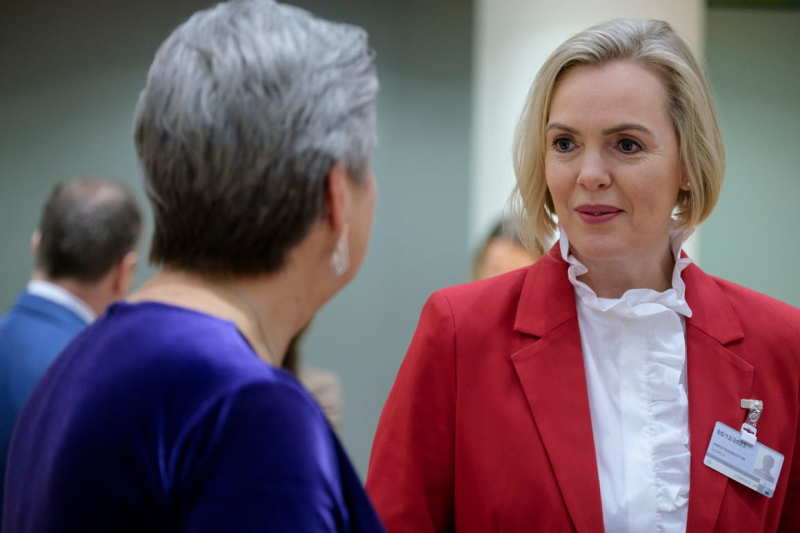

Guðrún Hafsteinsdóttir casts the Aug. 29 vote on reopening accession talks as a question of Iceland’s hard-won sovereignty.
BRUSSELS — The leader of Iceland’s largest opposition party is urging European politicians to stay out of the country’s referendum on reopening EU membership talks next month, as senior figures across the bloc welcome the prospect of renewed negotiations.
“It’s extremely important that this decision in August will be left to the Icelandic nation,” Guðrún Hafsteinsdóttir, an MP and chair of the center-right Independence Party, told POLITICO. “People should just let Icelanders go through this without foreign influences.”
For Hafsteinsdóttir, who opposes membership, the issue goes to the heart of Iceland’s national identity. “Independence is emotional for Icelanders. We have only been independent for about 100 years out of 1,200.”
The Nordic country will vote on Aug. 29 on whether to resume accession talks with Brussels, with early voting beginning Monday. The referendum will not decide whether Iceland joins the EU — any eventual membership agreement would require a second public vote.
Polls suggest the question of reopening discussions is finely balanced, although a clearer majority remains opposed to membership itself. “We are divided into nearly equal groups for yes and no” on the former, Hafsteinsdóttir said in a phone interview from Vatnajökull, Iceland’s largest glacier. “The referendum will be very tight.”
The vote fulfills a pledge made by Prime Minister Kristrún Frostadóttir’s three-party coalition when it took office in late 2024. The alliance — dubbed the “Valkyrie government” because all three parties are led by women — includes a party that supports EU membership. Frostadóttir has said the referendum is intended to settle “a debate that has hung over the Icelandic nation.”
Several prominent European figures have sounded positive about the prospect of renewed talks. French MEP and Renew Europe leader Valérie Hayer traveled to Iceland in June and called for the EU to make accession easier. Enlargement Commissioner Marta Kos welcomed the vote and said the bloc “will be ready” if Iceland chooses to join, while French Foreign Minister Jean-Noël Barrot said Reykjavík had “nothing to lose” by restarting negotiations.
The warm tone comes as Brussels seeks to revive enlargement as a geopolitical project, drawing Ukraine, Moldova and the Western Balkans closer while showing the EU can still attract new members amid strained relations with Washington and growing competition with China.
Iceland’s case is different from those of most current candidates. The North Atlantic nation of around 400,000 people is already closely integrated with the bloc through the European Economic Area and the Schengen zone, and conducts most of its trade with the EU.
It applied to join in 2009 following its worst-ever financial crisis that saw its banks collapse, but suspended negotiations in 2013 as its economy quickly recovered and amid a dispute with Brussels over fishing rights.
“My message to Brussels is that Iceland is a close friend and we want strong cooperation,” Hafsteinsdóttir said. “But friendship does not require membership. The EU should respect that Iceland can be a reliable European partner outside the Union.”
Sovereignty first
Hafsteinsdóttir’s Independence Party, which holds 14 of the Icelandic parliament’s 63 seats, argues that the country’s current relationship with the EU already delivers the benefits of close cooperation without the obligations of membership.
“Our place in the world is clear: We are a European democracy,” she said. “The question in this referendum is not whether Iceland should cooperate with Europe, because we already do that every day.”
For opponents of membership, the central concern is whether Iceland would retain control over policies at the heart of its economy and national identity.
“The question is whether Iceland should transfer key decisions over fisheries, agriculture and economic policy to the EU,” Hafsteinsdóttir said. “And I believe that is not in Iceland’s interest.”
That sovereignty argument has gained a new dimension as security concerns grow across the Arctic.
U.S. President Donald Trump’s threats to seize Greenland — which he repeatedly referred to as “Iceland” during a speech at the World Economic Forum earlier this year — have intensified debate over how small Arctic states should protect themselves in dealings with larger powers.
For supporters of closer EU ties, the turmoil strengthens the case for anchoring Iceland more firmly inside Europe. Hafsteinsdóttir argues that it instead underlines the need for strong alliances without surrendering control over national decisions.
Iceland has no standing army and relies on NATO and its partners for its defense. Hafsteinsdóttir pointed to the country’s history as evidence that it can defend its interests without joining the EU.
“We have only battled in one war, and that was the Cod Wars against the U.K.,” she said, referring to the confrontations over fishing rights in the 1970s that ended in Iceland’s favor.
“We are a small state, and a small state needs strong alliances,” Hafsteinsdóttir added. “But we also need the ability to make decisions that fit our own circumstances.”