

Already strained by Russia’s war and managing relations with Donald Trump, the EU is now scrambling to respond to a conflict where it has even less leverage.
BRUSSELS ― Ursula von der Leyen will on Monday chair an emergency meeting of European commissioners as the conflict with Iran deepens and after the EU’s 27 foreign ministers differed over a joint statement.
As missiles rained across the Middle East and with fears of a threat to Cyprus, the EU pivoted to crisis mode, calling emergency Sunday sessions and planning a series of extraordinary meetings. It faces the difficult task of pulling together a coherent foreign policy response for a region where it doesn’t have huge leverage while confronting challenges on several fronts at home and abroad.
With the leaders of the so-called E3 — France, Germany and the U.K. — issuing a far tougher statement Sunday night than the EU managed just hours earlier, the episode underscores a broader pattern: As global crises multiply, from Russia’s war in Ukraine to renewed transatlantic strains under U.S. President Donald Trump, the bloc is struggling to speak with one voice.
The EU’s priority is to “ensure the protection of civilians and the de-escalation of the situation as well as to ensure that the Iranian people are able to express their will ― while maintaining unwavering support for Ukraine and continuing pressure on Russia,” Latvian Foreign Minister Baiba Braže told POLITICO.
Commission President von der Leyen’s emergency security-focused meeting of officials in Brussels on Monday coincides with a scheduled gathering of Europe ministers in Cyprus.
It comes after two days of intense U.S.-Israeli-led bombing of Iranian cities designed to overthrow the regime. The airstrikes have killed Supreme Leader Ayatollah Ali Khamenei and triggered Tehran to launch counterattacks across the Middle East.
“The risk of an attack on Cyprus,” the closest EU country to the region, was “high,” according to a European Commission official briefed on the situation who was granted anonymity, like others in this article, because the issue is so sensitive.
Cyprus, also at the helm of the rotating presidency of the Council of the EU, called an Integrated Political Crisis Response meeting for Tuesday, bringing together the bloc’s institutions and member countries to game out internal security, trade flows and energy supplies. It’s a format that’s previously been convened over Covid, the migration crisis and the outbreak of war in Ukraine.
A meeting of EU top diplomats with Gulf foreign ministers is also being organized this week, two officials with knowledge of the discussions told POLITICO.
“There has to be emergency meetings left, right and center,” a senior diplomat from the region told POLITICO, underscoring the urgency for the EU to quickly adopt a strong position. “This is a turning point for the Middle East, Europe and the U.S.”
International law
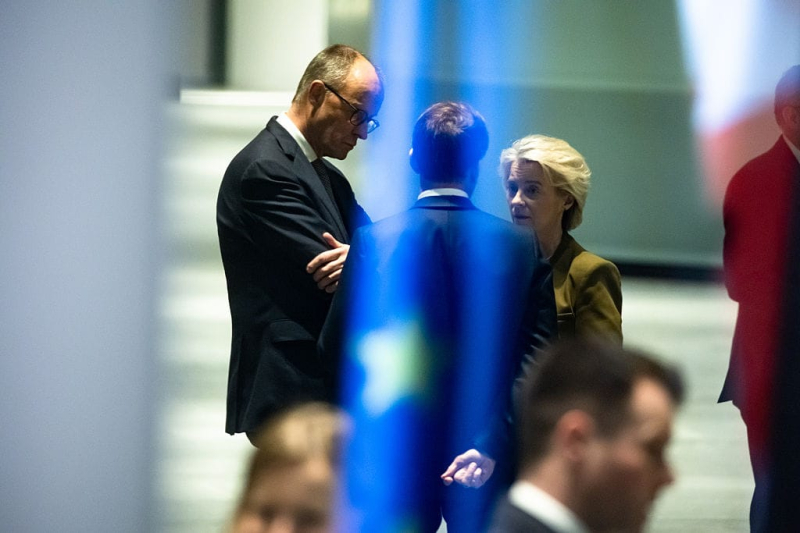
Emmanuel Macron, Friedrich Merz and Keir Starmer, the leaders of France, Germany and the U.K., said on Sunday night they would “take steps to defend our interests and those of our allies in the region, potentially through enabling necessary and proportionate defensive action to destroy Iran’s capability to fire missiles and drones at their source.” They will “work together with the U.S. and allies in the region on this matter.”
Shortly before that, the EU published a carefully balanced statement after the 27 foreign ministers held a two-and-a-half-hour video call. They called for “full respect of international law,” urged Iran to stop developing its missile program, stressed the need to restore regional security and expressed support for the “fundamental freedoms” of the Iranian people.
A major sticking point during the call of foreign ministers was whether the “international law” part of the statement could be seen as criticism of Trump and the Israeli government, four European diplomats either present or briefed on the meeting said.
On that point, European leaders have been publicly split.
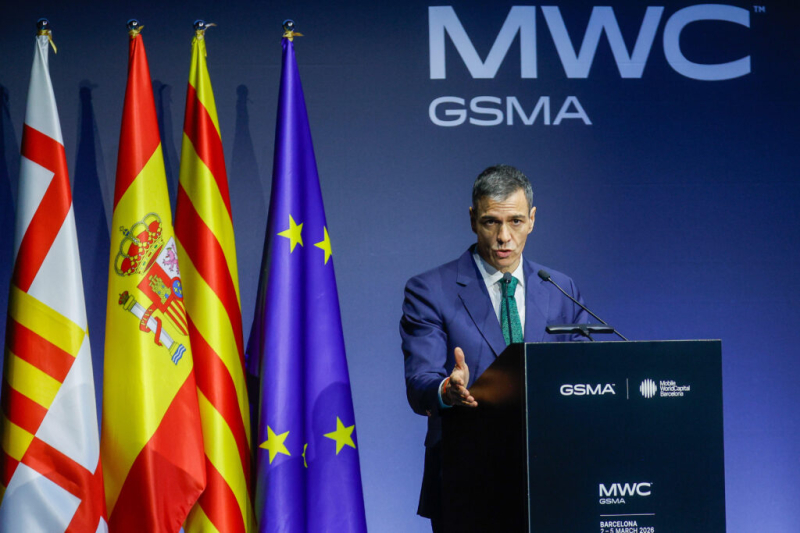
Spain’s Prime Minister Pedro Sánchez condemned the U.S.-Israeli strikes, warning they risked bringing about a “more uncertain and hostile international order.” But German Chancellor Friedrich Merz said Sunday it wasn’t “the time to lecture our partners and allies,” adding “we share many of their goals without being able to actually achieve them ourselves.”
In the end, all countries approved the joint statement, with the EU saying it would take “all necessary steps” to protect their citizens who have been caught up in the conflict.
Earlier on Sunday, ambassadors from the bloc’s governments were unable to reach a consensus on the statement, three European diplomats aware of the negotiations told POLITICO, with two saying Hungary refused to sign off on it. The Hungarian delegation in Brussels declined to comment.
Budapest instead used the talks to air its grievances on the unrelated matter of the EU’s support for Ukraine, bringing up a broken pipeline transporting Russian oil to Central Europe. Hungary has for weeks accused Ukraine of keeping it offline, blocking a €90 billion loan to Kyiv as a result.
Furious assault
Explosions have been erupting across the Middle East since Saturday, when the U.S. and Israel’s strikes on Tehran killed the supreme leader and several senior Iranian officials.
Iran hit back with a furious assault on U.S. military bases in the region, including in Bahrain, Iraq, Jordan, Kuwait, Oman, Qatar, Saudi Arabia and the United Arab Emirates.
In Dubai, a luxury hotel was struck and went up in flames, while in the Bahraini capital, a missile hit a U.S. Navy base, sending up thick plumes of black smoke.
Three American soldiers were killed in the wave of attacks. Trump said Sunday he expects the U.S. operation against Iran to continue for about four weeks “or less.”
EU ambassadors on Sunday focused on how the crisis would affect the safety of Europeans in the region, as well as the implications for the bloc if the fighting continues, according to an EU diplomat.
Among the issues discussed was the impact on air and maritime traffic, particularly if the key Strait of Hormuz is closed. The strait, which is partly in Iranian territorial waters, is a key shipping lane through which 20 percent of the world’s oil passes.
Earlier, Cyprus was forced to hose down reports that Tehran had targeted it with missiles on Sunday after the U.K.’s Defence Secretary John Healey told Sky News that “we had two missiles fired in the direction of Cyprus.”
Zoya Sheftalovich, Nicholas Vinocur and Gabriel Gavin contributed to this report.