

As the dust settles after the congress of Europe’s third-largest political family, POLITICO takes a look at the successes and failures.
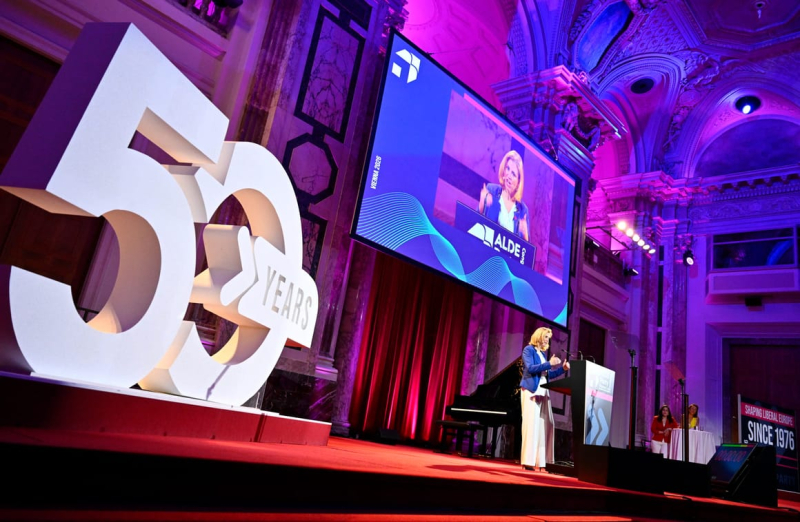
VIENNA — The top brass of the Alliance of Liberals and Democrats for Europe huddled in the Austrian capital this weekend to celebrate ALDE’s 50th anniversary — and debate how to face the far-right surge.
The gathering in Vienna served as an opportunity for national parties — including Austria’s NEOS, the Netherlands’ D66, Belgium’s Reformist Movement, Romania’s USR and Germany’s FDP — to schmooze and scheme in the grand ballrooms of the Habsburg’s Hofburg Imperial Palace while debating current topics like social media restrictions, EU institutional reform, and the single market’s competitiveness.
So who’s up in the liberals’ world, and who’s down? POLITICO reads the runes.
WINNERS
— Valérie Hayer
Renew Europe leader Valérie Hayer was one of the biggest winners of the congress, quietly launching her campaign for reelection this autumn — despite not even belonging to ALDE.
French President Emmanuel Macron’s Renaissance has always refused to join the European liberal party, yet it has led the European Parliament’s liberal group for years. Every leadership race revives the same question inside ALDE: Should the French lose the job? This year was no different. But despite the grumbling, few expect change.
“She is doing a good job, there’s no appetite for change, and there’s also no real challenger,” said one MEP granted anonymity to speak freely.
The only name mentioned was Sophie Wilmès, Belgium’s former prime minister and current European Parliament vice president. But neither she nor her party leader, Georges-Louis Bouchez, attended the congress.
— Rob Jetten’s ego
Rob Jetten may not have made it to the congress because of political turmoil back home, but he was still its biggest talking point. Still riding high off D66’s sweeping election victory in October, the Dutch prime minister embodied the optimism Europe’s liberals had been searching for after years of electoral setbacks — earning him ALDE’s Liberal of the Year award.
His campaign against the far right, built around positive messaging and broad promises of a better future, became the dominant theme in Vienna. “We’re liberals because we believe change is possible,” Jetten said in a video message. “Authoritarians can sell fear, populists can sell anger, but we liberals, we can offer progress … the kind that makes people’s lives safer, freer and more prosperous.”
Jetten’s victory also strengthened the socially liberal camp, which sees liberalism as about more than free markets, placing equal emphasis on civil rights, climate action and progressive social policies. D66, the U.K. Liberal Democrats and Progressive Slovakia all won vice presidencies, while Belgium’s liberals, backed by the party’s more classic market-oriented wing, lost out. MEP Svenja Hahn was reelected ALDE president, but none of the adopted resolutions reflected the German FDP-led camp’s push for sweeping deregulation.
— The party’s donors
Amid dozens of side events at the congress, only a few were held behind closed doors and by invitation only, including two “stakeholder roundtables” bringing together senior party officials and liberal MEPs with executives from companies that also happen to be ALDE’s biggest corporate donors.
One session on Friday — “strengthening Europe’s pharmaceutical attractiveness” — included top executives of the EU-wide pharma association (EFPIA), Eli Lilly, Amgen and Bristol Myers Squibb, according to a guest list seen by POLITICO. A second session the following day — “made in Europe” — featured executives from the same three companies, joined by Vodafone.
So far in 2026, Eli Lilly, Bristol Myers Squibb and Amgen have each donated €18,000 to ALDE.
“Our relationships with corporate stakeholders are governed by fully transparent agreements and comply with the EU rules applicable to all European political parties,” said Elena Linczenyiova, ALDE’s head of communications. “Dialogue between policymakers and stakeholders is a normal and legitimate part of the democratic process.”
LOSERS
— Kristen Michal and social media
Estonia’s Prime Minister Kristen Michal was left with egg on his face after a majority of delegates backed a resolution calling for a minimum age for access to social media.
The vote exposed one of the deepest divides within Europe’s liberal family, with 59 percent of delegates supporting the proposal and 38 percent opposing it. The issue dominated closed-door discussions throughout the congress.
The split was on full display during a joint press conference with Michal and Austrian Foreign Minister Beate Meinl-Reisinger, who also leads NEOS.
“People need the skills to cope and also the most important is to retain the critical thinking,” said Michal, whose Reform Party opposes a ban and instead focuses on educating minors.
Meinl-Reisinger’s party disagrees, and Austria’s government is preparing to introduce a ban while seeking to protect users’ privacy. “We have to make sure that this doesn’t lead to the end of anonymity in social media,” she said.
— The Lib Dems
Every ALDE congress is another reminder for the staunchly pro-EU U.K. Liberal Democrats that, after Brexit, they are no longer fully part of the club. “For them, every congress is a therapy session,” quipped one participant from an EU party.
This year’s congress delivered another blow. Delegates approved reforms cutting the voting rights of non-EU parties and barring them from ALDE’s top leadership, implementing a new EU law designed to curb the risk of foreign interference in European parties that influence Brussels politics and policy.
— Real debate
This was a feel-good congress, with largely consensual resolutions on issues the party has long agreed on: backing Ukraine, defending the rule of law, reforming the EU, and boosting competitiveness and European technological sovereignty. Speeches were heavy on vague rhetoric — “reform,” “renewal” and “the future” — but light on hard debates, leaving some delegates frustrated as Europe’s far right continues to surge, topping the polls in countries including Germany, Austria, Romania and the Netherlands.
“We need more tactical strategy planning, to talk about what we disagree on, what works and what doesn’t with voters — I already know the broad slogans,” said a senior attendee from a national party.