
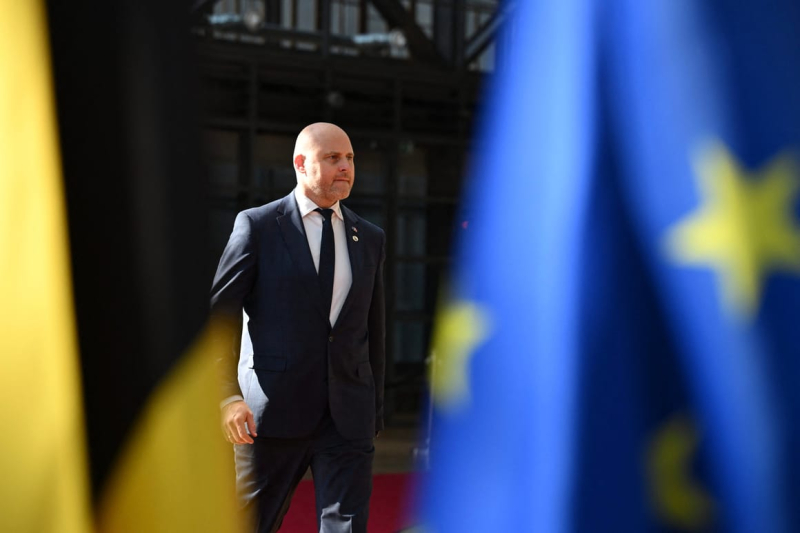

As Riga gears up for crucial election, Prime Minister Andris Kulbergs says frontline nations are carrying too much of the cost of confronting Moscow.
RIGA — Latvian Prime Minister Andris Kulbergs wants Brussels to hand over €7 billion to help cover the military and economic costs of confronting Russia, as pressure grows over the price of the country’s hard line on Moscow.
The money should come from the EU’s next seven-year budget, under a new Competitiveness Fund, to offset higher defense spending and the collapse in trade with Russia since Moscow’s full-scale invasion of Ukraine, Kulbergs told POLITICO’s Brussels Playbook in an interview.
The cash, which Riga wants to come on top of other funds earmarked for the country, would amount to almost half of Latvia’s projected €15.1 billion defense bill over the seven-year budget period.
The demand comes at a sensitive moment. Latvia has been one of Europe’s staunchest supporters of Ukraine, sharply increasing defense spending since Moscow’s full-scale invasion, even as sanctions and the collapse of bilateral trade have cut deeply into economic links that once ran eastward. But ahead of an Oct. 3 national election, parties arguing that Riga should demand more in return for sanctions and military support are gaining ground.
The European Commission has proposed substantially increasing EU-level defense funding in the 2028-2034 budget, including a €125.2 billion security, defense industry and space pot in the European Competitiveness Fund. That money is designed to finance projects across the bloc rather than provide Latvia with a pre-agreed €7 billion allocation, and the entire budget remains subject to negotiations between EU governments and the European Parliament.
Kulbergs argues that Latvia deserves special consideration because it is borrowing to provide security for countries much farther from the front line. “We are getting our budget deficit to the maximum […] and from that debt we’re paying […] the defense of the whole [of] Europe,” the prime minister said at the government chancellery.
Much of Latvia’s military spending ultimately flows back to richer Western European economies, Kulbergs added, pointing to arms purchases from Germany, France, Spain, Sweden and the Netherlands. “We fuel their economies,” he added.
Election pressure
A sharper version of the same argument is emerging on the campaign trail.
Ainārs Šlesers, a veteran populist businessman whose party sits with the far-right Patriots for Europe group in Brussels, says Latvia should demand compensation when it backs EU sanctions on Russia. Šlesers condemns Moscow’s invasion and says support for Ukraine should continue, but argues that Latvia cannot absorb the costs indefinitely.
“We are losing money … we are talking about how to support Ukraine, but we are a victim,” he told POLITICO at his Riga campaign headquarters.
When EU sanctions come up for renewal, Šlesers said Latvia should “get in return support.” Asked whether that could mean withholding Riga’s backing for sanctions, he stopped short of threatening a veto but did not rule it out. “I don’t want to talk about [a] veto [now],” he said. “I guess that we […] will find a peaceful solution.”
Šlesers, who has business ties with Russian oligarchs, said the country needs to eventually restore economic ties with Moscow, and advocated for a quick end to the war. “There are things which we cannot replace because if it’s your neighboring country and you’re connected historically […] we need to find the right model.”
He argued that whether to hand over territory to Russia should be “a decision by Ukraine” but argued that other countries have lost territory to Russia after conflicts, including Latvia, “to reach [a] peace agreement.”
Kulbergs’ center-right party currently leads the polls, but coalition arithmetic could determine how far Latvia’s Russia policy shifts after October.
The far-right, pro-Russia Sovereign Power party, polling second, wants to restore ties with Moscow but is considered off-limits by mainstream parties. Šlesers, polling third, is a more plausible coalition partner — and Kulbergs has left the door open to governing with him.
The center-left Progressives, polling fourth and also hoping to enter government with Kulbergs, warn that bringing Šlesers into the coalition would gradually soften Riga’s line on Russia.
“I’m 100 percent sure Latvia’s foreign policy towards Russia is going to soften over time,” the party’s prime ministerial candidate Andris Šuvajevs told POLITICO outside parliament. He pointed to possible sanctions exemptions for Russian business interests and ministers “speaking in a more friendly tone towards Russia.”
Tough on Russia
Ahead of a new sanctions package due in the fall, Kulbergs called for a total EU visa ban on Russians. EU countries granted more than 630,000 visas to Russian citizens in 2025.
In the last sanctions package, France and Italy resisted a blanket ban on Russian combatants, arguing this issue should be covered by EU visa rules rather than as part of sanctions, while northern and eastern countries pushed for tougher restrictions. The eventual deal created the legal and political basis for barring Russian combatants and ex-combatants who took part in the war — leaving it up to EU countries to decide when the ban would take effect.
“Are we nuts?” said Kulbergs on the delay. “We allow Russian military soldiers to be given visas, the ones killing [Ukrainians] on the field.”
He also urged EU countries to revisit sending Russia’s €210 billion in sovereign assets frozen in Europe to Ukraine, dismissing concerns Moscow could challenge the move after the war.
Kulbergs also rebuked European Council President António Costa’s decision to open a communications channel with the Kremlin, saying doing so should be “a decision of all the countries together.”
He called any Kremlin outreach “a useless exercise,” arguing there’s no sign President Vladimir Putin is ready to negotiate and that talks would merely give Russia “breathing time” to make its “next move.”
Despite Latvia severing ties with its eastern neighbor, and Kulbergs’ hawkish position on relations with Moscow, he said “we have to be open” to reestablishing ties once Russia pays reparations to Ukraine and those responsible for war crimes face justice, pointing to postwar Germany as the example to follow. “Do we isolate Germany because of that? No, it’s acceptance of guilt, acceptance of wrongdoing, punishment, and retribution,” he said.
After a ceasefire, Kulbergs concluded, “the insecurity of the border will only rise” as the real threat will be a wave of migration as hundreds of thousands of “screwed up” soldiers return from the battlefield seeking a better life and other citizens flee as Moscow’s war economy crumbles.