

Candidate countries, including Ukraine, say the enlargement process needs to accelerate as enemies circle.
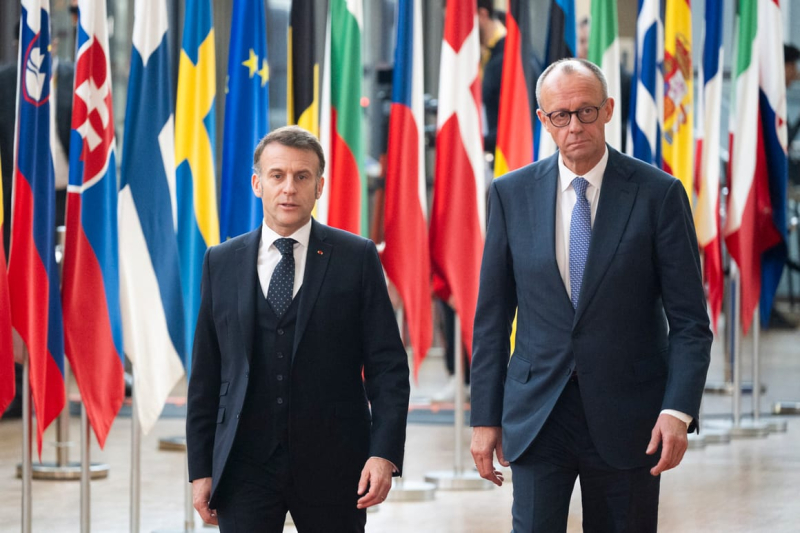
TIVAT, Montenegro — French President Emmanuel Macron and German Chancellor Friedrich Merz will join a group of EU leaders at a summit on Friday, as capitals try to find consensus on how far, and how fast, the process of bringing new members into the bloc should go.
They are taking part in talks in the small Balkan nation of Montenegro at the annual EU-Western Balkans summit, as Brussels accelerates efforts to advance membership for countries seeking to join the bloc. No new member has been admitted since Croatia joined in 2013, but amid a backdrop of political and economic uncertainty, candidate countries are piling on the pressure to open the doors.
“There is clear momentum on enlargement,” said European Council President António Costa, who has traveled for talks with candidate countries across the region over the past week. Montenegro is now drafting its EU treaty, Albania is moving ahead in the process, and both Moldova and Ukraine have unlocked the first round of negotiations, he said.
“This is proof that reforms by candidates pay off and that the EU is committed to the enlargement process. Enlargement is and will remain merit-based. At the same time, recent proposals show that there is a new willingness to simplify and accelerate the process,” Costa told POLITICO.
Candidate countries like Montenegro, Albania, Moldova and Ukraine say the enlargement process needs to accelerate to reflect geopolitical realities in an age of trade wars and armed conflicts. Officials in Brussels are worried that enemies could exploit delays in the accession process to weaken the European ambitions of countries still outside the bloc.
“Anyone can see the Western Balkans is an island surrounded by EU member states,” said an EU official, granted anonymity to speak frankly. “So the consequences of hostile states gaining influence there would be high.”
Number 28?
Montenegro, with a population of just over 600,000, has high hopes of becoming the EU’s 28th member by 2028. It’s already part of NATO and has decided unilaterally to use the euro as its currency, but joining the EU has proved a slow process. Its application was first filed with Brussels in 2008.
“We have reached a position where we enjoy the full support of the member states and, as the frontrunner among candidate countries, are on track to join the European family within the planned timeframe,” Montenegro’s prime minister, Milojko Spajić, told POLITICO.
Just last month, the country’s negotiators scored a historic win, with the start of the formal drafting of its accession treaty. However, while Montenegro insists its application should be dealt with on its own merits, the legal terms under which it enters will set a precedent for those that follow, including Ukraine and Moldova.
EU governments are keen to avoid a repeat of the standoff with Hungary, where a member state breached EU law and repeatedly used its veto to block key policies.
As a result, a host of new “guardrails” — legal measures that could see support held up and voting rights curtailed in response to backsliding on the rule of law and democracy — will be tested out in Montenegro’s treaty, according to three officials working on the document. While two-thirds of those terms and conditions will be the same as those in other countries, around a third will be new, they said.
“We do not shy away from safeguard mechanisms if they contribute to preserving the credibility of the process and trust among member states,” said Spajić. “However, it is important that such mechanisms be clearly rule-based and activated exclusively in cases of non-compliance with agreed obligations.”
He added: “We believe that by fully embracing European values, we will place ourselves in a position where we can enjoy all the rights and assume all the obligations.”
Growing pains
Earlier this year, the European Commission floated the idea of a much faster accession process in response to geopolitical uncertainty. But countries like France, Germany and the Netherlands see the rigorous negotiations and sweeping internal reforms required as an assurance that future members won’t cause problems later on.
Instead, the EU plans to move ahead with that process while offering pre-accession benefits to ensure that candidate countries begin to experience some of the advantages of closer integration as soon as possible. For example, Commission President Ursula von der Leyen is set to announce Friday that Western Balkan countries will get access to free data roaming in the EU.
On Thursday, France and Germany joined forces to present options for those candidate countries in the region that are unlikely to join the bloc in the short term — including inviting them to meetings as observers and offering access to the Single Market.
In a major breakthrough, Ukraine and Moldova will begin the formal opening of negotiating “clusters” on June 15 after Hungary’s new prime minister, Péter Magyar, dropped Budapest’s long-standing veto as part of a deal with Kyiv.
But while capitals agree the enlargement system as a whole needs to be redesigned and streamlined to avoid a repeat of Montenegro’s decades-long negotiations, they have complained about the lack of opportunities for leaders to discuss the issue. Merz has insisted he will raise the subject at an EU summit in Brussels that begins June 18.
Despite their concerns, fears of security risks and foreign influence make it increasingly likely that the status quo won’t endure.
“After the Russian aggression in Ukraine, the European Commission can present enlargement in that context,” said Nina Vujanović, a Montenegrin enlargement expert at Brussels’ Bruegel think tank. “Knowing that these countries are strong has benefits to the EU too.”