

Contents
What began as an effort by Caracol to “break the box” of traditional 3D printing has evolved into transatlantic scale and a broader vision for autonomous manufacturing systems.
Most people think of additive manufacturing — better known as 3D printing — as small plastic prototypes or desktop machines producing objects you can hold in your hand.
Since emerging in the 1980s, the technology has steadily evolved from a rapid prototyping tool into a serious industrial process used across aerospace, automotive, healthcare, and defence.
But scaling additive manufacturing to produce very large industrial components has remained far more difficult. Industries such as aviation, maritime, and energy still rely heavily on expensive molds, long production cycles, and highly centralised supply chains to produce metre-scale components using methods that are costly, labour-intensive, and generate significant material waste.
According to Francesco De Stefano, additive manufacturing largely accepted the physical “box” of the printer as a limitation until around 2015. There was still a lot of work needed inside that box to industrialise the technology.”
But what if you broke the box entirely?
De Stefano’s Italian-founded advanced manufacturing company, Caracol, is solving the challenge of producing industrial-scale, large, and mixed-volume parts through Large Format Additive Manufacturing (LFAM), using robotic arms, advanced software, turnkey additive manufacturing systems, materials, and factory integration to reliably manufacture large polymer, composite, and metal components at production scale.
Caracol combines robotics, automation, software, and manufacturing engineering into integrated production systems that can create complex lightweight structures and industrial components at scale. Industrial robotic arms were already widely used in automotive manufacturing, welding, and pick-and-place applications.
A traditional 3D printer operates on three axes, while industrial robots operate on six, enabling far greater geometric freedom and scalability.
“That combination allowed us to move beyond the traditional limitations of additive manufacturing,” he explained.
Prior to founding Caracol, De Stefano studied business in Milan and London and later moved into consulting, working in executive advisory, particularly in aerospace and industrial sectors.
At some point, he realised that while PowerPoints and Excel were great, he wanted to work on something with real industrial impact.
“I already knew Giovanni and Paolo, two of the other co-founders, from university. Back in 2015, they already believed additive manufacturing was the future, but they felt the technology was still too limited in scale.”
Their insight was to combine additive manufacturing with robotics. Between 2015 and 2017, they worked on integrating the two technologies to bring additive manufacturing into large-scale industrial production. With another co-founder, Jacopo, on board by the end of 2017, they realised their technology could have a real impact on industrial manufacturing.
Breaking manufacturing’s entrenched habits
Geopolitical tensions, supply chain fragility, and industrial sovereignty have become increasingly important across aerospace, defence, energy, and transportation. After COVID and the ensuing supply chain disruptions, many companies realised the old model of highly centralised manufacturing was no longer resilient.
As labour shortages grow, supply chains regionalise, and industries seek more flexible production models, additive manufacturing is increasingly shifting from an experimental technology to a strategic industrial capability.
Yet startups and scaleups typically struggle to disrupt traditional industries like manufacturing and supply chains.
When it comes to additive manufacturing, one of the first challenges is certification.
Take a boat component as an example.
“Traditional composite manufacturing processes are certified, well understood, and supported by decades of production data. Certification bodies already recognise those manufacturing methods,” explained De Stefano.
The second barrier is mindset. In industries like maritime or composites:
“You build moulds by hand, operators manually place carbon fibre and glass fibre, and finishing work is also largely manual. It works, it’s relatively inexpensive, and people have been doing it that way for decades.
So when you introduce a new technology, the first reaction is often: ‘This is never going to work. We’ve always done it this way.’”
Caracol addressed the challenges facing additive manufacturing with a scientific approach.
For the first five years, it didn’t sell the technology at all. Instead, it operated as a service bureau, qualifying and certifying the process before commercialising it. It worked with aerospace, maritime, and automotive OEMs on testing, prototyping, material characterisation, and certification.
Only once the applications were qualified and the business case was validated, did it start offering the technology commercially in 2022. At the same time, it focused heavily on training customers.
De Stefano explained:
“Because we operated the systems ourselves for years, we were able to guide customers not just on the machine itself, but on how to redesign and scale their production processes around the technology.”
The benefits of robotic additive manufacturing
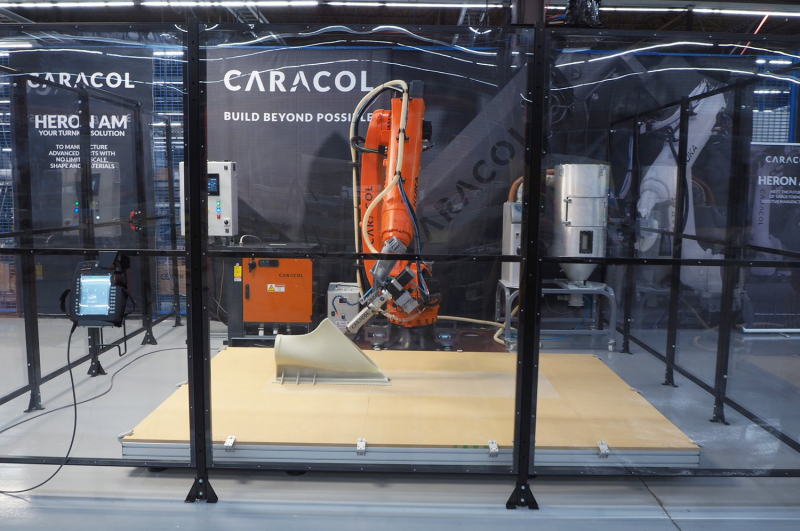
Image: Caracol.
Instead of 3D printing small prototype parts, Caracol’s robotic systems manufacture large-scale marine structures, molds, and functional components for boats and yachts.
Rather than relying on traditional tooling or moulds, Caracol’s systems manufacture parts layer by layer directly from digital designs, helping companies reduce waste, lower production costs, and accelerate manufacturing timelines. Its core sectors today are transportation (including dual defence applications across maritime, aerospace, and land mobility), creative industries like architecture, construction, retail environments, and design applications using sustainable materials and customised geometries.
The company launched a metal additive manufacturing platform around two years ago, expanding into energy applications, including propulsion systems, industrial components, and nuclear-related applications. The company is also exploring solutions for manufacturing in space.
In maritime composite manufacturing, producing a component traditionally involves several months of lead time. It can take three to four months just to create the mould, then several more weeks to laminate and finish the part. Caracol eliminates the mold entirely.
De Stefano detailed:
“You go directly into production and then perform the same finishing processes afterwards. In many cases, lead times are reduced by more than half.”
This not only saves time but also money. A project with yacht makers Ferretti Group achieved cost savings of more than 30 per cent. The benefits also extend to waste reduction.
In conventional aerospace tooling, traditional manufacturing often wastes 70 to 80 per cent of the material during machining. With Caracol, waste drops to below 5 per cent. Caracol’s process also leads to significant weight reduction. In some cases, tooling components are now one-tenth the weight of traditional alternatives, making them much easier to move and manage in factories.
Building a transatlantic manufacturing footprint
The company is currently the only large-format additive manufacturing player operating manufacturing facilities in both Europe and the US.
According to De Stefano, Caracol made this decision early in recognition of how important the US market would become, particularly for aerospace, defence, and industrial manufacturing. In the US, manufacturers have historically relied more on very large and expensive gantry systems. Flexible robotic manufacturing is gaining momentum there now as companies increasingly understand the importance of deployable, localised manufacturing.
Comparing the two markets, De Stefano said: “Interestingly, Europe is actually more advanced in robotics integration than parts of the US. I think that comes from Europe’s industrial heritage and manufacturing traditions.
“One major difference is that US customers are generally faster to adopt new technology. There is less resistance from a mindset perspective and more willingness to take risks. At the same time, expectations around support and responsiveness in the US are much higher:
“Customers expect you to be physically close, react quickly, and support them directly throughout implementation.”
From supervised machines to autonomous manufacturing
Automation within large-scale additive manufacturing has evolved rapidly over the past decade, shifting from highly supervised production environments toward increasingly autonomous and self-optimising systems. De Stefano describes progress in the sector as “dramatic”. In 2017, the company’s systems required constant oversight.
“Operators had to supervise the machines continuously and manually intervene throughout the process.”
Today, he explained, “Caracol’s systems can operate lights-out for days at a time. Once the print is launched, the machine can run autonomously with very minimal intervention.”
While there is still some manual work involved in setting up prints, loading materials, and post-processing parts, AI and machine learning are increasingly automating those operations as well.
The next stage is machines becoming capable of understanding and optimising their own processes in real time. The company already has its Nexus software platform, which monitors large amounts of production data.
“Last year, we also launched our ADOS AI platform, which allows the system not only to monitor the process but to understand deviations from the target outcome and automatically adjust parameters live. That improves productivity, reduces waste, minimises downtime, and even enables predictive maintenance.”
To support that vision, Caracol built its own integrated hardware, software, and automation ecosystem designed to centralise manufacturing intelligence across its global network. De Stefano explained: “All our systems connect through the Nexus platform, which allows us to aggregate and analyse production data globally. That means the machines are effectively learning from one another already.
For Caracol, what began as an effort to “break the box” of traditional 3D printing has evolved into a broader vision of distributed, software-driven manufacturing systems. Its long-term ambition is not just autonomous machines, but globally connected manufacturing systems capable of collectively learning and improving over time.
Rather than robots directly ‘talking’ to each other individually, the learning happens through a centralised data and software layer. The more data we gather across the network, the faster the systems improve collectively.
“That’s really the long-term vision: globally connected manufacturing systems continuously learning and optimising together,” shared De Stefano.